
Hanging lampshades
This selection is also available in our French store: Abat jours suspendus
No products in this selection.
- Tracked delivery to your country Tracked delivery
- Secure payment at checkout Multiple payment methods
- 14 days to change your mind 14-day returns
- Secure payment Secure payment
Not sure of your style? Find it in 30 seconds
A few questions, and we will show you the pieces made for you.
Frequently asked questions
How do I choose the right product?
What are the delivery times?
Can I return an item?
Can I pay in instalments?
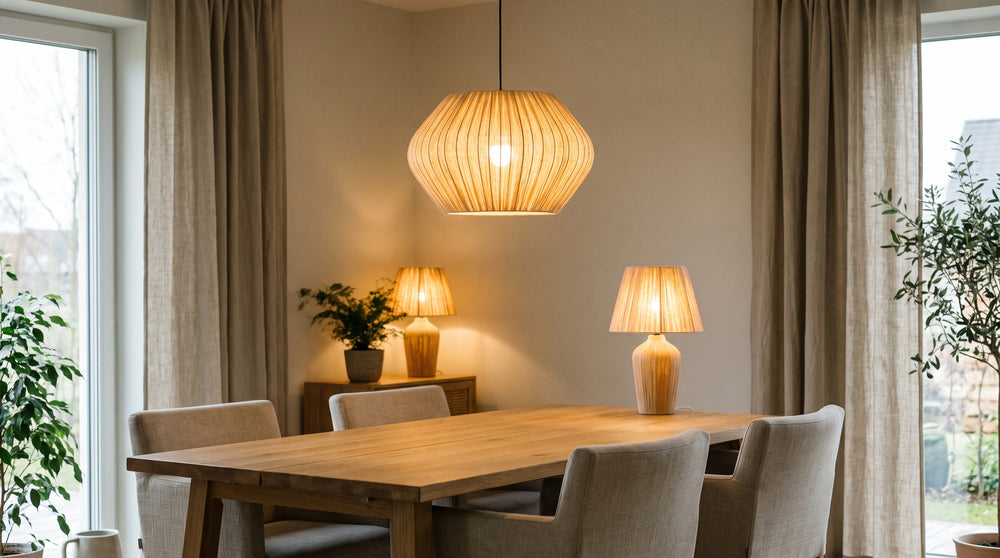
An interior that reflects who you are
Carefully selected pieces, shipped from our warehouses. Our team advises you before you buy, so you choose with confidence.
- Tracked delivery
- Pay in instalments, where available
- 14 days to change your mind
- Advice & showroom in Lyon, France
A hanging light shade is chosen first by the diameter of its shade and the material that filters the light: it is this pairing that decides the effect above a table. Allow for the bottom of the shade to sit above the eye line of a seated person, a cable that can be adjusted once installed, and a material suited to the room.
What is a hanging light shade and what light does it give?
The pendant fixed to the ceiling carries the shade, which dresses the bulb and filters its output. In the evening, above a table, the shade creates a round pool of light that defines the dining area and leaves the rest of the room softer. The word itself comes from there: to shade the day, that is to say to bring down and soften the light, whether from the sun or from a lamp. The complete fixture can be found in our full range of lighting, to be matched with the room.
Fabric pendant shade: the most common effect
Fabric stretched over a frame diffuses without harsh reflection: the lower part of the room stays legible, faces are not marked by a bare bulb. It is the choice that forgives height mistakes the most, because it diffuses sideways as much as downwards. To compare the effects, see fabric shades.
What a shade changes on a bare pendant
A pendant without a shade sends the light straight along its axis and dazzles anyone who looks up. The shade directs it, cuts direct glare, protects the bulb and changes the perceived colour of the light depending on its inner tone. It also weighs on the cable: the wider the shade, the sturdier the fixing and the socket must be.
What is the difference between a light shade and a pendant?
The shade is the cover that surrounds the bulb; the pendant is the complete fixture, with its cable, ceiling rose and socket. A shade on its own is fitted to a pendant, a table lamp or a floor lamp. The pendant itself is wired to the ceiling. This distinction avoids buying twice: you replace the cover when the wiring is already in place, and take the whole pendant when nothing is installed. The socket diameter marker (E27 for large caps, E14 for small ones) lets you check compatibility before ordering.
I already have the cable in the ceiling: what do I buy?
A shade on its own is enough if the socket, ceiling rose and cable are in good condition. Measure the socket diameter and the type of fitting it accepts (ring or spider frame): that is what determines compatibility. For a glass bedside lamp shade, the question is different, since the whole piece stays on a table base.
Vintage pendant shade: changing only the cover
A textile cable and an original socket take a new shade very well: it is the lightest way to update an existing fixture without touching the wiring. Start by looking at all shade sizes to stay within the format of the original fixture, and for a floor lamp, keep it consistent with the stem: a slim stem takes a narrow cone, a wide stem a cylinder.
What height and diameter for a hanging light shade?
The diameter is chosen in relation to the furniture the shade hangs over: the wider the table, the more the shade can spread. The height is set so that the bottom of the shade stays above the eye line of a seated person. An adjustable cable lets you fine-tune once the pendant is in place, which is better than calculating beforehand.
| Format | Light obtained | Room or use | Point to check |
|---|---|---|---|
| Narrow cone or cylinder | Light directed downwards, little glare | Kitchen island, worktop, hallway | The bottom of the shade must stay out of the seated field of view |
| Balloon or globe | Even 360 degree diffusion | Living room, bedroom, circulation | The bulb must not protrude below the shade |
| Flat, wide shade | Wide, low pool of light | Dining table, desk | Allow an adjustable cable to raise the whole piece |
| Large fabric cylinder | Soft light, no harsh reflection | Dining room, bedroom | Access to the socket for changing the bulb |
| Woven, rattan or paper shade | Patterned shadows, warm light | Reading corner, child bedroom, conservatory | Weight of the shade and distance to the bulb |
What height for a shade?
There is no single measurement: the height depends on the person living there and on whether they are seated or standing. The practical rule is to keep the bottom of the shade above the eye line when seated at the table, and high enough not to get in the way when standing. A tape measure and two tries are worth more than a calculation.
Pendant above a table: how to adjust the cable length?
Adjust the cable once the pendant is installed and the bulb is in place, checking the field of view from a chair. The cable is shortened at the ceiling rose, not by twisting the wire in the middle. This step is done with the power off, before the final switch-on.
What colour and material to choose for a hanging light shade?
The material decides the effect, the colour plays on the perception of the room: the material filters, the tone lights up or darkens the walls. White reflects more light and brightens a dark room, a dark colour structures, contrasts and reflects less light. Choose the desired light first, then the tone. White shades suit dimly lit rooms, while black tones frame an already bright room better.
| Material | Light diffused | Recommended room | Care |
|---|---|---|---|
| Stretched fabric | Diffuses and softens, no harsh reflection | Living room, bedroom, dining room | Duster or vacuum on a gentle setting |
| Linen | Warm light, visible texture | Bedroom, living room | Duster, avoid a damp sponge |
| Woven rattan | Patterned shadows, warm atmosphere | Reading corner, conservatory, child bedroom | Dry dusting, soft brush |
| Paper | Very soft, light diffusion | Bedroom, reading corner | Duster only, keep away from damp |
| Metal | Directed or reflected light, crisp effect | Hallway, kitchen, desk | Soft cloth, no abrasive product |
| Glass | Direct light, easy to wipe | Bedside lamp, floor lamp, hallway | Microfibre cloth |
Paper pendant shade: what effect, what limits?
Paper gives a very diffuse light and soft shadows, with little visual weight, ideal for low ceilings. It dislikes close heat and damp: keep a clear distance from the bulb and avoid a bathroom. It holds up if it is lined and stretched over a rigid frame.
Rattan pendant shade: for which room?
Rattan draws shadows on the walls, which suits a reading corner or a conservatory, and is dusted dry. Linen, for its part, gives a warmer and more even light: see linen for a warm light. For a crisper design and clean lines, look at modern shapes.
How to hang a light shade from the ceiling?
Switch off the power at the breaker, fix the ceiling rose into a solid ceiling support, connect the wires to the fixture terminal block, then screw in the bulb and fit the shade onto the socket. The last step is to adjust the cable length and the vertical alignment. The weak point is almost always the ceiling fixing, not the shade: in a hollow ceiling, locate the joist before drilling.
- Spider frame: several arms rest on the socket, tightened by a ring. For wide shades and stretched fabrics.
- Socket ring: the shade screws directly onto the socket. For small and medium cones or cylinders.
- Cable and ceiling rose: the cable is fixed to the ceiling, the shade goes on the socket. For a room with no existing light point.
- Bulb clip: clips onto the bulb. For a small accent shade, not for a main pendant.
How to fit a shade onto the socket?
Slide the shade onto the socket, lock it with its ring or frame, then screw in the bulb when the shape requires fitting it last. Check that the fabric does not touch the bulb and that nothing weighs on the wire. An LED bulb gives off less heat, which leaves more latitude with delicate materials.
When should you call an electrician?
As soon as there is any doubt about the wiring, a missing earth, a damaged cable or a ceiling with no identified support, an electrician should come before the purchase. Fitting a shade onto an existing socket stays simple; creating a new ceiling light point does not.
How to change the fabric of a light shade?
Remove the shade, take off the old fabric and glue, clean the frame, then stretch the new fabric over the rings, smoothing the edges inwards. A thin, non-stretch fabric is easier to pull tight. Linen and cotton are the simplest to fit onto a frame. Allow for shade glue, a smoothing tool and full drying before reassembly.
How to make a light shade yourself?
You need a frame, two rings joined by arms, a thin fabric, glue and patience. Glue the fabric, press it onto the top ring, pull it down, then fold the excess inside. The result depends above all on even tension, not on the pattern.
Re-stretch or replace: what to choose?
Fabric that has come unstuck by a centimetre can be glued back. Stained, slack or yellowed fabric should be replaced, especially if the frame is still straight. Before you start, compare with fabric stretched over a frame: sometimes a new cover takes less time than a renovation.
Which hanging light shade for a bedroom, living room or hallway?
In a bedroom, you want soft light and the bottom of the shade out of the field of view; in a living room, a wide shade diffuses more broadly; in a hallway, a conical format sends light down to the floor without glare. The daily gesture matters as much as the style: a shade you can reach to change the bulb and dust without taking everything apart will serve you longer.
Bedroom pendant shade: what light in the evening?
Soft light, rather low in colour temperature, around 2700 K as a common reference, prepares for sleep. A fabric or linen shade, closed at the bottom, avoids a bright point in line with the bed. Find the right formats in a shade for the bedroom.
Pendant shade for a baby bedroom: what to check
Three points above all: the strength of the ceiling fixing, the distance between the fabric and the bulb, and how easy it is to clean. A closed shade with no rough edges, which does not come apart when pulled, limits the risks. For the rest, the baby bedroom calls for washable or dry-dustable materials.
Living room pendant shade: the wide shade
The living room takes large diameters and soft shapes: a flat shade lights a coffee table without casting hard shadows, a globe spreads light through the circulation. To match the rest of the furniture, lighting a living room is also about the base and the tone.
Affordable hanging light shade: how to choose without getting it wrong?
On a small budget, the frame matters more than the decor: a solid fixing, an accessible socket and a material that is easy to dust save you from buying twice. Fabric and paper need more care than metal or glass. A shade that can be taken apart is cleaned and re-stretched instead of thrown away. There is no official ranking of brands: reliability shows in the fixing, the socket, the finish and the availability of spare parts.
How to care for a hanging light shade?
A duster once a month is enough on fabric, linen and paper. Metal and glass are cleaned with a soft cloth, without abrasives. Avoid a damp sponge on stretched materials, which marks and slackens them. Switch off the power before any handling near the socket.
Keep your pendant and change only the shade?
It is often the best calculation: the ceiling rose and cable do not age, the cover does. Check the socket ring and the diameter, then choose a model consistent with the size of the room. For clean designs, pendants with a clean design modernise an existing fixture without an electrician.
Secure payment, tracked delivery, returns and Designix customer service: you order the cover or the complete fixture, and you adjust the height once installed. To compare the latest available pieces, the Designix lighting catalogue remains the entry point; for the cover alone, the shade range covers pendants, table lamps and floor lamps.
Frequently asked questions
How to install a light shade?
Switch off the power, fit the pendant or the socket depending on the model, then slide the shade onto the socket and secure it with its ring or frame. Screw in the bulb before fitting the shade when the shape requires it, and check that the fabric does not touch the bulb.
Glass shade for a bedside lamp: which model to choose?
A bedside shade fits onto a socket or the frame of a small lamp, not onto the ceiling. Glass gives a crisp light, easy to wipe, but it weighs more than fabric. Check the fixing and the heat of the bulb before choosing.
Floor lamp shade: how to match it?
Our FAQ also covers 2026 trends for floor lamps: shapes, materials and colours, without prices or brands.
The shade must stay consistent with the base: a slim stem takes a narrow cone, a wide stem a cylinder or a balloon. The ring must match the socket diameter and the bottom of the shade must stay above the seat, so as not to dazzle a seated person.
Why is it called a light shade?
The word comes from the verb to shade and the noun day: the shade brings down, that is to say softens and lowers the light of day or of a lamp. The term therefore refers to the accessory that filters and directs the light, not to the source itself.
Paper pendant shade: does it last over time?
Paper lasts if it is lined, stretched over a rigid frame and kept away from the bulb: heat and damp weaken it. Dust it with a duster, never with a sponge. For a damp room such as a bathroom, another material is better.
Which lighting brand is the most reliable?
There is no official ranking of brands: reliability shows in the fixing, the quality of the socket, the finish of the fabric or metal and the availability of spare parts. Compare these points and the clarity of customer service rather than the name alone.




