
Green lampshades
This selection is also available in our French store: Abat jours coloris vert
No products in this selection.
- Tracked delivery to your country Tracked delivery
- Secure payment at checkout Multiple payment methods
- 14 days to change your mind 14-day returns
- Secure payment Secure payment
Not sure of your style? Find it in 30 seconds
A few questions, and we will show you the pieces made for you.
Frequently asked questions
How do I choose the right product?
What are the delivery times?
Can I return an item?
Can I pay in instalments?
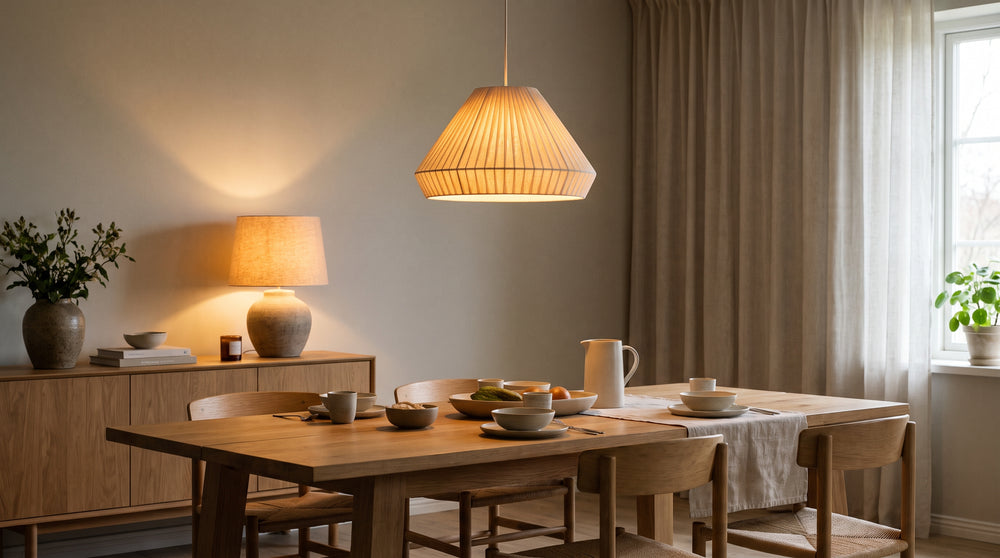
An interior that reflects who you are
Carefully selected pieces, shipped from our warehouses. Our team advises you before you buy, so you choose with confidence.
- Tracked delivery
- Pay in instalments, where available
- 14 days to change your mind
- Advice & showroom in Lyon, France
Start with the shade, then the material: a pale aqua or almond green brightens a room, sage green keeps a natural light, forest green concentrates the beam downwards. Then check the fitting (E27 or E14) and the height of the lampshade, because those decide whether the light falls where you want it or stays up at the ceiling.
Contents
- What a green lampshade changes in a room
- Which shade of green for which room
- Matching green with your decor
- Size, fitting and light fixture
- Where to install it
- Care
- Green chandelier or lampshade
- Buying and delivery
What does a green lampshade change in a room?
A green lampshade does not repaint the room: it filters the light from the bulb and tints whatever it falls on, the walls, the table, the open book. What decides the result is less the pigment than the density of the material the light passes through.
Linen lets its weave show and softens the beam, a tight cotton concentrates it, enamel and glass throw it back sharper. Before settling on a shade, browse the linen lampshades and the fabric models: two families that give a completely different light at the same colour.
Pale aqua green lampshade
Pale aqua brightens: it cools the light slightly and sets a clear, restful mood. In cotton or pale linen, it suits rooms where you want softness without darkness.
Sage green lampshade
Sage green keeps a natural, low-contrast light, close to pale wood and beige. In textured fabric, it shows a definite colour without saturating. Forest or emerald green, by contrast, sends the beam downwards and creates a cosier corner.
Which shade of green for which room?
The room decides before fashion does. A pale green spreads widely where you want softness, a deep green directs light towards the floor where you want contrast. The choice follows use, not the trend effect.
For a bedroom or nursery
Pale aqua and almond green are the easiest to live with at night: they give a soft light and do not mark faces. Find these shades in the bedroom lampshades and the nursery selection, where the material matters as much as the hue.
For a living room or hallway
Sage, forest or emerald green holds better in a space you move through: it brings contrast against pale walls and takes a stronger bulb. Compare sizes in the living room lampshades before settling on the shade.
| Shade | Effect on the light | Recommended room | Material that shows it off |
|---|---|---|---|
| Pale aqua | Soft, slightly cool diffusion | Bedroom, nursery | Cotton, pale linen |
| Sage green | Natural, low-contrast light | Living room, reading corner | Linen, textured fabric |
| Almond green | Bright, gentle result | Hallway, corridor | Opaline, fine fabric |
| Forest or emerald green | Light concentrated downwards | Living room, dining room | Enamel, glass, brass |
| Apple green | Vivid shade that colours the light | Already colourful interior | Printed fabric, cotton |
How do you match a green lampshade with the rest of the decor?
A green is always judged next to the colours already there. The simple rule: if the main piece of furniture is green, the lampshade must stand apart from it through lightness or material, otherwise the two merge into one uniform block.
What colour goes with a dark green sofa?
With a dark green sofa, a paler lampshade or one in another material works better: pale aqua, natural linen, off-white, brass or terracotta. White lampshades bring the sharpest contrast, while black versions harden the result against a dark background.
A glossy or enamelled green lampshade, with which style?
Apple green, glossy green and enamel assume an already colourful interior or a deliberate Art Deco choice. Against a neutral background, these finishes read as a graphic piece. Modern shapes in enamel or glass go in that direction, provided they are the only colour accent in the room.
| Colour already present | Green that works | Result you are after |
|---|---|---|
| Dark green sofa | Pale green or another material | Avoid one uniform green block |
| Natural wood and beige | Sage green, almond green | Soft, natural mood |
| White and grey | Forest green, emerald green | Sharp, readable contrast |
| Terracotta and ochre | Enamel green or olive green | Warm, colourful match |
| Midnight blue | Pale aqua or glossy green | More graphic effect |
How do you choose the size, the fitting and the type of light fixture?
The size depends on the fixture before it depends on the style. A pendant, table lamp or floor lamp lampshade has neither the same height nor the same opening, and the fixing differs again on a vertical wall light.
Pendant, table lamp or floor lamp lampshade
As a pendant above a table, the height and the opening determine the pool of light: a wide cone lights the whole table, a narrow cylinder concentrates it. On a table lamp, look for a compact, stable size, sitting on a bedside table or desk. On a floor lamp, height and how the material holds up matter, since the lampshade stays within reach. The lampshade guide sets out these matches in detail.
Fitting, socket and bulb compatibility
The fitting must match the socket of the fixture: E27 for most table lamps and pendants, E14 on slimmer models. The material of the lampshade must stay compatible with the heat of the bulb you choose. As a rule, a bulb with a warm colour temperature, around 2700 to 3000 K, flatters a green fabric, while a fine textile lets light through better than opaque enamel.
| Type of fixture | What matters for the lampshade | Typical use |
|---|---|---|
| Pendant | Height and opening suited to the room | Above a table or a kitchen island |
| Table lamp | Compact size and stability | Bedside, desk, reading corner |
| Floor lamp | Height and material that holds the light | Living room, armchair corner |
| Vertical wall light | Wall fixing and small footprint | Corridor, hallway, staircase |
Once the fitting and size are confirmed, the shade is chosen from the green lampshade selection: it is the last criterion, not the first.
Where to install a green lampshade in the home?
A green lampshade finds its place wherever you want a readable pool of accent light: a low, warm beam, placed near a surface, without lighting the whole room. Above a table, it structures the space; on a piece of furniture, it moves with use.
In the living room, as accent light
A green floor lamp next to an armchair, a table lamp on a console, a pendant above the table: three layers of light that complement each other. For this room, the shade can be darker than in a bedroom, because deep green draws a corner there. Browse the Designix lighting range to put these combinations together.
In a bedroom and nursery
At the bedside, a pale aqua or almond green in cotton gives a low, soft light. In a nursery, choose a pale shade and a fine material, to avoid too directed a beam. On the bedroom side, the size matters more than the decorative effect.
How do you care for a green lampshade without damaging it?
Care follows the material, not the colour. A dyed textile is dusted dry and will not take water, while an enamelled or glass surface is cleaned damp. In both cases, work with the power off and let it dry before switching back on.
Fabric, linen and cotton
Duster, soft brush or vacuum on the lowest setting, without rubbing: a green shade lightens where you press too hard. Water makes a bonded lampshade buckle and can bring marks to the surface. To see which materials are involved, look at the linen lampshades and the woven models.
Enamel, glass and brass
A soft, slightly damp cloth is enough on enamel and opaline, then a dry wipe to avoid marks. Brass just needs a dry cloth. Finally, check that the bulb fitted complies with the fixture manufacturer's instructions.
Green chandelier and green lampshade: what is the difference?
A green chandelier is a complete fixture, often with several light points, that replaces the whole installation. A green lampshade dresses a socket already in place: the structure stays, the shade and the diffusion change.
When to change only the lampshade
If the socket, the fixing and the wiring are in good condition, the lampshade alone is enough to transform a room on a modest budget. It is also the answer when you like the structure but the current shade tires you. A paler green or a different material changes the light without touching the electrics.
When to go for the complete fixture
You replace the whole fixture when you need several light points, when the support is damaged, or when the location changes. A hallway, a staircase or a large table sometimes call for a pendant redesigned for the room. The full lighting collection covers those cases, whereas the lampshade alone does not.
Where to buy a green lampshade and how do you receive it?
You confirm the shade by comparing it with others: pale aqua against sage, fabric against enamel. That is what stops you discovering a green that is too pale on delivery, once the lampshade is fitted and lit.
Compare the shades before ordering
Look side by side at a pale green and a deep green, then a matt material and a glossy finish: the difference in result is bigger than the difference in colour. Contemporary shapes and fabric models let you decide between the two approaches.
Delivery, returns and customer service
At Designix, you order online with secure payment, tracked delivery, returns and customer service you can reach to confirm socket compatibility or a shade. To check a colour in person, you can look up the opening hours of the nearest lighting shop on its online listing before going there.
- Secure payment
- Tracked delivery
- Returns
- Designix customer service
An E27 or E14 fitting confirmed, a height measured on the fixture, and the shade chosen for the real use of the room: now is the time to pick the green lampshade that will hold that light.
Frequently asked questions about green lampshades
What colour goes with a dark green sofa?
A paler lampshade or one in another material: pale aqua, natural linen, off-white, brass or terracotta. Two greens that are too close create one uniform block. In an already colourful interior, apple green or a glossy finish can instead embrace the contrast.
Green chandelier or green lampshade: which should you choose?
A green chandelier replaces the whole fixture: it suits a lighting overhaul or a need for several light points. A lampshade dresses an existing socket, you keep the structure and change the shade, the diffusion and the look of the room.
Where can I find a lighting shop near me that is open right now?
Check the opening hours of the nearest shop on its online listing, as they vary from day to day. Without travelling, the online store stays open around the clock, with secure payment, tracked delivery, returns and customer service to confirm a shade.
Does a green lampshade darken the room?
A deep or saturated green lets less light through and concentrates the beam downwards: it darkens more. To keep things bright, choose pale aqua, almond green or a finer material.
Coloured lampshades: how do you combine several shades?
Two shades at most in one room, with one dominant and one accent colour. Sage green with off-white stays readable, whereas two greens that are too close blend together. Repeating the same shade on two fixtures creates visual continuity.
Green lampshades: which materials are available?
Fabric, linen and cotton diffuse an enveloping light and show the texture. Enamel, glass and opaline give a sharper, glossier result. The material matters as much as the colour: at the same green, the effect on the room is not the same.




