
Glass floor lamps
This selection is also available in our French store: Lampes à poser sur pied en verre
No products in this selection.
- Tracked delivery to your country Tracked delivery
- Secure payment at checkout Multiple payment methods
- 14 days to change your mind 14-day returns
- Secure payment Secure payment
Not sure of your style? Find it in 30 seconds
A few questions, and we will show you the pieces made for you.
Frequently asked questions
How do I choose the right product?
What are the delivery times?
Can I return an item?
Can I pay in instalments?
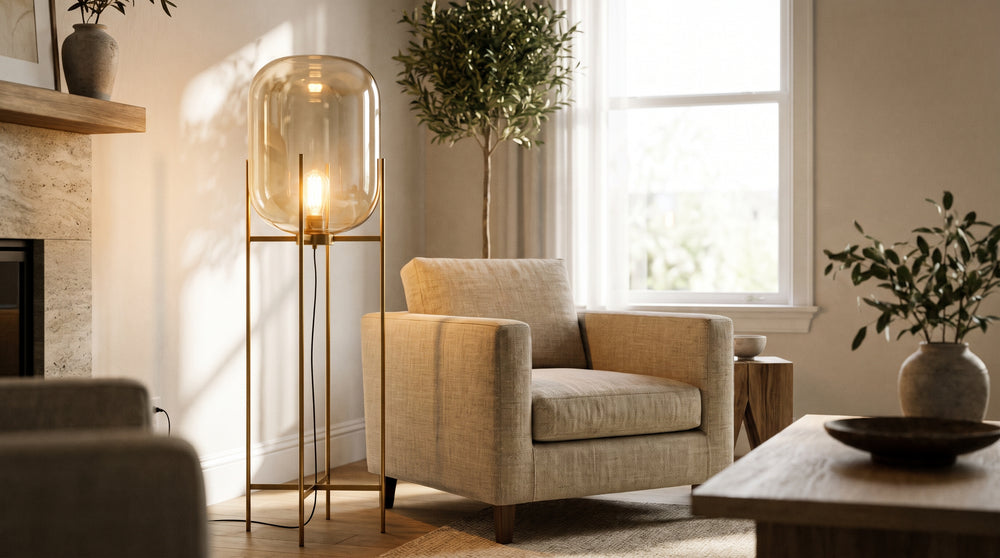
An interior that reflects who you are
Carefully selected pieces, shipped from our warehouses. Our team advises you before you buy, so you choose with confidence.
- Tracked delivery
- Pay in instalments, where available
- 14 days to change your mind
- Advice & showroom in Lyon, France
First, measure the free space on the furniture and the height the light needs to reach: that is what decides between a small table model and a glass floor lamp. Glass itself is not chosen by colour alone: its transparency governs how the halo renders in the room.
What light does a glass floor lamp give?
Glass lets light through instead of blocking it: the lamp lights the room as much as it lights itself, with a soft halo and no harsh patch thrown on the wall. The more frosted the glass, the more enveloping the light; the more transparent it is, the sharper and more defined the result.
Floor lamp in clear glass
Clear glass shows the bulb and the frame, and throws reflections on the walls. It suits a bright living room or a study, where you want to see where the light comes from. For an all-reflections look, compare with the crystal versions and their reflections.
Floor lamp in green glass
Green, amber or smoked tinted glass colours the halo without washing the wall: the room takes on an end-of-day mood. It is the choice for a reading corner or a hallway kept lit. Conversely, opaque ceramic for concentrated light sends light up and down.
| Type of glass | Light diffused | Effect in the room | Where to place it |
|---|---|---|---|
| Clear | Direct, sharp, with reflections | You see the bulb and the frame | Bright living room, study, hallway |
| Tinted (green, amber, smoked) | Coloured and subdued | Adds colour without washing the wall | Reading corner, evening mood |
| Frosted | Even, without glare | Enveloping halo, invisible bulb | Bedroom, bedside, small room |
| Textured or bubbled | Diffused with a pattern | Plays shadows on the wall | Living room corner, feature room |
Where to place a floor lamp in the living room?
Near the sofa or armchair, at shoulder height once seated, to light reading without glare. Keep it out of walkways and slightly away from the wall: the glass then sends light into the room instead of pressing it against the wall.
Living room floor lamp in clear glass
In a sofa corner, clear or slightly tinted glass links the wall and the seat. About a metre of clearance is often enough to avoid the harsh patch. To tie the whole together, the modern selection for the living room gives reference points for shape and shade.
Living room floor lamp: tall stem or standard lamp?
A tall stem placed on a side piece of furniture brings the glass to seated eye level and frees the floor. A standard lamp occupies the floor and rises above an armchair. If the room is a thoroughfare, prefer the furniture, which keeps the passage clear, or the adjustable and directional models to aim without moving.
| Room | Main use | Type of light | Point to watch |
|---|---|---|---|
| Living room, reading corner | Read without glare | Soft halo, frosted glass | Height at seated shoulder level, out of walkways |
| Living room, sofa corner | Mood and accent light | Clear or tinted glass | Leave a gap from the wall to diffuse |
| Bedroom | Reading in bed, gentle waking | Frosted glass, discreet bulb | Switch within reach from the bed |
| Study | Lighting the work surface | Clear glass, directed light | Socket and bulb suited to prolonged use |
| Hallway | Welcome, light left on | Tinted glass, low halo | Stable base in a walkway |
How to choose between a floor lamp, a standard lamp and a table lamp?
A floor lamp sits on furniture and moves; a standard lamp stands on the floor and carries the light higher, often above an armchair. The table lamp remains the most compact. The choice depends on the free surface and the height the light needs to reach.
Large glass floor lamp
In a tall volume or under a high ceiling, a generous stem and a wide glass hold the room without overwhelming it. The model must stay stable: a narrow base on tall furniture is a risk. The design floor lamps for the living room give an idea of proportions that work.
Original floor lamp
A shape that breaks from the classic, irregular blown glass or an offset frame, is reserved for an already calm room so it stays legible. On a desk, a sober line is better: see the desk lamps and the metal models for work.
Italian design floor lamp: how to recognise well-made glass?
Three observable markers: even glass thickness throughout the piece, a clear and constant tint, a discreet frame that does not compete with the shape. Add a practical criterion: the weight and stability of the stem, because thick glass on a light base tips over.
Blown glass and its finishes
Blown glass keeps slight variations in thickness, and that is normal: they create the halo. What is not normal are coarse bubbles in the mass and blurred joints with the stem. A tint that fades on one side often betrays surface-tinted glass.
Fine metal frames
A fine brass or black metal frame lets the glass carry the shape and blends with an already busy interior. To stay in this logic of restrained lines, look at the Nordic lines and light wood and the wooden stems and their warmth.
Which socket and bulb for a glass lamp?
The socket must match the bulb holder: large screw type E27 on most living room lamps, small screw type E14 on compact models. Check it before buying, it is shown on the holder or the packaging. Glass does not filter heat, so an LED bulb heats less and suits prolonged use better.
Halogen floor lamp: what to check beforehand
Halogen is possible if the socket and wattage shown on the holder match. It heats more: avoid leaving the lamp on unattended and do not touch the glass near the bulb. An LED of equivalent output stays calmer day to day, as on the design LED lamps.
Warm or white light behind tinted glass
Around 2,700 to 3,000 kelvins, the light is warm and suits the evening; above 4,000 kelvins, it leans white and cools a restful room. Behind tinted glass, the bulb tint adds to the glass tint: start from a neutral bulb to keep the intended colour. See the LED lighting for the bedroom.
How to connect several lamps to a single power point?
Several lamps are linked with a power strip or a rail fitted with a switch, adding up the bulb wattage to stay within what the socket supports. Do not stack extension leads and power strips, and keep cables visible rather than under a rug.
Power strip, rail or remote socket: which to choose?
A power strip with a switch is enough for two or three living room lamps. A remote socket saves bending behind the sofa, useful when the lamp is in a corner. Count the bulbs, not the empty holders: a lamp that is off uses nothing, but a loaded power strip heats up.
Running the cable without trapping it
A cable does not go under a rug, against a hot skirting board, or through a closing door. Along a wall, a cable clip fixes the wire to the floor and prevents tripping. For a desk lamp, a metal-framed model cables more neatly: see the black finishes for the living room.
Glass, crystal, ceramic: which material for a floor lamp?
Glass stands out for its transparency and lets you see the support or the bulb. Crystal adds relief and reflections, with a weight that stabilises the stem. Ceramic, opaque, concentrates light up and down. Glass suits bright rooms, ceramic suits hushed moods and small rooms.
Maintenance also separates them: glass cleans in one wipe, ceramic withstands knocks on its edges poorly. For a bedroom, a small opaque format avoids waking glare, like the small bedside formats. This guide describes the criteria; the collection grid remains available to browse, with no items available to date.
One last criterion, often decisive: the style of the rest of the room. A light wood interior will carry frosted glass and a fine frame, whereas a dark living room will benefit from tinted glass. Browse all the home lighting to place the lamp in the whole, and our selection designed for the bedroom if the room is a place of rest.
How to clean and stabilise a glass floor lamp?
Glass is cleaned switched off, with a soft slightly damp cloth, never with an abrasive product or paper that scratches. On a tall stem, check that the base sits flat, and keep the lamp away from walkways so it does not tip at the slightest touch.
Cleaning a glass shade without leaving marks
Dust dry first, then wipe with a damp microfibre cloth, without pressing. Fingerprints come off with warm water. Let it dry before plugging back in, and never spray product directly on the socket. Bubbled glass is cleaned with a cloth that follows the relief.
A stable stem in a thoroughfare
A wide, heavy base is better than a thin stem on an uneven floor. If the lamp is in a hallway, stick an anti-slip pad under the base and check the cable: a taut wire brings the lamp down. For damp or busy rooms, compare with the wooden lamps for the living room.
Ordering from Designix
Secure payment, tracked delivery, returns and Designix customer service: you can check the socket and dimensions on receipt before choosing the bulb. Compare the available finishes and keep your furniture height in mind before confirming.
Frequently asked questions
Where can I find inexpensive lamps?
The most affordable models are often the simplest shapes: a thin stem, clear or frosted glass, a standard E27 socket that is easy to fit. Compare format and socket first, then finish: it is the glass work, more than the size, that raises the budget.
How can I make a lamp from a glass bottle?
You need a clean, thoroughly dry bottle, a bulb holder that fits the neck, a cable with a switch and a bulb with the right socket. Do not drill the glass yourself. Switched off, check that the whole stands upright before plugging in.
How should ceiling spotlights be arranged?
Spotlights are spread in regular lines, set back from the walls, to avoid marked shadow areas, and aimed at work surfaces or walls rather than at the eyes. A glass floor lamp completes the whole with low, mobile light.
The most beautiful living room lamps: how to recognise them?
They are the ones whose light falls exactly where wanted: glass that diffuses without glare, a stable stem, a height suited to the seat. Shape matters less than the relationship between the glass, the frame and the lamp's actual place in the room.
How to match a glass lamp with an already furnished living room?
Pick up a shade already present in the room, wood, black metal or brass, and keep the glass as the only new element. If the living room is busy, frosted glass and a fine frame go unnoticed; if the room is bare, tinted glass becomes the point of colour.




