
Floor lamps for dining room
This selection is also available in our French store: Lampes à poser sur pied pour salle à manger
No products in this selection.
- Tracked delivery to your country Tracked delivery
- Secure payment at checkout Multiple payment methods
- 14 days to change your mind 14-day returns
- Secure payment Secure payment
Not sure of your style? Find it in 30 seconds
A few questions, and we will show you the pieces made for you.
Frequently asked questions
How do I choose the right product?
What are the delivery times?
Can I return an item?
Can I pay in instalments?
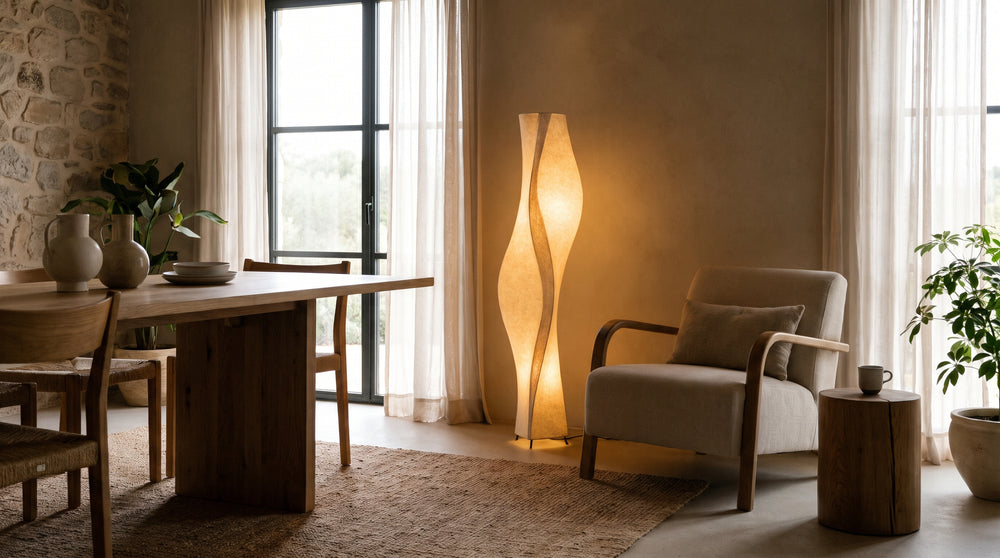
An interior that reflects who you are
Carefully selected pieces, shipped from our warehouses. Our team advises you before you buy, so you choose with confidence.
- Tracked delivery
- Pay in instalments, where available
- 14 days to change your mind
- Advice & showroom in Lyon, France
Allow for a floor lamp whose shade reaches the eye level of a seated person, or just below: the light then falls on the tabletop without dazzling the guests. Place it in a free corner, away from the pull-back of the chairs, and let the ceiling light illuminate the whole room.
Dining room lighting: what is a floor lamp near the table for?
A floor lamp complements the ceiling light by placing light at tabletop level, where people eat. It can be moved, switched on by itself in the evening and keeps the room lit without dazzling the guests. It serves as supplementary light for meals and as a marker when the dining room doubles as an office.
Floor lamps for a wooden dining room
Wood echoes the grain of the table and chairs without creating a break. A light wood base lightens a dark room, a dark wood matches older furniture. The shade matters as much as the base: in thick fabric or linen, it filters the light and avoids the bright spot that washes out faces. To compare woods and tones, browse the wood lamps and the crafted wood bases.
Floor lamps for a designer dining room
A simple base line, a slim stem, a plain shade: the model reads as a placed object, not as one more piece of furniture. In an already busy room, this restraint avoids visual clutter. Bolder shapes, a wide cylinder or a low tray, find their place in a dining room open to the living room. See the modern models for the living space and the whole Designix lighting catalogue.
Floor lamp or standard lamp: how to tell them apart?
The word standard lamp refers to the same family, lights that rest on a base and stand on the floor. In everyday use, the floor lamp suggests a more compact format, with a shade close to the tabletop, while the standard lamp rises higher and lights a wider area.
The living room floor lamp, between supplementary light and decorative object
In a dining room that opens onto the living room, the same light changes role over the evening: table lighting during the meal, low light afterwards. A medium-height stem, a wide shade and a warm bulb around 2700 to 3000 kelvins give this calm result, to be kept for moments when no one is working. The designer living room lamps show this decorative register.
What sets a standard lamp apart from a tall table lamp
Three points are enough to decide: the height of the shade relative to the seat, the stability of the base and the footprint on the floor. A tall standard lamp lights a wide area but needs space behind the chairs. A tall table lamp, placed on a sideboard, gives a similar result without blocking the way. For other rooms, the bedroom lamps follow the same height logic.
Chandelier or floor lamp for a dining room?
The chandelier lights the whole room from the centre, the floor lamp lights the table area and the faces. The two complement each other: keep a modern chandelier or a pendant above the tabletop, then add a floor lamp near a corner for evening meals and reading.
Modern dining room chandelier and floor lamp: two complementary lights
The chandelier places the source high up, which suits meals and serving, but leaves faces in the shadow cast by the shade. The floor lamp corrects this by lighting at an angle. To avoid clutter, keep a single visible focal point: either the chandelier or a cut-glass model. The crystal lamps play this dressed-up role.
Living room chandelier: why keep a floor lamp
A chandelier in the centre of the living room leaves the corners in the dark. A floor lamp near the sofa or the sideboard creates a second, lower level of light that makes the room liveable in the evening. It is also a safety net: if the central point fails, the room stays lit. The rest of the solutions can be found in the whole lighting catalogue.
| Solution | What it lights | Strength | Limit |
|---|---|---|---|
| Central chandelier | The whole room from the ceiling | Lights the guests at the table | Shadow cast under the shade, cannot be moved |
| Pendant above the tabletop | The table and the plates | Light directed downwards | Height to be adjusted to the size of the guests |
| Floor lamp | The area where it is placed | Moves and switches on by itself | Does not replace a ceiling light for the whole room |
| Wall light or reading light | One specific spot | Frees up the floor | Requires an electrical supply on the wall |
Which floor lamp to light a dining table?
Look for a shade that reaches the eye level of a seated person or just below, so that the light falls on the plates without hitting the eyes. Check the footprint of the base and the passage of the chairs: a wide base stands more firmly but takes up more floor space.
The light should fall on the tabletop, not in the eyes
Sit at your table, in your usual place, and look at the bottom of the shade: if it is visible below the eye line, the source will dazzle. A shade that is opaque on top and open at the bottom solves the problem. An adjustable head lets you tilt the beam towards the centre of the tabletop. The adjustable models are useful when the lamp also serves as a reading light.
Floor footprint and passage around the chairs
Allow for the pull-back of the chairs when people get up, plus room to move behind them. A wide or weighted base stays stable if someone brushes the shade, a slim stem slips into a corner but tips over more easily. In a narrow room, choose a compact model and a dark finish that blends into the floor, like the black finishes.
A size choice is made sitting down, not standing up: shade height below the eyes, a base that fits between the wall and the chair. Once these two points are checked, the model is chosen on material. Secure payment, tracked delivery and returns possible: the final adjustment is made at home, in the lamp's real place.
| Dining room area | Role of the light | Floor lamp format | Choose it if |
|---|---|---|---|
| Free corner near a wall | Meal lighting and reading | Tall base, shade below eye level | The room also serves as an office in the evening |
| Near the sideboard or serving unit | Ambient light and serving | Slim base, linen or ceramic shade | You want to dress a piece of furniture rather than the table |
| Entrance to the room | Marker and transition to the living room | Compact model, stable base | The passage is narrow and the chairs often pull back |
| Sofa corner of the dining room | Low light and conversation | Large shade, wide base | The room is open to the living room |
How to match the floor lamp with the dining room decor?
Pick up the materials already present in the room: a wood base with a wooden table, a matte ceramic with raw walls, a slim metal with black furniture. The lamp should read as a placed object, not as one more piece of furniture; its finish and shade are enough to make the link.
Modern kitchen decor and open dining room: extend the same family of materials
When the table looks onto the kitchen, a modern kitchen decor succeeds when materials repeat from one space to the other without copying each other. A dark worktop, black metal chairs and a floor lamp with a graphic stem form a readable continuity. Avoid adding a new material with every piece of furniture. The ceramic bases and the linen shades soften a very mineral room.
Kitchen decoration: materials that answer each other from one room to the next
Kitchen decoration is played out with two or three materials at most: wood, metal, ceramic. A floor lamp that picks up the wood of the table and the black of the chairs belongs to the same family. Also think about worktop lighting, handled separately with the kitchen LED lamps.
| Material or finish | Light rendering | Atmosphere | Care |
|---|---|---|---|
| Wood | Light filtered by the shade, warm reflections | Natural, warm | Dry cloth, avoid standing water |
| Metal | Reflects light, sharp rendering | Modern, graphic | Soft cloth, no abrasive product |
| Ceramic | Matte, absorbs light | Soft, artisanal | Damp sponge then dry |
| Linen | Diffuses widely, without glare | Peaceful, textured | Dust without rubbing hard |
| Crystal | Bounces bright glints | Dressed up, evening | Lint-free cloth |
| Matte black or gold | Strong contrast with the light | Assertive, contemporary | Microfibre cloth |
How to install and maintain a floor lamp in the dining room?
Place the socket so that the cable crosses neither the passage of the chairs nor the access to the sideboard, and prefer a model whose switch is within reach from the table. A soft cloth on the shade and the base is enough; dust regularly to keep a clean rendering.
Where to place the socket to avoid the cable across the passage?
Find the wall socket closest to the chosen corner, then choose a model whose cable comes out of the bottom of the stem, on the wall side. A switch on the cable or on the stem, within reach when seated, avoids getting up every time. If the socket is far away, a discreet cable trunking along the skirting board is safer than an extension lead across the floor. For an additional light point, an electrician is needed.
Shade, base and cable: routine care
Dust the shade with a soft cloth or a feather duster, without rubbing hard on a fine fabric. Wood is cleaned dry, without standing water; ceramic and metal tolerate a slightly damp sponge then immediate drying. Check the condition of the cable and the socket once a year. The metal versions and the designer LED lamps require the same simple gesture.
Which mistakes to avoid when choosing a floor lamp for the dining room?
The most frequent mistakes: relying only on the ceiling light, choosing a base that is too wide in a narrow room, leaving the shade at eye level, forgetting the place of the socket. A floor lamp is chosen after measuring the pull-back of the chairs and identifying the corner that will stay free.
Relying only on the ceiling light
A single central point flattens the room and leaves faces in shadow as soon as you move away from the centre. A second source, low and movable, corrects this without any work. If the dining room serves as an office during the day, the desk lamps complete the set on another piece of furniture.
A base that is too wide or a shade that is too low
A wide base in a narrow passage blocks the pull-back of the chairs and ends up pushed against the wall. Conversely, a shade that is too low places the source in the line of sight: you see the bulb, you no longer see the plate. The solution lies in a trial on site, seated, before settling on the model. A sober model in white more easily forgives a constrained position.
The most beautiful living room lamps: what makes the difference over time?
A beautiful living room lamp is judged by the stability of the base, the quality of the assembly and the softness of the light under the shade, more than by its style alone. A material that ages well, such as wood, ceramic or tinted metal, keeps its looks through moves.
Materials and finishes that age well
Solid wood and enamelled ceramic develop a patina without deteriorating; tinted metal resists everyday knocks; crystal needs a lint-free cloth but lasts through the years. A finish that marks at the slightest contact, on the other hand, shows quickly in a living room. For an exceptional piece, look at the gold and black accents and the white colours that are easy to match.
The weight and stability of the base
A heavy base at the bottom, a straight stem and a centred shade: balance is what prevents a fall when you brush the lamp getting up from the table. A wide base compensates for a slim stem, provided there is room on the floor. Test the stability by lightly touching the top of the shade: the whole should not tip over.
Designix customer service available to confirm a height or a material before ordering, tracked delivery and returns: the lamp is chosen at home, in the place it will really occupy.
Frequently asked questions
WC lighting: what should you plan for?
In a WC, you look for a light that does not dazzle and a compact fixture, often a ceiling light or a wall light. A floor lamp has no place there for lack of floor space. Plan for a model that is easy to clean and a switch within reach from the door.
How to connect several lamps to a single electrical supply?
Use a multi-socket or a socket block connected to the existing supply, checking that the combined power of the lamps stays within the limits of the circuit. For fixed lights or an additional light point, you need an electrician and must comply with the standard in force.
Can you eat on a wooden table without a tablecloth?
Yes, a wooden table can be used without a tablecloth if the top is protected by an oiled or varnished finish and if marks are wiped up quickly. Hot dishes require a trivet. A floor lamp placed at an angle brings out the grain without lighting the plates too harshly.
Grandmother's recipe for stripping furniture: which one to choose?
Gentle stripping relies on simple products: black soap, bicarbonate of soda, whitening powder or household alcohol, applied with a non-abrasive cloth then rinsed. Test on a hidden area and finish with an oil or a wax, especially if the furniture is to hold a lamp every day.
Do you need a chandelier above the table when adding a floor lamp?
No, a chandelier is not compulsory. If the room already has one, the floor lamp takes over in the evening to lower the light. Without a chandelier, a pendant above the tabletop or a ceiling light is enough to light the whole room, with the floor lamp providing the supplement.
Designer floor lamps for the dining room: how to avoid an overloaded model?
Limit the number of visible materials to two and keep a simple base line, slim or frankly wide. A plain shade lets the shape speak. In an already decorated room, a sober finish, black or wood, works better than a model with several materials.




