Designer wall lights for stairs
This selection is also available in our French store: Appliques murales design pour escalier
- Tracked delivery to your country Tracked delivery
- Secure payment at checkout Multiple payment methods
- 14 days to change your mind 14-day returns
- Secure payment Secure payment


Not sure of your style? Find it in 30 seconds
A few questions, and we will show you the pieces made for you.


Frequently asked questions
How do I choose the right product?
What are the delivery times?
Can I return an item?
Can I pay in instalments?
An interior that reflects who you are
Carefully selected pieces, shipped from our warehouses. Our team advises you before you buy, so you choose with confidence.
- Tracked delivery
- Pay in instalments, where available
- 14 days to change your mind
- Advice & showroom in Lyon, France
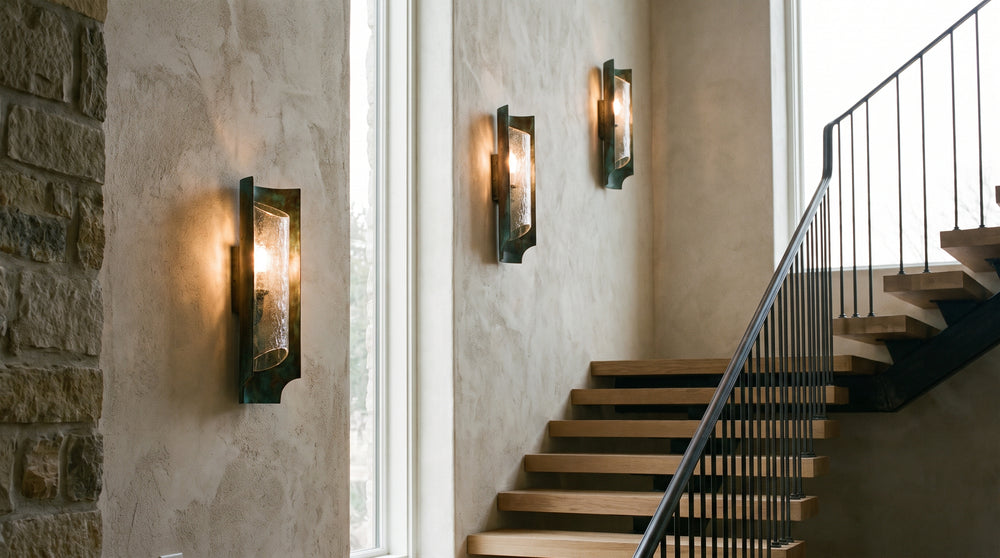
Allow one wall light per half-flight, positioned at hand height above the stair nosing and aimed toward the following steps rather than toward the eyes. A compact aluminium or metal model keeps the passage width clear and is enough to lift the climb out of the dark.
Which designer wall light for a staircase?
A designer wall light for stairs is chosen on three points: a compact format that does not reduce the passage width, a beam directed toward the steps rather than toward the eyes, and a finish matching the stairwell. Cylinders 6 cm in diameter and articulated arms meet these constraints.
Which type of interior wall light for a staircase?
A small cylinder aimed downward works when the wall is close to the step. The gold diamond wall light suits this type of wall, in aluminium with a GU10 socket. Its openwork black version uses exactly the same format with IP20. For a long bare wall, a light bar covers more distance than an isolated point.
Black designer wall light for stairs or gold finish?
Black blends into a light wall as well as a dark render, gold warms a white wall and a stairwell without natural light. The safest approach is to keep a single family of finishes from one floor to the next. You will find them in the gold finishes, then in the black colour models, to be chosen once for the whole stairwell.
Which wall light for a staircase?
For a house staircase, one wall light per half-flight is enough if the beam lights the two neighbouring steps, and it is placed at hand height. Tall stairwells take two points per flight, narrow staircases a single compact model, preferably adjustable.
Fitting a wall light on a straight, quarter-turn or spiral staircase?
On a straight staircase, the alignment follows the slope without surprise: same distance between two points, same height above the stair nosing. A quarter-turn calls for treating the corner as a separate point, with a source facing the turning step. A spiral handles wide beams poorly: better to choose an adjustable articulated arm, in metal and brass, whose cylindrical head is set toward the descent.
One or two wall lights per flight?
Two points are justified beyond a long flight or on a wide landing, provided the light cones do not overlap on the same step. On a half-level, an inclined LED tube in metal, iron and linen is enough as a complement. Along a continuous wall, prefer a light bar in three lengths, which gives a line rather than a succession of points.
| Configuration | Constraint | Recommended type | Model |
|---|---|---|---|
| Straight staircase in a narrow stairwell | Reduced passage width | Small cylinder aimed downward | Reliefa or Losangia |
| Staircase open to the living room | Light two levels | Adjustable articulated arm | Calix |
| Long wall along the climb | Visual rhythm | Light bar from 40 to 80 cm | Néa |
| Landing or half-level | Complementary lighting | Inclined LED tube on round base | Sivo |
| Old staircase, halogen replacement | Bulb to replace | GU10 socket | Reliefa, Losangia or Calix |
How to dress the walls of a stair climb?
You dress the climb by spacing the wall lights regularly, by the same number of steps, so that the eye follows a continuous line. A single finish, gold, black or white, linked to the frames and handrails, holds the length better than a mix of different models.
Irregular spacing makes the climb look longer and darker, even with correct sources. Keep the same family of materials as the handrail, and extend the line on the ground floor with the modern wall lights for hallway then something to light an entrance, without changing style at the bottom of the steps.
How to install a wall light on a staircase?
The wall light is fitted at hand height above the stair nosing, aligned with the slope of the staircase, to light the next step without dazzling. Each wall light is fixed into a solid support, on a supply taken from the hallway circuit, with the power off.
At what height should a wall light be placed on a staircase?
Hand height remains the simplest reference: around 1.10 m above the stair nosing, following the slope so that the line is parallel to the staircase. Too low, it dazzles; too high, it no longer lights the step but the opposite wall. The gap between two points must stay constant from one level to the next.
Fitting a wall light on concrete, stone or plasterboard?
The support decides the plug, not the model. A solid concrete or stone wall takes a direct fixing, plasterboard needs a toggle plug or a reinforcement, panelling requires locating the studwork before drilling. Also check the space available behind the wall light for the connection: a compact model like the designer LED wall lights leaves more room than a large diffuser.
Warm white or cool white: which light for a staircase?
Warm white, between 2700 and 3500 K, suits interior staircases and rest rooms; cool white, between 4500 and 6500 K, lights large stairwells and circulation corridors. Several models in the collection offer both temperatures, with dimming on some.
Replacing a designer halogen light with an LED wall light
An old designer halogen light can be replaced without redoing the circuit when the power point already exists: you take the supply, fit a wall light and unify the shade across the whole stairwell. It is the moment to align the light temperature with the rest of the floor rather than leaving a yellow step next to a white one.
Fitting a dimmer on a staircase wall light?
Some models accept a dimmer, notably Calix, Sivo and Néa. The dimmer must match the type of bulb or LED module used, as stated in the instructions: this is what allows lowering the light in the evening without switching off the climb completely.
Which light to choose for a hallway, a toilet or an entrance?
In a hallway, an entrance or a toilet, an IP20 wall light placed at shoulder height lights without taking up the passage. Models with a GU10 socket allow changing the bulb and the light shade, which suits circulation areas where you want to stay discreet.
The logic remains the same as at the foot of the staircase: dedicated source, directed beam, no dependence on the ceiling light. For a small windowless space, a discreet light for WC placed near the door is enough. Complete the circulation with the models with integrated light if you prefer never changing a bulb again. All these wall lights are IP20 and are not intended for wet areas.
How to match staircase wall lights with the rest of the house?
You match staircase wall lights with the rest of the house by keeping the same family of finishes, gold, black or white, and the same light temperature from one room to another. In an open staircase, the ceiling light of the neighbouring room is chosen in coherence.
A staircase open to the living room reads with the room: an LED wall light for living room or a large chandelier for a high ceiling sets the level of finish that the steps must follow. From the climb, the kitchen is also visible: this is where coherent modern kitchen decoration, with the wall lights intended for the kitchen, avoids a break in shade between two spaces. Finish with the bedrooms, with the LED wall lights for bedroom, to keep a single warm white from top to bottom.
How to choose between an LED wall light and a GU10 bulb model?
An LED wall light is installed without a bulb to buy again and gives continuous light along the whole bar; a GU10 socket model takes a bulb that can be changed, and therefore a different temperature or intensity depending on the floors. The choice depends above all on the need for adaptation.
Choosing an integrated LED model: continuous light and maintenance
The integrated module removes the act of replacement and also removes variety: the light is even along the whole length of a tube or bar, without a hot spot. The inclined LED tube in metal, acrylic and linen suits a landing wall, and the light bar in three lengths suits a continuous climb.
Choosing a GU10 model: changing the bulb and the temperature
The GU10 socket keeps control over the bulb: you replace it, change the temperature or intensity without changing the wall light. This is an advantage when several staircases or several floors must match each other, or when an old designer halogen already leaves its power point. Reliefa, Losangia and Calix rely on this principle, with IP20.
Choosing the right model and ordering
The decisive reference remains depth: a compact cylinder 10.6 cm deep lets a narrow stairwell pass, a light bar is reserved for long walls. Then check the mounting support and the desired light temperature before confirming.
- Secure payment on the Designix site
- Tracked delivery of your wall light
- Returns according to the shop conditions
- Designix customer service for installation or compatibility questions
You will find all the wall lighting references in all our lights, with light and dark finishes to compare before ordering.
Frequently asked questions
How many wall lights are needed in a stairwell?
Generally one wall light per half-flight is planned, each lighting the neighbouring steps, and two points in a tall stairwell or on a wide landing. The number is decided in use, avoiding multiplying sources that overlap on the same step.
At what height should a wall light be placed on a staircase?
It is aligned at hand height above the stair nosing, following the slope, to light the next step without dazzling. The gap between two wall lights stays constant from one level to the next, which gives a regular line along the climb.
An LED wall light or a GU10 socket model, which to choose?
The LED model avoids changing the bulb and gives even light along the whole length of a bar. The GU10 socket model leaves the choice of bulb and its temperature, which helps when several staircases or several floors must match.
Do the wall lights in this collection work with a dimmer?
Some models work with a dimmer, notably Calix, Sivo and Néa, which accept several light temperatures. The dimmer must be suited to the type of bulb or LED module used, in accordance with the product instructions.
Can this type of wall light be fitted in a bathroom?
The wall lights in this collection are IP20, which destines them to dry rooms: staircase, hallway, entrance, bedroom or living room. For a bathroom, choose a wall light with a higher protection rating, intended for wet areas, like those gathered in the bathroom selection.