
Clamp-on spotlight





- Tracked delivery to your country Tracked delivery
- Secure payment at checkout Multiple payment methods
- 14 days to change your mind 14-day returns
- Secure payment Secure payment
Not sure of your style? Find it in 30 seconds
A few questions, and we will show you the pieces made for you.
Frequently asked questions
How do I choose the right product?
What are the delivery times?
Can I return an item?
Can I pay in instalments?

An interior that reflects who you are
Carefully selected pieces, shipped from our warehouses. Our team advises you before you buy, so you choose with confidence.
- Tracked delivery
- Pay in instalments, where available
- 14 days to change your mind
- Advice & showroom in Lyon, France
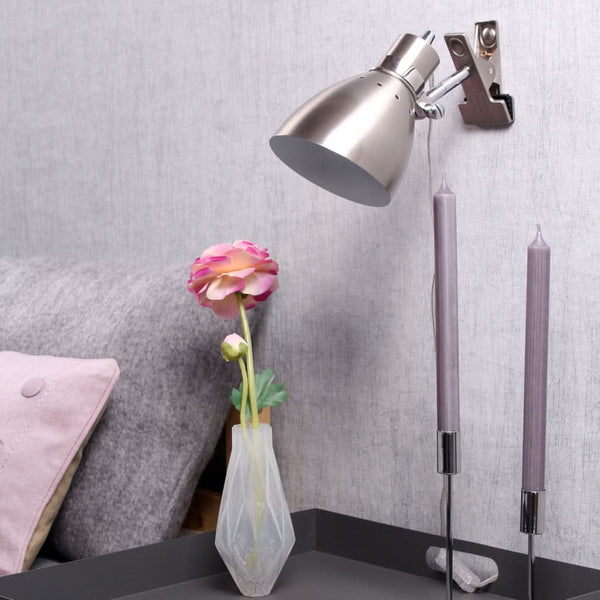
A clip on lamp attaches without drilling to a worktop, a shelf or an upright, then angles towards the area to be lit. This selection brings together clip on lamps with E27 sockets and recessed spots with GU10 sockets, in metal and plastic, in white, black or silver finishes.
How do you choose a clip on lamp by room and socket?
A clip on lamp is chosen first on its socket and wattage: E27 for a screw bulb, GU10 for a more compact module. Then come the finish, white, black or silver, and the body material, metal and plastic, which decide the look in the room.
LED clip on lamp or E27 clip on lamp: what are the differences day to day?
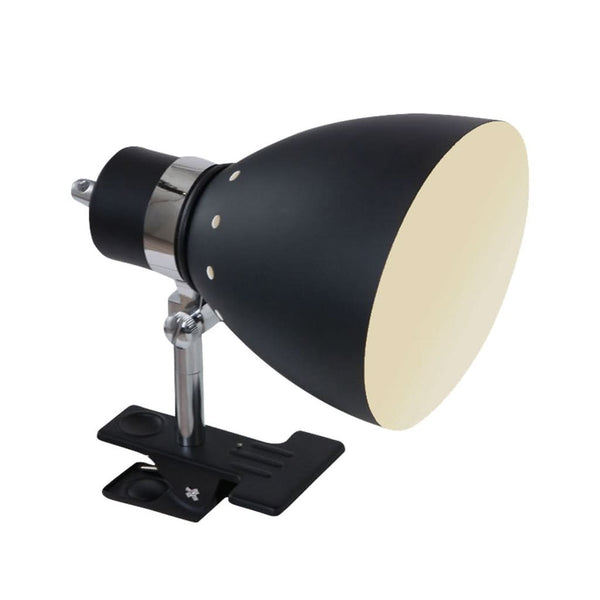
An adjustable clip on lamp with an E27 socket, such as Ferro or Velma, takes a screw bulb and casts a wider beam: it lights a desk, a worktop or a side table from a single point. Compact GU10 modules are more often fitted to the ceiling, in a bathroom or a hallway. The choice therefore comes down to the gesture: lighting close up with a wide beam, or lighting from above with a discreet module. Browse the spots that can be directed to compare the two families side by side.
White clip on lamp or black clip on lamp: what look for which wall?
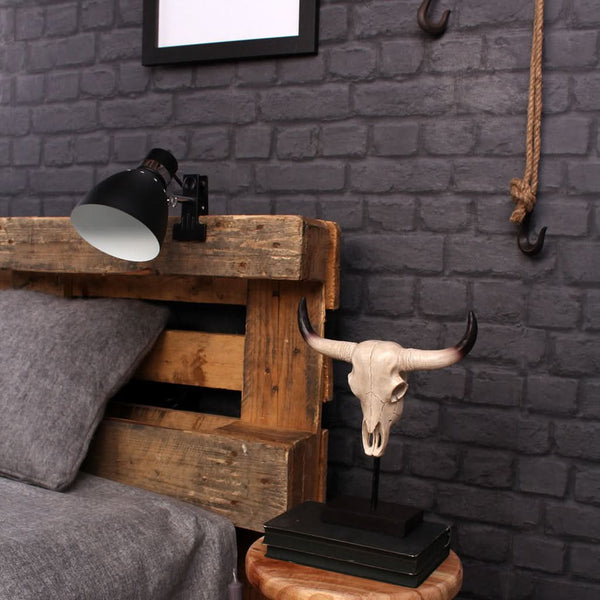
A white finish blends into a pale wall and a matt splashback: the fitting disappears, only the light remains. A black or silver finish outlines the spot and structures a white wall, a pale wood shelf or a dark worktop. Metal and plastic combine well in both cases, with an industrial note for tubular bodies. Compare white finishes and black versions before deciding.
| Criterion | GU10 | E27 |
|---|---|---|
| Models in the selection | Lisio, Encastra, Vidar, Marissa | Ferro, Velma |
| Stated wattage | 10 W | 40 W |
| Shape of the fitting | Round, recessed | Conical tube, clip on |
| Rooms listed | Bathroom, outdoor, living room | Kitchen, hallway, living room, entrance, dressing room |
| To remember | Compact module for a low ceiling | Wider beam, adjustable spot |
Cordless or rechargeable clip on lamp: what to do when the socket is far away?
The spots in this selection run on mains power, through a GU10 or E27 socket: no cordless or rechargeable model appears here. When the socket is far away, you therefore choose the spot's position according to the connection, then check on the model's page how it is powered and fixed.
Can a clip on lamp be moved from one room to another?
The clip fixing loosens and tightens without tools, so you can move from a dressing room shelf to a worktop in seconds. The cable remains the limiting factor: keep the fitting within reach of a socket, or add an extension suited to the original connection. An adjustable spot is also easy to reposition once the room has been reorganised.
Fixing a clip on lamp to a shelf or an upright: what you need to know
The clip needs a flat surface and an even thickness to hold: a fixed shelf, a shelf upright, a desk edge, the back of a sofa. A shelf that is too thin or too thick prevents it from gripping. Also check that the head can turn without knocking against the wall or the shelf above, otherwise the beam stays locked on a single point.
How do you wire spots in series or in parallel?
Parallel wiring feeds each spot directly from the mains: if one fails, the others stay lit, which is why it is so common. Series wiring makes the current pass from one spot to the next. In both cases, switch off the power before working.
Parallel spot wiring: why is this arrangement the most common?
In parallel, each light point receives the same voltage and works independently: one blown bulb does not cut the line. It is also the arrangement best suited to a room where a light point is added later. For a whole room, first compare ceiling spots and recessed modules, as the fitting technique differs.
When does series wiring cause problems?
In series, a single faulty bulb switches off the whole line, and diagnosis becomes painful when the spots are recessed into a ceiling. This arrangement is mainly found on small sets. As soon as any doubt remains about the existing diagram, call an electrician rather than altering the circuit yourself.
What distance and ceiling layout of spots for a living room?
To lay out ceiling spots in a living room, distribute the light points on a regular grid and keep them away from the walls, to limit shadow areas and glare. The layout is drawn from the furniture and the sofa, not from the ceiling plan alone.
Ceiling spot distance: how far apart should two light points be?
There is no single spacing: the higher the ceiling, the further apart the light points can be, because the cone of light opens as it descends. Tighten them above a reading area or a walkway, spread them out in a large living room to avoid multiplying points. The aim remains continuous light, with no isolated patch on a wall. Find comparable layouts in spots designed for the living room.
Modern living room ceiling spot: what grid for an open-plan space?
In an open-plan living space, divide the area by use: one group above the seating corner, another towards the table, a third for the walkway. A grid aligned with the width of the room stays more readable than a tight grid. Modern spots with slim bodies blend into a white ceiling and let the light draw the space.
How many spots should you plan for in a kitchen?
The right reference is not a fixed number but the areas to be lit: worktop, sink, hob and walkway. Place the spots above the work areas rather than in the centre of the room, angling the beam, and adapt the ingress protection rating to the exposure of the location.
How do you light a worktop with adjustable spots?
The beam must fall in front of you, not behind: an adjustable spot placed above the worktop avoids the shadow cast by your hands while chopping. Angle it slightly towards the inside of the worktop rather than towards the splashback, which throws the glare back. On the socket side, an E27 clip on model clips onto the high shelf and brings the source closer to the worktop, like Ferro or its equivalent Velma spot with conical shade. See also lighting a kitchen.
IP20 or IP44: which rating to choose in a kitchen?
The ingress protection rating describes resistance to dust and water splashes. An IP20 suits a dry area, away from the sink and the hob. Near a water point or in a room where steam is produced, an IP44 is safer: that is the rating of Marissa in this selection. The practical rule: look at the actual installation area, not the whole room.
How do you change the bulb of an adjustable or recessed spot?
On an adjustable spot, switch off the power, turn the head towards you and remove the bulb by turning: a quarter turn on a GU10 socket, a simple unscrewing on E27. On a recessed spot held by fixing springs, lower the module gently before removing the bulb.
Changing the bulb of an adjustable spot with a GU10 or E27 socket?
Switch off the power and let it cool: a hot bulb is awkward to remove. On GU10, press the bulb towards the back and turn a quarter turn to release it from its holder. On E27, simply unscrew. Refit a bulb with the same cap and the same stated wattage as the original, without exceeding what the fitting accepts.
Changing a recessed LED spot in the ceiling and in the bathroom?
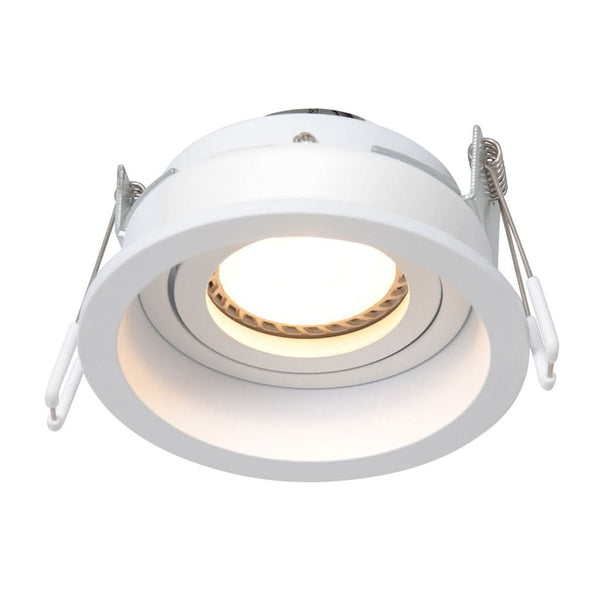
The recessed spots in this selection are held by fixing springs. Switch off the power, pull the module downwards without forcing to release the springs, then free the bulb. When refitting, put the springs back without twisting them and check that the module sits flush with the ceiling. In a bathroom, switch off at the circuit breaker before any handling. These steps are detailed for recessed ceiling spots.
Which models to choose for a living room, an open-plan space or a bathroom?
Two adjustable clip on lamps with E27 sockets, Ferro in silver and Velma in black with a conical shade, suit reading corners and workstations. The recessed GU10 models, Lisio, Encastra, Vidar and Marissa, are mainly used in bathrooms and living rooms, with an IP44 rating for Marissa.
Ferro and Velma: two adjustable clip on lamps with E27 sockets
The Ferro adjustable clip on spot combines a silver metal and plastic body, a conical tube 13 cm in diameter by 22 cm high, and an E27 socket stated at 40 W. Velma takes the same base in black and silver with a conical shade, for an industrial look on a pale wall. Both clip onto a kitchen, hallway, entrance or dressing room shelf.
Lisio, Encastra, Vidar and Marissa: the recessed GU10 spots in the selection
The four round GU10 modules, stated at 10 W, slip into a low ceiling without weighing it down. Lisio spot with fixing springs and Encastra in white share a format of 10 cm in diameter by 4 cm deep. The silver Vidar model also suits a sheltered outdoor location. The recessed Marissa IP44 spot, more compact (8.5 cm in diameter), screws in above a shower thanks to its IP44 rating.
| Model | Cap | Stated wattage | Ingress protection rating | Dimensions | Colour | Style |
|---|---|---|---|---|---|---|
| Ferro | E27 | 40 W | IP20 | ø13 cm / H 22 cm | Silver | Industrial |
| Velma | E27 | 40 W | IP20 | ø13 cm / H 22 cm | Black and silver | Industrial |
| Lisio | GU10 | 10 W | IP20 | ø10 cm / D 4 cm | Black | Modern and contemporary |
| Encastra | GU10 | 10 W | IP20 | ø10 cm / D 4 cm | White | Modern and contemporary |
| Vidar | GU10 | 10 W | IP20 | ø10 cm / D 4 cm | Silver | Modern and contemporary |
| Marissa | GU10 | 10 W | IP44 | ø8.5 cm / H 7 cm | White | Modern and contemporary |
To change rooms, take a look at the models suited to the bathroom, the outdoor lighting for a covered location, and the LED lighting for interiors. A whole living space can also be composed with the Designix lighting catalogue.
Secure payment, tracked delivery and returns: ordering your spot
Designix supports your order from start to finish: secure payment, tracked delivery, returns and customer service. The spot selection is guaranteed for two years, enough to check the direction, the fixing and the light rendering in the room at your leisure.
Before confirming, go back over the socket, the ingress protection rating and the format of the fitting: these are the three points that decide whether the spot holds where you intend. If you hesitate between two families, browse all our spot families to compare formats, then order with confidence.
Frequently asked questions about the clip on lamp
How do you change the bulb of a recessed spot in the bathroom?
Switch off the power at the circuit breaker before any handling. In a bathroom, favour a model with an ingress protection rating suited to the area, such as the IP44 in this selection. Then lower the recessed spot gently, remove the bulb and refit the module.
How do you change a recessed LED spot in the ceiling?
Switch off the power and lower the module: the recessed spots in this selection are held by fixing springs. Pull gently to release the springs, remove the bulb according to the cap, then put the spot back in place, refitting the springs without twisting them.
LED clip on lamp or E27 clip on lamp: which should you choose?
The clip on lamp with an E27 socket, stated here at 40 W, takes a screw bulb: handy for lighting a worktop or a desk. The LED spots with GU10 sockets in the selection are stated at 10 W and concern the recessed, more compact models.
What distance should there be between two ceiling spots?
There is no single distance: the spacing is set by the ceiling height and by the areas to be lit. Bring the light points closer above a worktop or a walkway, and spread them out in a large living room to avoid multiplying unnecessary light points.
How many spots do you need in a kitchen?
The number is deduced from the areas to be lit rather than from the surface alone: worktop, sink, hob and walkway. Adjustable spots let you direct the light where you cook, and the ingress protection rating is chosen according to the actual exposure of the location.




