
Battery-operated LED strip light
This selection is also available in our French store: Réglette LED a pile
No products in this selection.
- Tracked delivery to your country Tracked delivery
- Secure payment at checkout Multiple payment methods
- 14 days to change your mind 14-day returns
- Secure payment Secure payment
Not sure of your style? Find it in 30 seconds
A few questions, and we will show you the pieces made for you.
Frequently asked questions
How do I choose the right product?
What are the delivery times?
Can I return an item?
Can I pay in instalments?
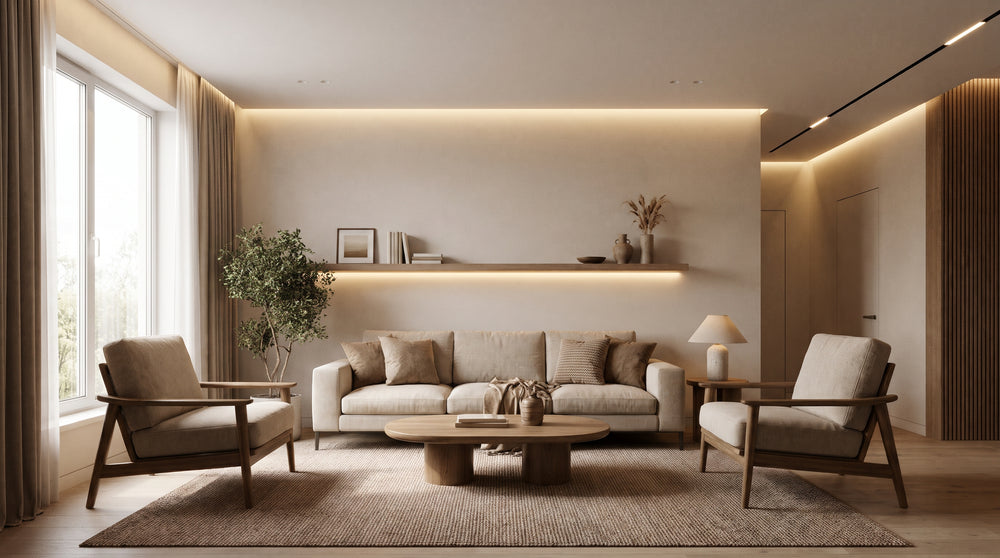
An interior that reflects who you are
Carefully selected pieces, shipped from our warehouses. Our team advises you before you buy, so you choose with confidence.
- Tracked delivery
- Pay in instalments, where available
- 14 days to change your mind
- Advice & showroom in Lyon, France
A battery operated strip light goes where no cable can reach: under a kitchen wall cabinet, inside a closet, above a workbench. You choose it first by its power source (batteries, rechargeable battery or mains), then by its control and mounting method, because these three points decide the real use, far more than the look of the bar.
What light does a battery operated strip light give?
A battery operated strip light gives accent lighting, focused on the surface it overhangs: worktop, shelf, inside of a closet. It does not replace the general lighting of a room. The result depends on the colour temperature and the diffusion, to be checked on the spec sheet of each model.
What the bar really lights
Fixed under a cabinet, the bar casts a grazing light that falls on the worktop and brings out the material: wood, tile, stainless steel. In a closet, it lights the contents and not the room, which is enough to find a garment or a box without switching on the ceiling light. The reach stays short, and that is what makes it comfortable: no light goes behind the person working.
Colour temperature and diffuser
Around 2700 to 3000 K, the light leans towards warm white and suits a bedroom or a reading corner. Around 4000 K, the white is more neutral and renders colours accurately on a kitchen worktop or a workbench. Beyond that, the result becomes cold and bluish, useful for a technical area. The diffuser matters just as much: opal, it smooths the light and avoids bright spots; transparent, it shows each diode and suits indirect use better.
Where to install a battery operated strip light in the home?
Places without a socket are the most numerous: under a kitchen wall cabinet, inside a closet, on top of a desk, hallway, pantry, TV unit. Since no power supply needs to be connected, the bar can move from one piece of furniture to another when needs change.
- Under kitchen wall cabinets, for the cutting board and the hob.
- In a closet or dressing room, to see the contents without switching on the bedroom light.
- On a desk shelf, against the wall, to work in the evening.
- In a hallway or stairwell, as a complement to a fixed point.
- In a pantry, utility room or TV unit, where the cable is missing.
This mobility explains part of the success of the LED bar you can place anywhere: you unclip the bar, recharge it, put it back elsewhere. For daily use in a kitchen, the USB rechargeable versions save you from buying batteries in bulk. In a hallway, a model that switches on as you pass changes everything: see the motion sensor versions.
How to choose a battery operated strip light?
You look at the power source first, then the control, then the length of the bar and the supplied mount. A battery model suits occasional use, a rechargeable battery daily use, mains a fixed installation. The product sheet always states the battery type or whether the cable is included.
| Power source | What it implies | Typical use | To check on the sheet |
|---|---|---|---|
| Disposable batteries (AA or AAA) | No cable, immediate replacement | Closet, drawer, quick fix | Number and type of batteries |
| USB rechargeable battery | Recharge without throwing away batteries | Desk, kitchen, daily use | Stated runtime and supplied cable |
| Mains 220 V | No battery changes, but a socket or a connection | Fixed under-cabinet, workshop | Ingress protection rating and cable length |
The control comes next: a switch on the bar is enough when it is within reach, a remote control becomes necessary if the bar is fixed high up. As for length, measure the furniture before choosing: a bar that is too short leaves dark areas, one that is too long overhangs. The supplied mount also counts: adhesive, magnet or screws. For fixed furniture and a more integrated result, compare with a wall strip light and, if a socket is nearby, with the models to connect to 220 V.
Cuttable LED strip: how does it work?
A cuttable LED strip is cut on printed marks, every few centimetres, and each section remains usable. A rigid bar, on the other hand, cannot be cut: you choose its length at purchase. For custom furniture, the strip adapts better; for a quick installation, the bar is simpler.
Cutting a strip, choosing a rigid bar
The strip is cut with scissors on the indicated lines, never between two lines, otherwise the section no longer works. It follows angles, goes around an upright, slips into a furniture groove. The rigid bar arrives ready to install, with its profile and diffuser: nothing to cut, nothing to solder, which is reassuring when you have no tools.
LED neon, mini LED, LED bar: the other formats
LED neon gives a continuous, flexible line of light, useful for highlighting a niche. Mini LEDs and short bars slip into a drawer or under a narrow shelf. A battery operated LED spot, on the other hand, aims at a specific point rather than a line. The choice therefore depends on the shape of the light you want as much as on the footprint. To change a recessed LED ceiling spot, plan for removing the spot, identifying the connector type and choosing a compatible replacement.
How to mount and care for a battery operated strip light?
Most strip lights are installed with an adhesive or a magnetic mount, without drilling; others accept screws on a wall. Degrease the surface before gluing, change the batteries when the light dims and dust the diffuser with a dry cloth.
Mounting according to the surface
| Mount | Recommended surface | Installation | To avoid |
|---|---|---|---|
| Adhesive | Lacquered furniture, painted metal, smooth tile | No drilling, immediate | Raw wall, fragile wallpaper, dusty surface |
| Magnet or magnetic plate | Metal surface or supplied plate | Removable for recharging | Wood not equipped |
| Screws and wall plugs | Wall, joist, wood panel | Durable hold | Tile, rental without permission |
Care and battery changes
A dry cloth is enough on the diffuser; alcohol and abrasive sponges dull the plastic. When the light dims or turns yellow, the batteries are at the end of their life: replace them as a full set, without mixing new and used batteries. On a rechargeable battery, a full recharge before storing extends its service life.
Battery operated strip light or LED ceiling lighting: which to choose?
LED ceiling lighting lights a whole room from above; the battery operated strip light lights a specific area, without work or wiring. For a kitchen or a living room, the ceiling light remains the base and the strip light complements it. In a closet or a pantry, the strip light is often enough.
When the strip light is enough
Closed volume, narrow work surface, occasional need: the battery bar responds without touching the electrical panel. It is also the simplest solution in a rental, where drilling a wall is not always possible. A waterproof strip light remains preferable in a damp room rather than a bare model.
When a ceiling light or wall light is needed
As soon as you need to read, cook or entertain in a whole room, a fixed point is essential. The LED ceiling light for living room or kitchen, the LED wall light and the LED chandelier then take over, and the strip light only serves as an accent. To put the whole thing together, browse all our light fittings.
Which battery operated strip light for a workshop, a garage or outdoors?
In a workshop or garage, choose a bar that mounts firmly and resists dust; outdoors and in a bathroom, the protection rating stated on the sheet becomes the main criterion. An unprotected indoor strip light must not be exposed to moisture.
A workbench takes knocks and sawdust: screw mounting holds better than adhesive, and a closed profile wipes clean in one stroke. For these premises, see lighting a workshop and the garage strip lights. In a damp room, the IP rating becomes the only question that matters: IP65 models withstand splashes, whereas a bare bar is only suited to a dry room. Also compare a bathroom strip light and our waterproof range before deciding. Outdoors, turn to outdoor lighting and the waterproof outdoor models. A sensor combined with a fixed power supply can be found in the mains sensor versions, and to go further, all the LED strip lights and the Designix light fitting catalogue give the overall picture.
Frequently asked questions about the battery operated strip light
Battery operated strip light with motion sensor: how does it work?
A sensor detects movement and switches the bar on for a set duration, then switches it off. On a battery operated strip light, this function saves you from looking for the switch in a hallway or pantry, and limits consumption since the light does not stay on.
Battery operated strip light with remote control: is the remote always supplied?
It depends on the model: some strip lights come with their remote control, others do not. It is mainly useful when the bar is fixed high up, under a cabinet or in a hard-to-reach place. The product sheet states whether the remote control and its batteries are included.
Battery operated strip light with switch: where is the button?
Depending on the model, the switch is placed on the bar itself, on the side or on the mount. It is the simplest control: no accessory to store, no extra battery. For a bar fixed out of reach, a remote control version is more practical.
Battery operated LED spot or battery operated strip light: what is the difference?
The battery spot projects a focused and often adjustable light, useful for aiming at a specific point. The strip light spreads a linear light over the whole length of the bar, which suits a worktop or a shelf better. The choice depends on the surface to be lit.
Battery operated LED lighting: is it enough to read or work?
A battery operated strip light is accent lighting: it suits a closet, a worktop or a desk corner, not for long reading or prolonged fine work. To work comfortably, keep room lighting and let the strip light complement it.
Battery operated LED ceiling light with remote control: for what use?
A battery operated LED ceiling light is used where no wiring can be run: small room, pantry, outbuilding or additional lighting. It does not replace a ceiling light connected to the mains for the main lighting of a living room or kitchen. The remote control saves you from reaching the ceiling.
Do you need to drill to install a battery operated strip light?
Not necessarily. Most strip lights are fixed with an adhesive or a magnetic mount, which avoids any drilling on furniture or tile. On a raw wall or an uneven surface, screw and wall plug mounting holds better. The surface must be clean and dry before gluing.
One last thing before ordering: measure the length of furniture to cover, note whether a socket is nearby and check the power source on the sheet. Secure payment, tracked delivery, returns and Designix customer service accompany every order, and to broaden the comparison, all our home light fittings remain accessible from the catalogue.




