
Floor lamps for baby's room
This selection is also available in our French store: Lampes à poser sur pied pour chambre de bébé
No products in this selection.
- Tracked delivery to your country Tracked delivery
- Secure payment at checkout Multiple payment methods
- 14 days to change your mind 14-day returns
- Secure payment Secure payment
Not sure of your style? Find it in 30 seconds
A few questions, and we will show you the pieces made for you.
Frequently asked questions
How do I choose the right product?
What are the delivery times?
Can I return an item?
Can I pay in instalments?
An interior that reflects who you are
Carefully selected pieces, shipped from our warehouses. Our team advises you before you buy, so you choose with confidence.
- Tracked delivery
- Pay in instalments, where available
- 14 days to change your mind
- Advice & showroom in Lyon, France
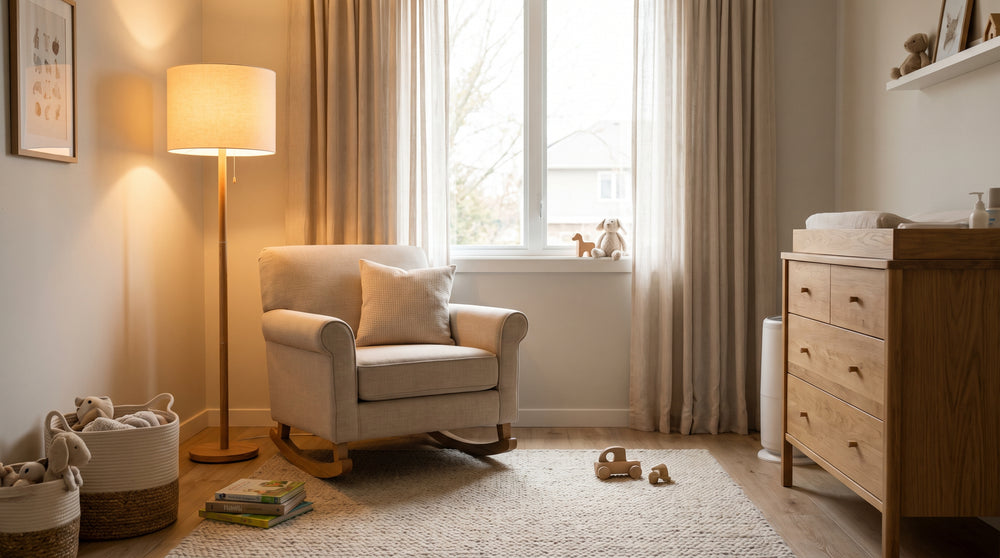
Choose a baby nursery floor lamp with a warm light and adjustable brightness, whose closed shade sends the light upward or toward the wall, never toward the bed. The base should stay heavy enough not to tip over, the stem stable, and the switch within reach without having to lean over the bed.
Which floor lamp should you choose to light a baby's room?
A baby nursery floor lamp should be chosen with a closed shade, adjustable brightness and a heavy base, with a stem of 120 to 150 cm. It lights without dazzling, can be turned down low for night feeds and stays stable when you brush past it. In the evening, the lamp comes on in the corner by the armchair and the wall takes on a warm tint: it is this reflected light that makes the room usable without waking anyone. For night feeds, it goes down to the minimum; for reading while baby falls asleep, it comes up just enough. Three criteria govern the rest: a closed shade that hides the bulb, adjustable brightness, and a base heavy enough to withstand a knock. A floor light is chosen first for its stability, then for its looks. The designer lamps for the bedroom cover this dual need, and the entire lighting catalogue lets you compare formats before deciding.
| Use | Type of light | Floor lamp format | What to watch for |
|---|---|---|---|
| Night light for feeds | Warm, very low brightness, dimmer | Slim, low stem, closed shade | Switch reachable from the armchair |
| Reading and nursing corner | Warm, directed at the book | Medium stem, adjustable head | Light kept away from the child's eyes |
| Bedtime ambience | Warm, reflected onto the wall | Tall stem, fabric shade | No bare bulb visible |
| Extra light as the child grows | Warm to neutral, moderate brightness | Classic floor lamp | Stable base, cable tidied along the wall |
Floor lamp or standing lamp: what is the difference?
Both terms describe the same object, a light that rests on the floor on a base. The useful reference point is not the vocabulary but the height of the stem and the weight of the base.
What stem height should you plan for in a small bedroom?
A stem of around 120 to 150 cm puts the shade just above a nursing armchair, without overwhelming the room. Beyond 160 cm, the light rises too high and the lamp visually clutters a bedroom of less than ten square metres. Check the height before buying.
What light won't disturb baby's sleep?
Aim for a warm light, around 2700 K, and low brightness: that is the usual reference for evening lighting. The lamp lights the wall or the floor rather than the bed, with a closed shade that hides the bulb. A dimmer lets you go down to the minimum for night feeds. The LED version for the bedroom simplifies this adjustment, provided the lamp and bulb are compatible with the dimmer.
| Moment | Colour temperature | Brightness | Diffusion |
|---|---|---|---|
| Night feed | Very warm, around 2700 K | Very low | Toward the wall or the floor |
| Changing and care | Warm, around 2700 to 3000 K | Low to medium | Indirect, closed shade |
| Evening reading | Warm | Medium, adjustable | Directed at the book |
| Waking and play | Warm to neutral | Moderate | Ambient, never facing the child |
What colour temperature should you choose for a baby's room bulb?
Stay in the warm range, from 2200 to 3000 K, and keep the same tint on every light source in the room. Mixing a very yellow bulb with a cool white one tires the eye and wakes you more. The figure appears on the bulb packaging, not always on the light's specification sheet.
How do you add a dimmer to a floor lamp?
Three solutions: a dimmer switch on the cord, a dimmable bulb controlled from an app, or a dimmer plug. In all three cases, the bulb must be stated as dimmable, otherwise it flickers or cuts out before the minimum. Adjustable models for reading often accept this setup.
Where should you place a floor lamp in the baby's room?
Place the lamp in the corner of the nursing corner or near the changing dresser, away from the bed and out of the path between the bed and the door. The cable runs along the wall to a free socket, and the switch stays within reach once you are seated. The light reflected onto the wall illuminates the changing surface without hitting the child's face. A linen shade softens this reflected light even further.
Can you put a floor lamp right next to the baby's bed?
It is better to keep a clear space of at least one step between the bed and the light. A stem within reach becomes something to hold onto when the child pulls themselves up, and the cable ends up trodden on. The corner of the room or the wall behind the armchair remain the safest positions.
How do you tidy the cable of a floor lamp in a child's room?
Run the cable against the skirting board, secured with adhesive clips, to the nearest socket. Never under a rug, never across a walkway, never at child height. As soon as baby starts moving around, add a wall fixing at the top of the stem.
How do you connect several lamps to a single power outlet?
A power strip with a switch and shuttered sockets is enough for a floor lamp and a night light, provided you add up the wattage of the bulbs and stay below the limit indicated on the strip. The extension lead runs along the wall, never under a rug or within the child's reach. This setup saves you hunting for the socket in the dark at night. To compare the available styles, take a look at lighting the bedroom with a designer model.
How do you add up the wattage of lamps plugged into a power strip?
Read the wattage on each bulb, add them up, then compare with the maximum marked on the power strip. Two low-wattage bulbs leave a comfortable margin. A light with an integrated LED cannot be replaced: take its original consumption into account.
Should you cut the power before plugging in a lamp?
Switching off at the breaker is not necessary for a simple socket, but the power strip switch must be off. Above all, check that the plug goes in fully, with no play, and that the cord is not taut. Plugging in takes two hands, out of the child's reach.
Unsure about the format or the height? The Designix customer service team answers before you order, then secure payment and tracked delivery take over.
Which materials and colours for a baby's room?
Light wood and ceramic give a warm light and a heavy, reassuring base. Linen softens without dazzling, lacquered metal stays understated and wipes clean in one go. Soft colours and natural tones last through the years better than a very pronounced theme, which goes out of fashion before the child leaves their bed. Lamps in wood with a light frame and matte ceramic bases are the two easiest families to match.
| Material | Mood created | Care | Note |
|---|---|---|---|
| Wood | Warm, natural | Soft cloth, no abrasive product | Matches light furniture |
| Ceramic | Soft, artisanal | Damp cloth | Often a heavy base, so stable |
| Linen | Softened, textured | Dry dusting | Diffuses light without dazzling |
| Lacquered metal | Modern, understated | Microfibre cloth | Matte colours easy to match |
| Crystal | More dressed up | Lint-free cloth | Better for older children's rooms |
Wood, ceramic or linen: which material for a baby's floor lamp?
Wood for warmth and stability, ceramic for a heavy base and a matte finish, linen for a shade that softens the light. A ceramic base withstands knocks better than a slim metal foot. Small ceramic bedside lamps suit narrow rooms.
Which styles and colours for a baby girl's room?
Stick to powdery tones and textured fabrics, without too strong a theme: the style lasts longer than bright pink. A white colour to stay understated leaves every door open, and a crystal piece can take over around five or six years old.
How do you match the lamp with the rest of the home?
Repeating the same family of materials from one room to the next gives a coherent home: light wood in the bedroom can reappear in the living room, matte ceramic near the kitchen. A baby's lamp is not an isolated object, it extends the style already in place. That is what lets a table lamp for the living room and a bedroom floor lamp look like they belong to the same home.
How do you repeat the same material from one room to the next?
Choose two dominant materials and stick to them. Wood for the living room echoes the wood in the bedroom, a modern style for the living room can dialogue with a lacquered frame. For kitchen decoration, the same matte tones work in continuity.
Can a bedroom lamp be reused in another room later?
Yes, a floor lamp with a stable base works very well in a living room or beside a reading chair. That is also a reason to prefer a neutral tone over a childish theme. A modern model for the office or one in metal for the office follows the same logic of reuse.
How do you care for and secure a floor lamp in a child's room?
Dust the shade dry and the base with a soft cloth, and change the bulb with the power off, once the lamp has cooled. Regularly check that the base does not move and that the cable is not trapped under furniture. A wall fixing prevents tipping as the child grows. These steps take two minutes and significantly extend the life of the light.
How do you clean a fabric shade without damaging it?
Brush dry with a microfibre cloth or a light adhesive roller, without rubbing. Water marks linen and cotton. For a stain, work on a small area with a barely damp cloth, then let it air dry, with the lamp off. A black wood bedside lamp is dusted the same way, dry.
When and how should you change the bulb of a night light?
As soon as it flickers, dims or takes time to come on. Switch off, let it cool, unscrew or unclip depending on the base, then replace with a bulb of the same base and the same colour temperature. Avoid touching the glass of a halogen bulb with your fingers.
Which mistakes should you avoid before buying a baby's floor lamp?
The most common mistakes: a white bulb that is too cool, a shade open toward the bed, a stem too tall for the room, a switch on the floor and a light base. Also check the bulb base before buying, so you don't depend on a bulb you can't find.
- Bulb too cool: stay around 2700 K.
- Shade open toward the bed: prefer light reflected onto the wall.
- Stem too tall: measure the room before ordering.
- Switch on the floor: choose a button at the top of the stem or on the cord.
- Light base: a foot that slides will fall at the first knock.
- Bulb base not checked: check the format on the light's specification sheet.
Ordering from Designix: secure payment, tracked delivery, returns possible and customer service available to confirm a bulb base or a height. Browse all our Designix lights to finish comparing, or go back to the designer LED lamps if you are looking for adjustable light.
Frequently asked questions
Floor lamp or standing lamp: what is the difference for a baby's room?
Both terms describe the same family: a light that rests on the floor on a base. "Floor lamp" is the common phrase, "standing lamp" the older one. In a baby's room, what matters is the height of the stem, the stability of the base and the ability to lower the brightness.
Is a ceiling light enough to light a baby's room?
A ceiling light shines brightly and often frontally, which wakes a baby during night feeds. It remains useful for changing and cleaning, provided it is controlled by a dimmer. A floor lamp with warm light complements the lighting and lets you stay at low brightness.
Can a living room floor lamp work in a baby's room?
Yes, if the base is stable, the shade hides the bulb and the light can be lowered. A living room lamp in wood, ceramic or linen adapts very well. Just check the height of the stem relative to the bed and the length of the cable to the socket.
Do you need a switched socket for a baby's night light?
Useful, not essential. A socket controlled by a wall switch or a power strip with a switch saves you searching for the button in the dark. On the lamp, prefer a switch at the top of the stem or on the cord, reachable without leaning over the bed.
Which bulb base should you plan for a baby's bedroom floor lamp?
Most floor lamps use a large screw base, others a smaller base, and some models have an integrated LED. The base is indicated on the product sheet: check it before buying, as it determines the compatible bulbs, particularly dimmable models.




