
220V LED under-cabinet lights for kitchen
This selection is also available in our French store: Réglettes LED 220V pour cuisine
No products in this selection.
- Tracked delivery to your country Tracked delivery
- Secure payment at checkout Multiple payment methods
- 14 days to change your mind 14-day returns
- Secure payment Secure payment
Not sure of your style? Find it in 30 seconds
A few questions, and we will show you the pieces made for you.
Frequently asked questions
How do I choose the right product?
What are the delivery times?
Can I return an item?
Can I pay in instalments?
An interior that reflects who you are
Carefully selected pieces, shipped from our warehouses. Our team advises you before you buy, so you choose with confidence.
- Tracked delivery
- Pay in instalments, where available
- 14 days to change your mind
- Advice & showroom in Lyon, France
A 220V LED strip light connects directly to the mains and mounts under wall cabinets, above the worktop: it is the layer of light most often missing in a kitchen. Start with the length that covers the prep area, then choose the light temperature and the protection rating according to the distance to the sink.
What is the ideal lighting for a kitchen?
Three layers are enough: general light on the ceiling for moving around, task light on the worktop, ambient light for meals. The 220V LED strip light takes care of the task layer, the one most often missing between the worktop and the wall cabinets. (52 words)
220V kitchen LED strip light: what it changes on the worktop
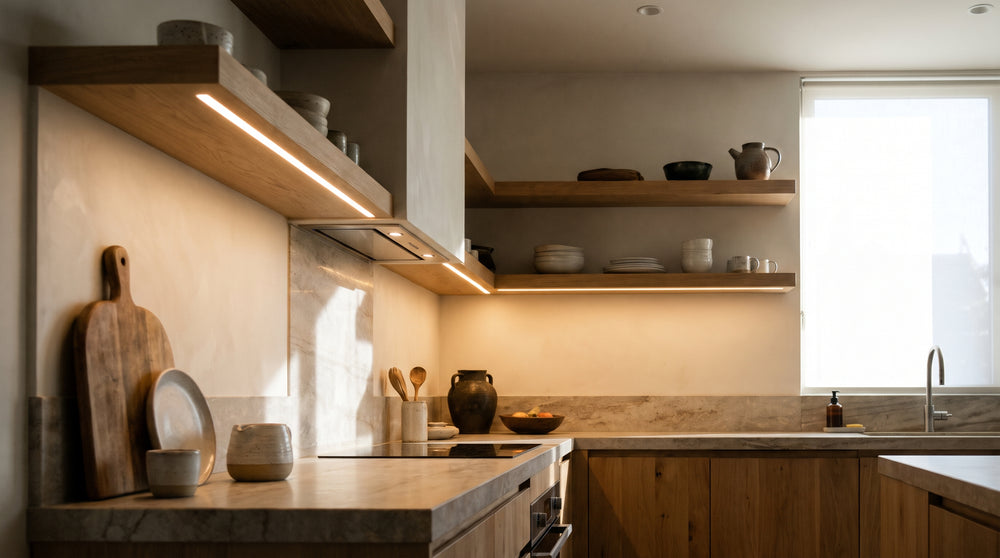
A worktop lit by the ceiling alone carries the shadow of the body and head exactly where you cut. The strip light, placed under the wall cabinet, sends light downwards: food keeps its colour, the splashback is highlighted, movements become clear. The profile stays slim, fades from view and adds no visible object to the room.
Kitchen light fixture: the other two layers of light
General light comes from a ceiling light or spotlights, ambience from a pendant above the table. These two layers are chosen from the Designix lighting catalogue, independently of the strip light: each has its role and its own order.
| Layout | Recommended strip type | Position | Point to watch |
|---|---|---|---|
| Straight worktop under wall cabinets | Under-cabinet strip with even light | Under the wall cabinet, towards the front | Avoid the shadow of the head on the worktop |
| Kitchen open to the living room | Discreet strip, warm to neutral white | Under wall cabinets and at the top of tall units | Do not throw light towards the sofa |
| Sink and dishwasher nearby | Waterproof model, IP44 or higher | Above the worktop, away from splashes | Protection against splashes |
| Corner or L-shaped worktop | Two sections or a suitable length | One strip per useful section | Avoid the shadow area in the corner |
| Glazed wall cabinets | Slim profile with indirect light | Inside or under the cabinet | Visible cable and profile heating |
How do you install a 220V LED strip light under a kitchen cabinet?
The cable goes to a connector block or a socket, then the profile is fixed under the wall cabinet, rather towards the front, to avoid the shadow of the body on the worktop. Switch off the power before connecting. No transformer to house, unlike a low-voltage system. (52 words)
220V LED strip light under kitchen cabinet: height and position
Fix the profile a few centimetres from the front edge of the cabinet, never flush against the wall: set back, it lights the splashback but leaves the worktop in shadow. On an L-shaped worktop, plan one section per useful portion rather than a single length crossing the corner. 220V LED strip lights that plug into the mains are chosen to match the cabinet length, and all LED strip lights can be compared on the same sheet: length, connection cap, protection rating.
Connecting a 220V strip light: socket, connector block or switch
A socket remains the simplest solution when renovating; a connector block on an existing line hides the cable. Plan an accessible switch, or a sensor model if the control is awkwardly placed. Once installed, the profile is cleaned with a soft cloth and the clips are checked from time to time.
220V kitchen LED strip light with sensor: is it useful under a cabinet?
A sensor model switches the strip on as a hand passes, so you do not have to look for the switch with busy or wet hands. It is useful if the control is badly placed, or for discreet night lighting; otherwise a standard switch is easier to live with. (51 words)
220V kitchen LED strip light with sensor: when it is the right choice
The gesture works when the detection area stays clear: a sensor hidden by the cabinet or a hood triggers nothing. Set a short delay so the light does not stay on after you pass. The 220V models with sensor avoid the transformer, while those in the motion detection lighting collection cover the other uses in the home.
Sensor, switch or dimmer: what can be controlled
The sensor triggers, the switch commands, the dimmer doses. Under a kitchen cabinet, a dimmer has little point: you work at full light or switch off. A battery-powered strip light, however, helps where no line arrives, see the rechargeable models without a socket.
What is the wattage of an LED lamp?
Watts indicate consumption, not the amount of light: it is the luminous flux in lumens that matters, relative to the length of the worktop. A strip light is judged above all on the evenness of its light, with no dark zone and no dazzling point on the splashback. (47 words)
Wattage and lumens: the right criterion for a worktop
For the same consumption, two profiles do not give the same illuminance: the quality of the opal diffuser does as much as the power. A model that is too powerful under a wall cabinet throws reflections onto the splashback and tires the eye; a steady light is better than maximum lumens. In a workshop, the reasoning changes, take a look at the strip lights designed for a workshop.
Strip length: covering the worktop without overhang
Measure the width of the wall cabinet, not the worktop: the profile must stay under the unit so the light falls exactly where needed. Two short sections are better than a length that overhangs and lights empty space. Beyond one metre, check that the stated profile holds the same intensity from one end to the other.
Which light temperature should you choose for a kitchen?
For a worktop, a neutral white around 4,000 K keeps colours accurate and stays comfortable; a warm white of 2,700 to 3,000 K warms a kitchen open to the living room, while a cool white above 5,000 K suits a workshop better than a table. (52 words)
Warm white, neutral white, cool white: which one under a kitchen cabinet
Neutral is the default choice above a chopping board: neither yellow nor clinical. Warm takes over when the kitchen is seen from the living room and you want to extend the living room ambience. Cool stays reserved for technical tasks and utility rooms.
Light temperature and how food looks
A tone that is too cool turns meat and green vegetables blue, a tone that is too warm pulls everything towards orange. Above all, check that the strip light and the ceiling light do not mix two whites in the same room: it is the difference in tone that shows, not the difference in intensity.
| Tone | Approximate value | Rendering in the kitchen | When to choose it |
|---|---|---|---|
| Warm white | 2,700 to 3,000 K | Golden light, meal ambience | Kitchen open to a living area |
| Neutral white | Around 4,000 K | Accurate colours, easy reading | Worktop and preparation |
| Cool white | Above 5,000 K | Very white, contrasting light | Workshop, garage, technical task |
Waterproof strip, IP65 or IP20: which protection rating for a kitchen?
The IP rating indicates protection against solids and water: an IP20 is enough under a dry wall cabinet, an IP44 withstands splashes near the sink, an IP65 can be cleaned with water and suits highly exposed areas. The hood and the sink are the two points to watch. (54 words)
IP20, IP44, IP65: what the protection rating changes
The first digit covers dust, the second liquids. Under a dry kitchen cabinet, an IP20 poses no problem. Within one metre of the sink, move to a model protected against splashes: the waterproof versions for wet areas and the profiles with an IP65 protection rating can be cleaned without particular care.
Waterproof strip near the sink or the hood
Around the hood, steam and grease rise: a closed profile is easier to clean than an open assembly, and a taut cable avoids build-up. The reasoning is the same as for lighting a bathroom, another damp room where the rating matters more than the power. For a utility room, compare with garage lighting.
How do you integrate a strip light into a modern kitchen decoration?
A slim, discreet strip light fades from view: the light highlights the splashback and the cabinet fronts without adding a visible object. That is what makes it fit a modern kitchen decoration, where the worktop stays clear and indirect lighting replaces bulky fixtures. (49 words)
Kitchen decoration: why hide the light source
An aluminium profile under a wall cabinet is the line of light without the fixture. On matt fronts, grazing light reveals the texture; on a light splashback, it almost replaces a decorative surface. It is a piece from see the 220V strip lights chosen as much for its discretion as for its rendering. For a coherent modern kitchen decor, keep to a single family of tones.
Trendy kitchen ceiling light and strip light: matching without overloading
Two visible sources above the same worktop are enough to clutter the view. The classic mistake remains mixing two whites: a very warm ceiling light with a very cool strip light gives a room that seems lit by two different homes. For utility rooms, the same logic applies with a clearly separate outdoor use.
Ceiling light, chandelier or wall light: which fixture with a kitchen strip light?
The ceiling light or chandelier lights the room, the strip light lights the task. Under a low ceiling, a flush LED ceiling light complements a strip light well; in a large kitchen, a chandelier above the island works, provided it does not dazzle while you work. (48 words)
Kitchen ceiling light or kitchen chandelier: choosing according to ceiling height
Below 2.40 m, a flush ceiling light avoids lowering the line of sight; above a clear island, a pendant lowered to eye level works better. In both cases, the strip light remains the only lighting placed between the eye and the worktop. The rest is chosen by browsing choosing a light fixture for the kitchen.
Powerful LED wall light and LED chandelier: lighting without a strip
A wall without wall cabinets, a worktop against a solid partition: a wall light directed downwards does the same job as a profile. It also suits small spaces, like motion detection lighting for a hallway or a toilet, where a short strip light is often enough.
Living room chandelier and WC light fixture: keeping consistency between rooms
An open kitchen is read together with the living room: match the tone of the living room chandelier with that of the strip light, otherwise the transition shows. For short rooms, a WC light fixture or a low wall light solves the problem in one line. The waterproof outdoor strip lights follow the same rule outside.
Designix reassurance: secure payment, tracked delivery, returns according to the terms of Designix customer service. Unsure about the length or the protection rating before ordering? Write to customer service with the width of your wall cabinet and the distance to the sink: that is the only really useful information to decide. The current price of each model is shown directly in the grid of the LED strip light collection.
Frequently asked questions
Does a 220V kitchen LED strip light need a transformer?
No. A strip light designed for 220V connects directly to the mains, like a wall light: the transformer only exists on low-voltage tapes and strip lights. This simplifies installation, avoids a part to hide behind the cabinet and makes replacement easier.
Kitchen ceiling light or strip light: which to choose above the worktop?
The two do not do the same job. The ceiling light lights the room but casts the shadow of the body on the worktop; the strip light, placed under the wall cabinet, lights the prep area and the hands. Most often, you keep the ceiling light and add the strip light.
WC light fixture: is an LED strip light suitable?
Yes, a short strip light suits a toilet well: grazing light above the worktop or mirror, compact, with no risk of hitting your head. Choose a neutral tone and check the protection rating if the room is damp.
Can you combine a modern kitchen chandelier with an under-cabinet strip light?
Yes, provided the roles are shared: the chandelier sets the tone and lights the room, the strip light stays discreet and functional. Keep to the same family of tones, for example warm white above the table and neutral white on the worktop.
Should you strip a cabinet before installing a strip light underneath?
It depends on the condition of the cabinet: stripping is justified when the varnish blisters or the colour no longer holds, not for fitting a strip light. If you are revamping the kitchen, treat and let the fronts dry completely before fixing a profile and connecting.




