Wooden chandeliers: choosing one for the room and the light
This article is also available in French: Lustre bois
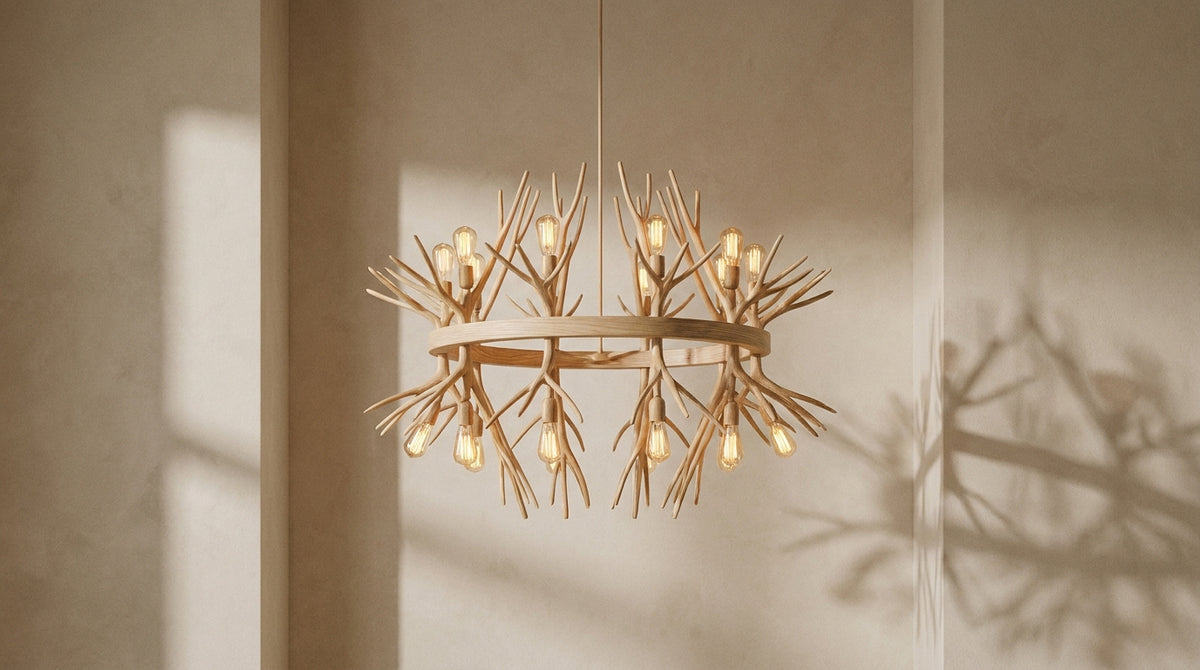
Choose the light before the shape of the wood. Check the socket first of all: E27 for a visible bulb, G9 for a low light grazing the branches. Aim for 2700 K in a living room and a pendant 75 cm above a table. The design of the chandelier comes last, once the room already knows how it is lit.
Which wooden chandelier for each room?
The living room calls for a wide diameter, the bedroom for a low, filtered light, the hallway for a compact format that does not eat into the passage. In all three cases, the ceiling height sets the diameter: the lower it is, the more the chandelier spreads out instead of hanging down.
When the room is being renovated, the lighting is planned before the fixture. A lighting project for your living space sets the light points, heights and circuits, and the chandelier is then chosen without mistakes.
Wood chandelier for the living room
In a living room of 20 to 25 m², allow 50 to 60 cm in diameter. Light wood reflects light, dark wood absorbs it: at equal volume, a walnut chandelier needs a more generous bulb than a beech one.
- Wood and black metal for a contemporary room
- Solid light wood to visually enlarge a dark living room
- Three light points rather than a single source in the centre
The result is best compared in photos: our selection of wooden chandeliers can be read room by room, both switched on and off.
The dimensions and styles of a chandelier are also calculated from the table and the set-back of the sofa.
Wood chandelier for the bedroom
In a bedroom, the light should come down low without dazzling you in bed. A bedroom chandelier in wood with a dimmer settles this with one gesture, in the evening.
On the product pages, buyers mostly comment on how the light renders on the wood when switched on. These reviews can be read on our Google listing, updated continuously.
Wood chandelier for the hallway and corridor
In a corridor, a wide chandelier gets knocked and is too conspicuous. Prefer a round format of 30 to 40 cm, or a wall light when the passage is less than a metre wide.
The wooden wall light collection has 525 references as of 5 October 2026, enough to match the shade of the chandelier without breaking the style.
What is the difference between a chandelier and a pendant?
A chandelier carries several sources and radiates around itself. A pendant carries only one and hangs straight down over a table or a worktop. The first lights the room, the second lights a zone.
- Chandelier: several sources, light that travels around the fixture
- Pendant: a single source, light concentrated on a surface
- Ceiling light: diffuse light, nothing hanging down into the passage
When in doubt, the difference between a chandelier and a pendant comes down to one simple criterion: the number of visible light points.
In wood, the pendant often takes the shape of a cone or a cylinder with one bulb. Our wood and rattan pendant follows this logic, useful above an island or a desk.
Wood and metal chandelier
The metal holds the structure, the wood diffuses. This mix takes a matte black without weighing it down, provided the bulb stays visible and the branches do not cross a beam.
Wood and rope chandelier
Rope absorbs light and sends it back in yellow tones. It suits warm rooms and high ceilings, where its relief stands out against the ceiling.
Which chandelier with a wooden ceiling?
A wooden ceiling absorbs light and warms the tones. Choose a light chandelier or a golden metal, with a 2700 K bulb. Under exposed beams, hang between two beams rather than below them, where the drop breaks the line.
- Light wood: reflects light, brightens dark panelling
- Golden metal: warms raw wood without competing with it
- 2700 K bulb: tone matched to the natural shade of the wood
- Fixing into a joist: essential between two beams
The case gets more complicated as soon as the roof structure comes down: installing a ceiling fixture with beams means drilling into the joist, never into hollow panelling.
Below 2.30 m, a chandelier that hangs down is no longer an option. A flush LED ceiling light keeps circulation free.
Scandinavian wood chandelier
Light wood, fine lines, white walls around: the style seeks indirect light. A well-adjusted Scandinavian wood pendant lights without patches on the ceiling.
Driftwood chandelier
Driftwood arrives already patinated, in greys. It pairs with off-white and a filament bulb, whose colour leans towards amber.
At what height should a wooden chandelier be hung?
Allow 75 to 80 cm between the bottom of the shade and the top of a table, and never less than 210 cm from the floor in a passage. In a stairwell, the chandelier hangs below the landing level to stay in the field of view.
These markers shift with the room: the relationship between chandelier and ceiling height should be checked before drilling.
| Location | Drop height | Target diameter |
|---|---|---|
| Dining table | 75 to 80 cm above the surface | 40 to 60 cm |
| Kitchen island | 75 to 85 cm | 30 to 45 cm |
| Hallway or corridor | 210 cm from the floor minimum | 30 to 40 cm |
| Bedroom | 210 to 220 cm from the floor | 40 to 50 cm |
Above a table
The drop is measured between the bottom of the chandelier and the table surface, not between the ceiling and the bulb. A round table tolerates a centred round chandelier, a rectangular table prefers two aligned pendants.
In a stairwell or on a staircase
The drop follows the height of the landing: the chandelier stops above the void, never level with the steps. Plan access to dust it without a ten-step ladder.
Still hesitating between two diameters or two drop heights? Write to us to talk about your project with the team: we go over the room, the measurements and the style before you order.
Which bulb for a wooden chandelier?
An E27 socket with a filament LED bulb at 2700 K and 6 to 8 W per point covers most wooden chandeliers. The socket should be checked before buying: in a survey of 57 wooden references in our catalogue as of 5 October 2026, 53% declare an E27 and 25% a G9.
Indoor use is not in question: 98% of this survey is IP20, that is 57 product pages out of 57. Dimming, however, is only declared on 21 pages, 28% yes and 9% no. If you want to lower the light in the evening, look for the mention instead of assuming it.
Above a table, it is better to spread the light than to light it strongly. A dining room fixture with E27 filament bulbs gives this soft light, without patches on the ceiling.
The rectangular format suits long tables: a dining room chandelier with three or five branches covers the whole length without doubling the sources.
Wood and black chandelier
Matte black structures the wood and hides the socket. It calls for a visible bulb, even if that means choosing a warmer one than average to avoid a harsh contrast.
E27 or G9 socket?
| Socket | What it changes | Share of the survey of 57 references (5 October 2026) |
|---|---|---|
| E27 | Visible bulb, wide choice, filament possible | 53% |
| G9 | Short format, low light under the shade | 25% |
| E14 | Small thread, for fine branches | 9% |
| Integrated LED | Nothing to change, but nothing to choose either | 7% |
Wooden chandeliers and pendants from our selection


A fixing needs preparing: hanging a chandelier on a wooden ceiling means a screw driven into the joist, not into the panelling.
On the same subject
In stock · shipping costs shown at checkout · up to 30% off in your cart


Ready to turn inspiration into reality?
Tell us about your room, your style and your budget, and we will show you the pieces that truly suit your project.
Get guidance in 30 seconds →