Which bulb for a bedroom: the guide to sleeping well
This article is also available in French: Quelle ampoule pour une chambre
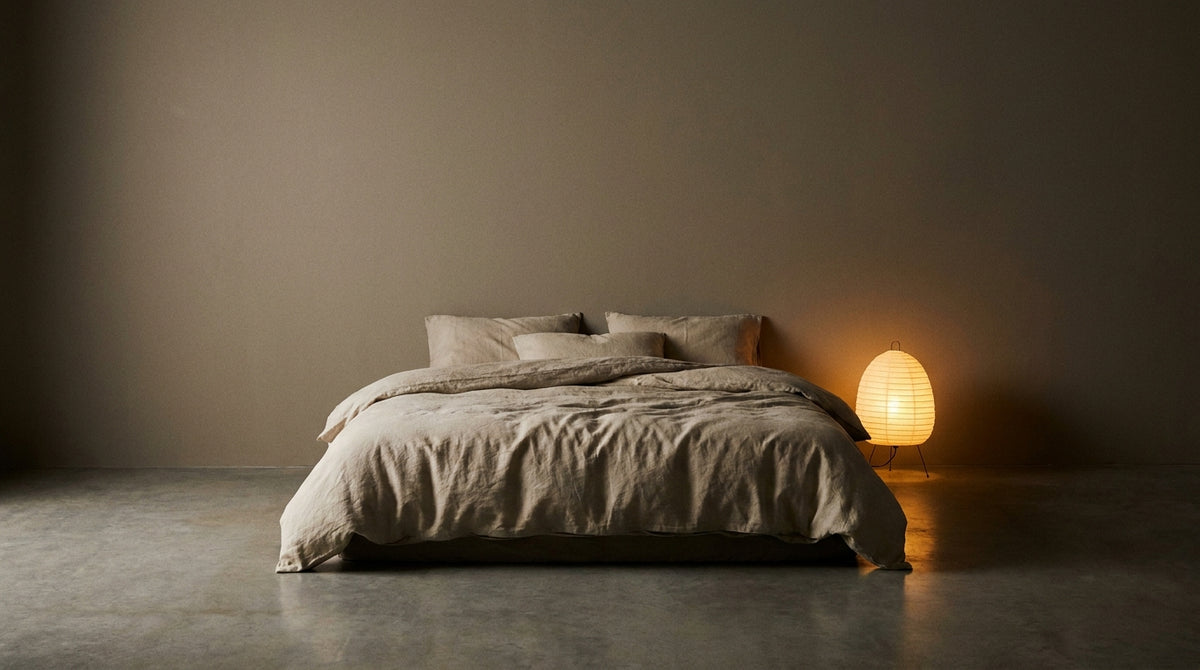
For a bedroom, aim for 2,700 K to 3,000 K and two or three sources rather than a single ceiling point: allow about 800 to 1,000 lumens for general light and 400 lumens for reading. Check the base before anything else: E27, E14, G9 and GU10 are not interchangeable.
How many lumens do you need to light a bedroom?
Allow 800 to 1,000 lumens for the general lighting of a 10 to 12 m² bedroom, then 300 to 400 lumens per reading area. A 20 m² bedroom needs about 1,500 lumens in total. Spreading that flux over two or three points is better than a single ceiling light turned up full.
- 10 m²: 800 to 1,000 lm in total
- 15 m²: about 1,200 lm
- 20 m²: about 1,500 lm
The calculation is done in lumens, no longer in watts: a 9 W LED bulb gives what a 60 W incandescent used to give. It all comes down to choosing the bedroom light fitting; the lower and more diffusing the source, the softer the light.
What LED bulb wattage for a 10 m² bedroom?
Plan for an LED bulb of 8 to 10 W for the general light, that is 800 to 1,000 lumens, and a second one of 4 to 5 W for the bedside lamp. A bedroom does not need to be lit like an office: too much power is tiring in the evening.
Are 2,000 lumens a lot in a bedroom?
Yes, that is almost twice the perceived need. Those 2,000 lumens suit a large room handled with indirect light, never directed at the bed. A well-diffusing bedroom ceiling light absorbs that flux without glare, unlike a row of spotlights.
If you are starting from an empty room or a plan to rework, the calculation method stays the same: surface, use, then distribution. Our guide to calculating the lighting you need details each step.
Which bulb colour is ideal for a bedroom?
A warm light, between 2,700 K and 3,000 K. That is the range that lets melatonin rise in the evening and gives the room that amber tint where you linger. Above 4,000 K, a bedroom takes on the look of a waiting room, even switched off at the right time.
Colour temperature is the first criterion to settle, before power and before aesthetics. This recap for choosing your bulbs without getting it wrong helps set the order of decisions.
- 2,200 K: night light, waking at night
- 2,700 K: warm evening light, bedside lamp
- 3,000 K: warm atmosphere, living room
- 4,000 K: neutral white, desk area only
Which colour temperature for falling asleep?
2,700 K on bedside lamps, and nothing cooler in the hour before bedtime. A filament LED bulb reproduces that rendering without heating the shade. Lowering the intensity of a bulb that is too cool will never make it warm, it will simply be less strong.
The right evening light accompanies a ritual, it does not light it up. Our article on interiors that help you sleep shows how to organise those last points of light.
Which bulb to choose for white light?
Aim for 4,000 K for a neutral white, reserved for the desk, the dressing room or the dressing table. Use it as localised accent lighting. White light suits work, not rest: to compare the two renderings, see white or yellow light, the choice comes down to use, not taste.
How do you choose the right bulb for your light fitting?
Three checks, in this order: the base, the clearance under the shade, then compatibility with the dimmer. A bulb that is too wide blocks assembly, a non-dimmable bulb makes the light flicker. Once these three points are settled, the bulb is fitted in a few minutes.
| Base | Where you find it | Common wattage |
|---|---|---|
| E27 | Ceiling lights, pendants, floor lamps | 9 to 15 W LED |
| E14 | Bedside lamps, slim wall lights | 4 to 7 W LED |
| G9 | Small fittings, replaced halogens | 3 to 5 W LED |
| GU10 | Adjustable spotlights, tracks | 4 to 7 W LED |
The catalogue covers these four families, and the LED bulbs available each state flux, temperature and base. Out of a sample of 209 references from our catalogue as of 26 September 2026, LED technology is declared on 77% of the listings that mention it.
Which base for a bedside lamp?
Most often E14, sometimes E27 on large shades. Measure the diameter of the socket before ordering, a few millimetres of difference are enough to make a bulb impossible to screw in. It is the most frequent mistake on a bedside lamp order.
Before deciding, our guide to recognising the size and base of a bulb shows how to read a socket by eye, without tools.
Bedroom light fittings and bulbs
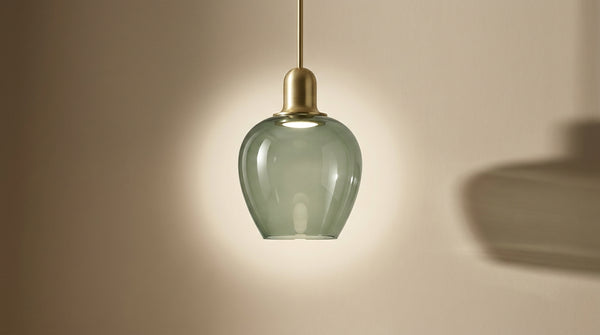
 Léonor vertical pendant – Colourful designer glass
 Tiffany floor lamp – Integrated LED, dimmable, gold finish
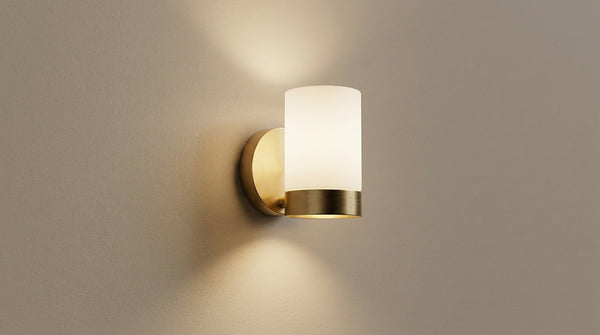
 Grace wall light – Wall light
 Tiffany vertical Diamond pendant – Elegant dimmable LED designer light
 Petit Grace wall light – Wall light
 Roxanne pendant Ø20 cm – Elegant transparent blown glass designer light
Can you put an LED bulb in any light fitting?
Yes, except in two cases: an old socket that has heated up, and a dimmer designed for halogen, which makes the LED flicker. At equal flux, the LED consumes far less than an incandescent. Check the dimmer's compatibility rather than the wattage displayed.
Unsure about your setup? Our explanation of dimmable LED describes how a mismatched bulb behaves. Out of the same sample of 209 references as of 26 September 2026, dimming is declared on 32% of the listings.
If any doubt remains about the base or the clearance of your old light fitting, describe your fitting to the team via the contact page: checking before ordering avoids an unnecessary return trip. You can also compare with the most common bulb types and bases.
Which bulb for a child's or baby's room?
A warm and very low light: 2,200 to 2,700 K, never directed at the bed. For a baby, stay under 200 lumens at bedtime. For a teenager revising, add a neutral white source localised on the desk, switched off once homework is done.
Which night light for a baby?
A night light with adjustable intensity, around 2,200 K, placed away from the bed and directed at the floor. The amber tint lets sleep come, a model that is too bright turns the room into permanent early morning. The gesture matters as much as the bulb.
- Adjustable intensity: essential for night waking
- Removable bulb: simpler to replace than a sealed module
- Placed on the floor or as a low wall light: never at the child's eye level
Our selection of baby night lights details the models that accept this type of warm, low-intensity bulb.
Which bulb for a teenager's room for revising?
450 to 500 lumens on the work surface, at 4,000 K, plus a warm ambient light on the ceiling. Turn the first on to work, turn it off to sleep. It is the gesture that changes a teenager's room the most, and it costs less than a redesign.
A bedroom floor lamp directed at the desk often fills this role better than a central pendant, because it brings the light down to page height.
What is your situation in the bedroom?
If the light points date from before LED, having the bedroom lighting renovated lets you rework the whole thing: dimmer, wall lights, separate sources. Night-time comfort is gained through distribution, not power.
In stock · shipping costs shown at checkout · up to 30% off in your cart


Ready to turn inspiration into reality?
Tell us about your room, your style and your budget, and we will show you the pieces that truly suit your project.
Get guidance in 30 seconds →