Makeup lighting: the light that does not lie
This article is also available in French: Quel est l’éclairage idéal pour se maquiller ?

What is the most restful light for the eyes?
A neutral light between 3,000 and 4,000 K, placed outside the field of vision and with no direct reflection on the mirror. Above 5,000 K, the eye takes longer to adjust to read the same scene. Below 2,700 K, contrasts flatten out and everything turns yellow. What rests the eyes is the source you cannot see.
A light fixture to move, a mirror to replace: these changes improve visual comfort more than a simple bulb swap. Our bathroom renovation service handles this type of work, from measuring to final installation.
What is the difference between warm and cool light?
Warm light, around 2,700 K, leans amber and flatters darker skin tones. Cool light, at 5,000 K and above, leans blue and hardens features. On a face, the useful range sits between 3,000 and 4,000 K: neutral enough not to lie, soft enough to stay comfortable for a full hour.
| Temperature | Effect on the skin | Where to place it |
|---|---|---|
| 2,700 K | Amber, redness softened | Bedroom, reading corner, evening |
| 3,000 K | Warm but readable | Around the bathroom mirror |
| 4,000 K | Neutral, close to overcast daylight | Dressing table, walk-in closet, windowless room |
| 5,000 K and above | Bluish, features accentuated | Workshop, garage, color checking |
This guide to white or yellow light covers each temperature room by room, including the cases where personal preference matters more than the rule.
Which LED bulb does not hurt the eyes?
Neither power nor price decides. It is the color rendering index and the absence of flicker that make the difference, at equal power.
- CRI 90 minimum so that pinks and reds do not turn grey
- No visible flicker, including when filmed in slow motion
- 3,000 to 4,000 K, no industrial white above 5,000 K
- E27, E14 or GU10 base depending on the socket already in place
The base matters when replacing. In a survey of 250 references from our catalogue as of September 30, 2026, the E27 base accounts for 30% of the survey, LED technology 78%, wall mounting 32%, and IP20 protection rating 94%. In other words, most fixtures can be replaced bulb in hand, without dismantling the unit. The guide to bulb types helps you sort things out before ordering.
What is the ideal lighting for applying makeup to the face?
At least two sources, at eye level, on either side of the face, at 40 or 50 cm. It is this geometry, more than the temperature, that determines whether foundation is applied correctly. A ceiling light, even a perfectly neutral one, plays no part in the result.
Light from the front, at eye level
The light comes in along the line of sight, never from above or from behind. One wall light on each side of the mirror, at 1.60 or 1.70 m from the floor, lights both cheeks equally.
The height of a wall light is set by the eyes of the person applying makeup, not by the symmetry of the room.
A diffusing LED wall light costs a little more than a model with an exposed bulb, but it avoids the hot spot that washes out the cheekbone.
How many sources around the mirror
A narrow mirror is fine with one wide strip above it. From 80 cm wide, two side sources become necessary, otherwise the nose casts its shadow in the center of the face.
- Mirror up to 60 cm: one horizontal strip above the glass
- Mirror from 60 to 90 cm: two symmetrical side wall lights
- Wide mirror or double vanity: four points, one every 40 cm or so
In a walk-in closet, a pendant light above the dressing table flatters the room but not the face: it sends light down from above. What remains is knowing how to calculate the amount of lighting needed, and that is counted in cumulative lumens, not in number of points.
CRI, the criterion nobody looks at
At a CRI of 80, a raspberry and a deep brown look alike. At 90 and above, the shade stays readable. It is the only figure that distinguishes a bathroom bulb from a hallway bulb.
Before ordering a replacement, this guide to changing the bulb in a bathroom mirror details the compatible sockets and wattages.
To go further on room layouts, our tips & inspiration pages gather complete configurations, with the sources and their heights.
Lighting for a well-lit makeup corner
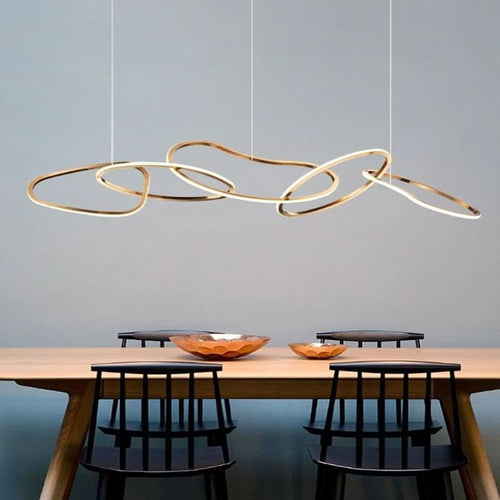
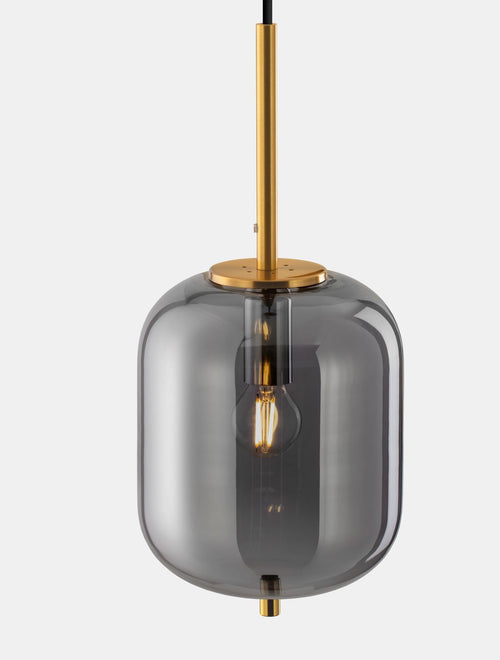
 Basic form Gold pendant light
 Basic form Gold pendant light
 Basic form Gold pendant light
 Velora Brown outdoor light
 Bobi 2-light black pendant
 Gentor 4-light white pendant
See the full selection: Lighting, Home Lighting, Online Lighting Store
What lighting for makeup in photos?
A large, diffused source, slightly above eye level, never filling the frame. At 45° to the face, the light adds modeling. Two symmetrical sources give a flatter but more predictable result. A ceiling light, on the other hand, adds shadows under the eyes that makeup cannot cover.
Why a ceiling light hollows out the features
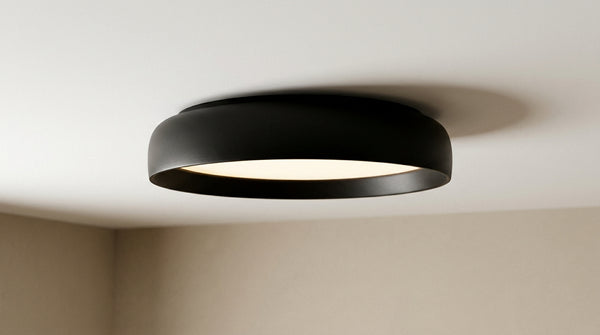
An LED ceiling light placed in the center sends light down from above. Eye sockets hollow out, the nose casts a shadow, and the chin casts another.
- Shadow under the eyes that concealer cannot hide
- Nose relief doubled by a dark line on the cheek
- Neck in shadow as soon as the head leans toward the glass
What evening light changes in the result
In the evening, outdoor light disappears and the eye adapts to the room. A too-warm shade then looks normal, and the tone chosen at 8 p.m. comes as a surprise the next morning.
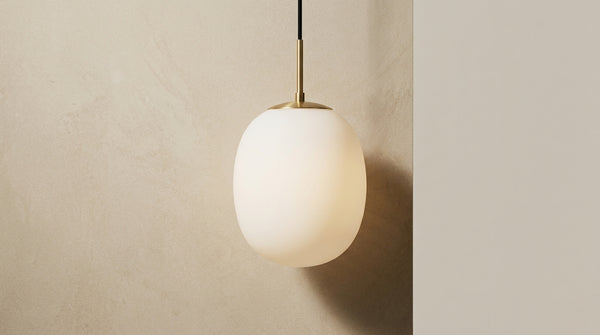
Frosted glass, a glass pendant or a light fabric shade breaks the glare of the point source and softens shadows on the face.
Cordless LED makeup lamp: good or bad idea?
A good idea for checking a detail at the last moment, a bad one as a main source. These lamps light up close, over a narrow band, and give a flattering tone that does not hold up in daylight. They complement, they do not replace.
In a bathroom
A damp room requires protected fixtures and a fixed source. The most common bathroom lighting mistakes come from a single point on the ceiling, not from the choice of bulb.
In a bedroom
A bedroom makeup corner calls for a well-placed adult bedroom wall light rather than an overhead point. A bedroom chandelier, however handsome, does not light a face.
In a dark room
Without a window, daylight is missing in the morning. Two side sources at 4,000 K replace the window for application, and a magnifying mirror placed near the face helps check details.
Where is your makeup corner?
The five-step method
Two sources facing you, at eye level, between 3,000 and 4,000 K, CRI 90 and above, then a check at the window. Five steps are enough, in this order.
If you are still unsure about the seller's reliability, the Designix Google listing shows its current rating and customer reviews, verifiable in one click.
When the room needs more than a bulb change (a wall light to move, a light point to create, a mirror to replace), describe your setup in a few lines: contact the team, it is the shortest path to the right reference.
In stock · shipping costs shown at checkout · up to 30% off in your cart
Ready to turn inspiration into reality?
Tell us about your room, your style and your budget, and we will show you the pieces that truly suit your project.
Get guidance in 30 seconds →