LED COB: seamless light, room by room
This article is also available in French: Led cob c'est quoi
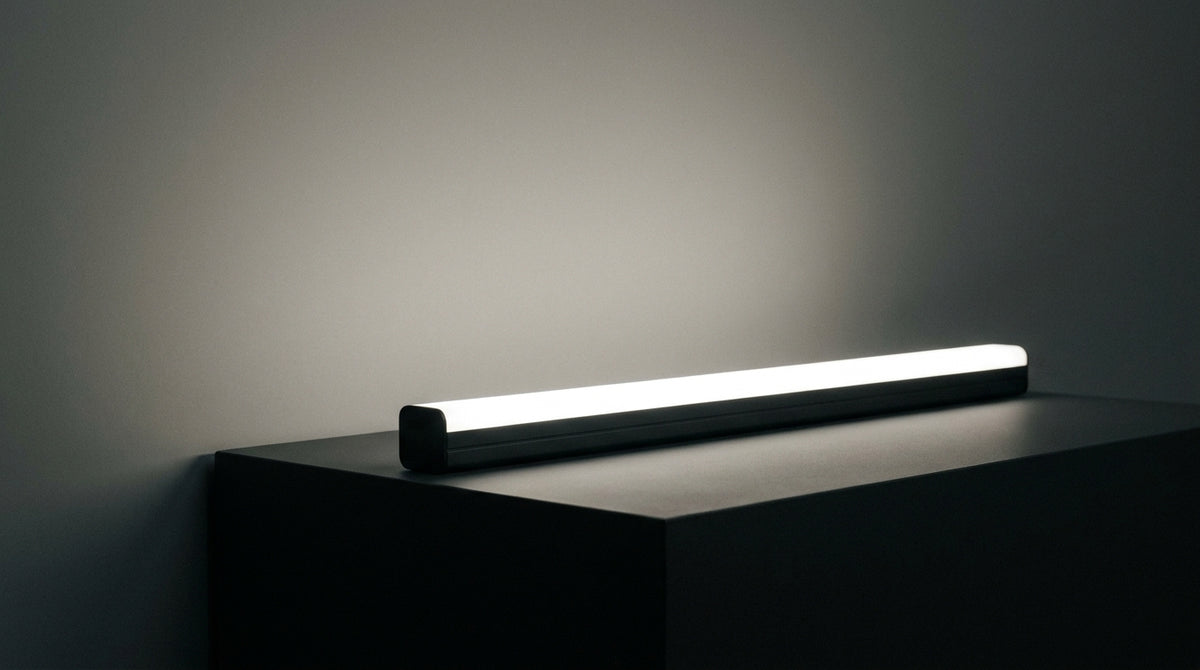
Count the distance between two light points: aligned beads mean SMD, an unbroken line means COB. A COB LED, or Chip On Board, brings several micro-chips together on a single board coated with phosphor. The light becomes continuous, with no visible gaps, which matters most when the eye moves close to the surface.
What is a COB LED?
COB stands for Chip On Board: the chips are placed directly on the board, then covered with a single layer of phosphor. There is no longer an individual housing per diode, nor any visible spacing between chips. The light comes out as one block.
What COB means, and what it changes in practice
On an SMD strip, each diode keeps its dome and its gap from the next one. On a COB strip, the whole board becomes the source. Up close, one draws dots, the other a line.
Direct mounting has a second, subtler effect: heat travels faster to the surface, provided that surface is metal.
COB LED definition: what the light does
The consequence comes down to one word: continuity. Under a light stone worktop, a steady line leaves no stepped reflection. The path of light, from the junction to the phosphor, is detailed in how an LED works.
The rest shows in the result. In our selection of LED lighting, the wider the lit surface, the softer the light appears, even at equal power.
What is the difference between COB and SMD LEDs?
SMD assembles separate diodes: closer than thirty centimetres, the eye makes out dots. COB places the chips on a single board and the light becomes a line. From a distance, both light a room; up close, only COB erases the dots.
The choice therefore comes down to the distance between the source and the lit surface. A strip stuck under a shelf forgives nothing, while a fixture hanging a metre from the floor forgives almost everything.
COB strips also come in 220 V, to wire directly to the mains without a transformer, and in RGB versions for a continuous line of colour rather than a string of dots.
Where continuous light really makes a difference
In the kitchen and in indirect lighting, where the eye moves close to the surface. Everywhere else, a good diffuser is enough, and COB costs more without anyone seeing the difference.
In the kitchen, under the worktop
It is the only place in the home where you work thirty centimetres from the source. A continuous line lights the chopping area without casting a string of shadows on the splashback.
For general lighting, a kitchen pendant above the island takes over. The strip remains a complement.
Profiles, adhesives and useful lengths are described in LED strip under a kitchen cabinet.
In the living room and bedroom, in indirect light
A cornice, a niche, a recessed ceiling: COB erases the last visible dots in the halo. A LED ceiling light with a large diffuser gives a similar result for general lighting.
For reading in bed, a bedroom wall light aimed at the book avoids lighting the whole room.
Where COB is pointless
- High ceiling: above two metres, the eye no longer makes out the dots of a decent SMD.
- General lighting only: the continuity is not seen, and neither is the expense.
- Damp room: the protection rating matters more than the fineness of the line.
- Tight budget: a well-cooled SMD is better than a COB stuck on bare.
If you are hesitating between several fixtures for the same wall, tell us about the room and the surface to be lit: we point you to the right model, without going through five quotes.
Where does continuous light change the most, in your home?
What is the lifespan of a COB LED strip?
No figure in hours means much on its own: heat dissipation and driver quality decide. A strip stuck to an aluminium profile lasts far longer than a strip laid bare in a corner, with identical components.
What decides, and where to read it on the spec sheet
- Mounting: aluminium profile rather than direct adhesion to wood or plaster.
- Driver: stable voltage, power suited to the total length.
- IP rating: IP20 in a dry room, IP44 and above near water.
- Warranty: the only written commitment you can hold them to.
Across a survey of 250 references in our catalogue as of 30 September 2026, a 2-year warranty was stated on 100% of the survey and IP20 on 94%. In other words: dry-room use in the vast majority of cases, and a product sheet to read line by line before drilling.
Which colour temperature to choose?
| Intended mood | Temperature | Rooms |
|---|---|---|
| Evening, relaxation | 2700 K | Living room, bedroom, reading corner |
| Precision | 4000 K | Worktop, desk, bathroom |
Warm white remains the safest in a living room, neutral white on a worktop. To decide, white or yellow light details the result room by room.
A strip is often installed as a complement to adjustable lighting. A dimmable LED model avoids two moods fighting each other.
The diffuser material matters as much as the chip: a glass light fixture diffuses differently from polycarbonate, and ages more slowly.
The selection is commented on by buyers, and our Google review sheet can be checked in one click: Designix reviews.
LED fixtures with continuous light


On the same subject
In stock · shipping costs shown at checkout · up to 30% off in your cart


Ready to turn inspiration into reality?
Tell us about your room, your style and your budget, and we will show you the pieces that truly suit your project.
Get guidance in 30 seconds →