Watts per m²: what it really changes for lighting your rooms
This article is also available in French: Watt m2
Add up lumens, not watts. Count around 100 lumens per square metre for moving around, up to 300 over a reading surface, then factor in the efficiency of your light sources. Watts per m² remains a measure of electrical consumption, never an indicator of visual comfort.
How many watts per m²?
No single figure answers this, because watts per m² measure installed power, not the light produced. An incandescent bulb gave about a dozen lumens per watt, a standard LED gives around a hundred: the same ratio no longer lights the same way.
Watt m² heating: what the figure means
In thermal terms, W/m² relates a heating requirement to the surface area. The number varies with insulation, ceiling height and climate zone: two homes of the same size can require very different power levels. Confusing this ratio with a lighting requirement leads to oversizing.
For a benchmark suited to your rooms, the home lighting advice sets out the approach, from eye-level volume to the choice of light points.
Watt m² to joule and watt m² kelvin: the confusions to stop making
Three neighbouring units circulate and get mixed up. None can be converted without additional data, which generic tables forget to mention.
- W/m² to joule: multiply by the duration, because one watt equals one joule per second.
- W/(m²·K): this is a thermal transmission coefficient, useful for insulation and unrelated to light.
- W/m² to decibel: impossible without a reference acoustic intensity.
- W/m² to lux: possible, provided you know the luminous efficiency of the source.
How many spotlights per square metre?
Allow one point every 1.5 to 2 m² for general lighting, tightening near a work surface. Density matters less than the power of each unit and the beam angle.
The details of spacing by room can be found in how many spotlights per square metre.
Many rooms are fine with a single well-positioned LED ceiling light, simpler to adjust than a row of spotlights.
How many watts of light are needed per m²?
Think in lumens. Allow around 100 lumens per square metre for moving around and relaxing, up to 300 over a reading surface. For a 20 m² room, that means a minimum of around 2,000 lumens, spread across several points rather than the ceiling alone.
To set out the full calculation, calculating a room's lighting in lumens and lux covers surface area, height and actual use.
| Unit | What it measures | What it is for |
|---|---|---|
| W/m² | electrical power per surface area | estimating consumption |
| lm/m², i.e. lux | light received per surface area | checking that a room is lit enough |
| lm/W | efficiency of the source | comparing two bulbs |
| W/(m²·K) | thermal transmission | insulation, unrelated to lighting |
Watt m² to lux: why the conversion is not fixed
One lux equals one lumen per square metre. Converting a power density to lux therefore means knowing the luminous efficiency, expressed in lumens per watt, and that varies greatly from one technology to another.
Take 10 W/m² over 15 m², i.e. 150 W installed. With LEDs at 100 lm/W, that produces 15,000 lumens, around 1,000 lux in the room. The same power with halogen at 20 lm/W gives only 3,000, around 200 lux. No single conversion table can cover both cases.
The material of the diffuser matters too. A frosted glass fixture spreads the light over a large surface and reduces the number of points needed.
How many lumens for a bedroom or a dining room?
- 100 lux for moving around, relaxing and talking in soft light
- 200 lux over a table or work surface, to distinguish details
- 300 lux for reading or writing, over a limited area
- 2,700 K in the evening for a warm white, 4,000 K for a neutral working white
In a bedroom, aim for restful light: around 100 lux, or 1,500 lumens for 15 m², with a dimmer to lower it in the evening. How many lumens for a bedroom details the values by surface area and use.
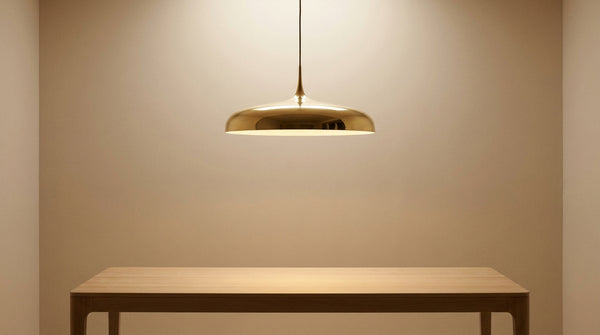
In a dining room, the effort goes on the table: allow around 200 lux over the surface, which calls for a lowered pendant and a concentrated output. The useful lumens in a dining room gives benchmarks by table format.
A project to rethink a living room's lighting often combines three sources, ceiling, wall and floor, to build the atmosphere in layers rather than from a single point.
When several rooms are involved, the room-by-room calculation method avoids treating each space in isolation.
How do you convert W to kWh?
Multiply the power by the duration, then divide by 1,000. A 100 W fixture switched on for 5 hours consumes 500 Wh, so 0.5 kWh. For a room, add up all the light points: that total is what appears on the bill, not the ratio per square metre.
- Note the power of each point, in watts
- Estimate the daily switch-on time, in hours
- Multiply the two, then divide by 1,000 to get kWh
Switching to all-LED changes the scale: a source that gives eight times more light per watt needs eight times less power for the same result. Switching to all-LED explains where the gain is real.
How an LED turns watts into light sheds light on the mechanism: part of the energy goes into heat, the rest into photons, and that ratio decides everything.
Is 1000 watts a lot?
It all depends on the duration and the number of points. 1,000 W for one hour makes 1 kWh. A 10 W LED bulb would stay on for 100 hours to consume as much. In domestic lighting, 1,000 W combined corresponds to around a hundred LED points switched on at the same time.
How many kWh is 800 W?
800 W for one hour makes 0.8 kWh, and 1.6 kWh over two hours. The most common mistake comes from forgetting to divide by 1,000 after multiplying.
If your room has a constraint that calculation cannot solve (a ceiling height, a beam, a wall that reflects light poorly), feel free to ask us your question: we will point you to the fixture that truly fits.
Which light fixture to choose once you know the lumens?
Once the figures are set, the choice comes down to shape and diffusion. A large volume calls for a broad central point, a low room prefers several discreet sources.
In a living room, a chandelier structures the space and carries most of the output.
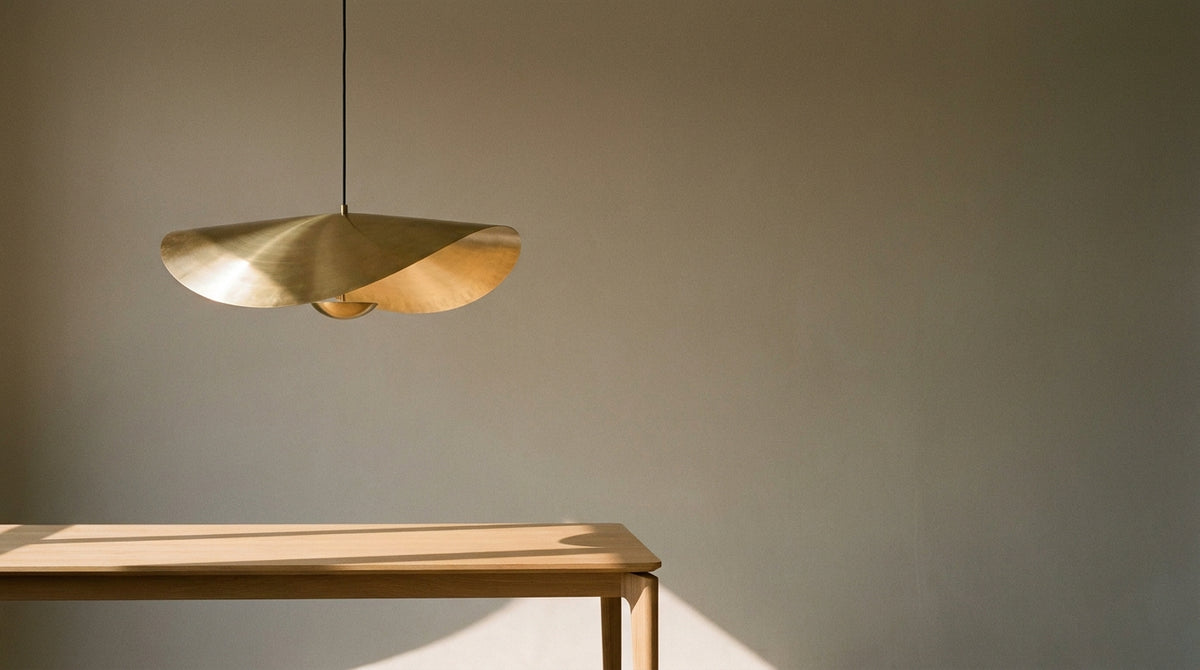
Above a table, a dining room chandelier is chosen mainly for its diameter and hanging height.
Which light for which room?
Each room has its use, and therefore its level. A hallway is fine with 100 lux, a kitchen needs more over the work surfaces, a bedroom less in the evening.
- Living room: a broad central point, complemented by two accent sources
- Bedroom: a moderate, variable output, directed downwards
- Kitchen: direct lighting over the work surfaces
- Hallway: regular points, with no shadow areas
In a living room, a pendant light above the sofa or the table provides the main output without dazzling.
For reading, a floor lamp places the light at shoulder height, where it is truly useful.
Which room do you want to light first?
In stock · shipping costs shown at checkout · up to 30% off in your cart


Ready to turn inspiration into reality?
Tell us about your room, your style and your budget, and we will show you the pieces that truly suit your project.
Get guidance in 30 seconds →