Rectangular ceiling light: the right light, room by room
This article is also available in French: Plafonnier rectangulaire
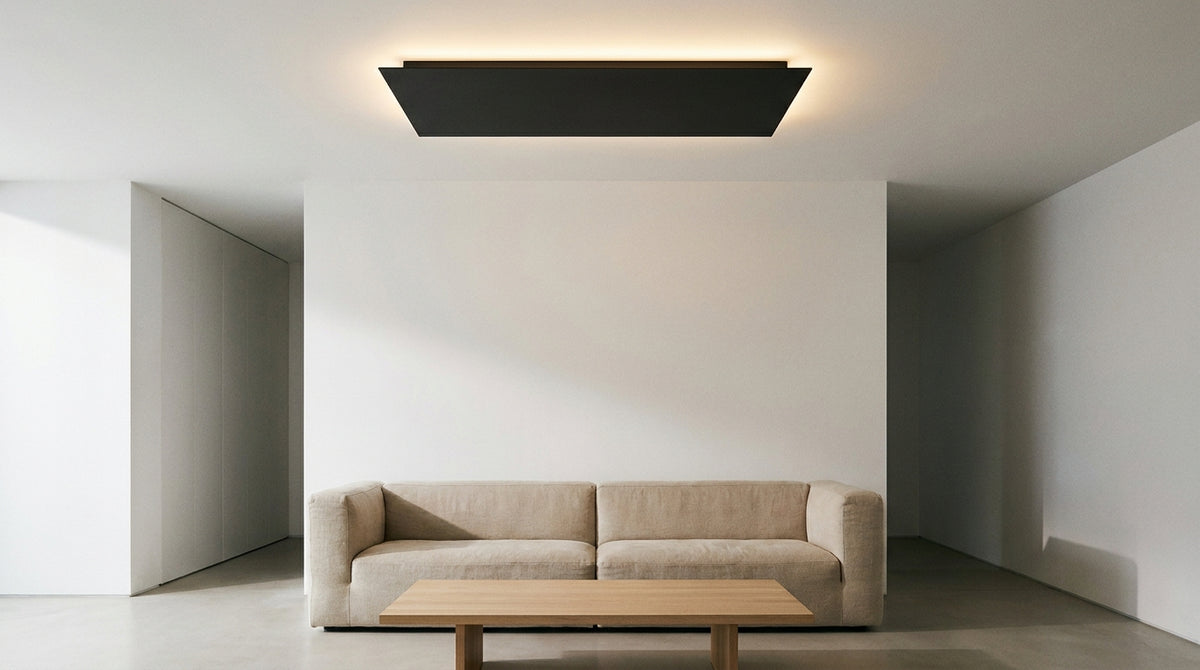
Measure the longest free length on the ceiling, then align the rectangle with the line of sight from the door: a rectangular ceiling light is chosen on these two references, not at random on the shelf. Next comes the socket, GU10, LED or E27, which decides the light and the bulbs to plan for.
What size of rectangular ceiling light should you choose?
Allow roughly one third of the longest free length on the ceiling, with at least 60 cm between the edge of the light and the wall. A rectangle of 80 to 100 cm suits a standard living room. In a very wide room, two modules are better than one stretched block.
In our survey of 222 references in the Grand plafonnier collection, taken on 5 October 2026, 97% are surface-mounted. The height lost at the ceiling is therefore almost never the issue. The length is.
How do you measure the room before choosing?
Measure the free length between the walls, not the length of the room: a beam, a tall cupboard or a door often takes up several tens of centimetres.
- One third of the free length gives the length of the rectangle.
- 60 cm minimum between the edge and the wall, to avoid a cramped light.
- The line of sight, from the door, decides the direction of the rectangle.
- More than 3 m: two 80 cm modules rather than a single 160 cm one.
Once the dimension is set, all that remains is to know how much light to send. Our method for calculating the amount of lighting needed in a room starts from the same surface measurement.
Extra-flat rectangular ceiling light: the solution when the ceiling is low?
Below 2.40 m, every centimetre lost shows. An extra-flat rectangular LED ceiling light is only a few centimetres thick and lets the room breathe. It is surface-mounted, like almost all of our selection.
One long rectangle or two modules in a hallway?
In a hallway, the light works lengthwise: a single rectangle aligned with the passage lights without casting shadows. Beyond 4 m, two evenly spaced modules give a more regular rhythm. The long ceiling light covers this case in detail.
The large-format rectangular ceiling lights in our Grand plafonnier collection, 378 references recorded on 5 October 2026, cover rooms where a single module seems too short.
A living room used for reading, entertaining and watching a screen needs several layers of light. The dedicated page on lighting your living room describes this breakdown room by room.
Which ceiling light gives the best light: integrated LED, GU10 or E27?
No socket wins everywhere. GU10 gives strong light, can be aimed and is replaced bulb by bulb. E27 accepts the most common bulbs and dims effortlessly. Integrated LED gives the most even light, but cannot be repaired.
| Criterion | GU10 | Integrated LED | E27 |
|---|---|---|---|
| Replacement | Bulb by bulb | No | Bulb by bulb |
| Aiming | Adjustable spots | Fixed | Depends on the bulb |
| Bulk | Low | Very low | Slightly thicker |
| Dimmable | With compatible bulbs | Depends on the model | Easy |
What our survey of 222 references shows
Of the 222 references recorded on 5 October 2026, 36% declare a GU10 socket, 33% an LED, 12% an E27 and 9% a G9. GU10 dominates because it forgives everything: a burnt-out spot is replaced without taking down the light.
Our selection of LED ceiling lights groups together the models with an integrated source, for those who prefer to forget about bulbs.
What the room demands: cooking, reading, moving around
- Cooking: diffuse, even light with no shadow on the worktop.
- Reading: an adjustable source or a diffuser that does not dazzle from the sofa.
- Moving around: regular light, even if it means dropping to 2700 K in the evening.
- Working: from 3000 K to 4000 K depending on the time and the orientation of the desk.
Bathroom: the IP44 rating and the distance from water
In a bathroom, look for IP44 and keep the light away from water. The choice narrows quickly: in the same survey of 222 references on 5 October 2026, 98% declare IP20 and only 2% IP44.
A water-resistant model is therefore chosen from the start, along with the matching IP44 bulbs.
Which room should your rectangular ceiling light illuminate?
Is your room hard to pin down? Take the time to describe your room to us: two lines are enough, and we will reply with the right shape and socket.
Which rectangular ceiling light for the kitchen?
Place the rectangle along the axis of the worktop, about 60 cm from the edge of the wall units: it lights both sides at once. In a kitchen, you want even light and an easy-to-wipe surface, so a surface-mounted model rather than a pendant light.
What light above the worktop?
- Even light avoids the shadow of your hand on the chopping board.
- A rectangle along the axis covers two worktops from a single point.
- A smooth surface wipes clean in one go, and cooking steam settles on it.
- IP20 is enough in a kitchen, except directly above the sink or the hob.
Above an island or a table: ceiling light or pendant?
A rectangle on the ceiling lights widely, but it lets your silhouette cast a shadow when you turn your back on the worktop. Over an island, a pendant lowered to eye level does the job better. Above a table, allow 75 to 85 cm between the shade and the tabletop. The kitchen light category groups both families.
Rectangular ceiling lights: the selection


Which ceiling light for a small living room?
A small living room can take the rectangle as long as you keep it short, around 60 to 80 cm, and centre it on the conversation area rather than on the room. If the sofa shifts the axis, the light follows the sofa. Colour matters as much as size.
The rectangle that does not overwhelm the room
A large rectangle on a small ceiling makes the room feel like it is coming down. A short format, or two small modules, keeps the eye at eye level. This year's trends point that way: our article on the 2026 ceiling light trend shows more compact formats and finer lines.
In an older flat, the constraints change again, between mouldings, ceiling height and overmantels. The minimalist ceiling light answers this with discreet shapes that leave the mouldings visible.
To cover a living room without darkening it, power matters more than size: our living room ceiling light comes in several formats depending on the room.
The selection is also reviewed by buyers, whose opinions can be found on the Designix Google listing.
Black, white or gold: the colour that changes the result
Of the 222 listings recorded on 5 October 2026, 61% declare black, 56% white and 22% gold. A single listing can declare several, so these shares do not add up.
- White: blends into the ceiling and visually recedes.
- Black: draws a clear line and structures a light interior.
- Gold: warms things up, and a brass ceiling light ages better than a painted finish.
How do you fit and adjust a rectangular ceiling light?
Most models screw onto a DCL box already in place. In our survey of 222 references on 5 October 2026, 97% are surface-mounted, 2% suspended and 1% recessed. A large format needs two solid anchor points.
Surface mounting: what to check before drilling
- The DCL box must fall in the centre of the future light, not beside it.
- The fixing spacing must match the holes in the light.
- The weight: above a few kilos, use plugs suited to the surface.
- Power switched off at the breaker before any work.
DCL, hook or drill-free fixing?
The DCL box suits surface-mounted ceiling lights, the most common solution. A hook takes heavy or suspended models. A drill-free fixing is a stopgap for a small, light rectangle, never for a large format.
The guide to wiring a ceiling light sets out the order of operations, from identifying the wires to tightening the connectors.
If the work goes beyond the light itself, you can also entrust the project to the workshop.
In stock · shipping costs shown at checkout · up to 30% off in your cart


Ready to turn inspiration into reality?
Tell us about your room, your style and your budget, and we will show you the pieces that truly suit your project.
Get guidance in 30 seconds →