Italian design pendant lights: choosing well without getting it wrong
This article is also available in French: Luminaire Suspension design italien
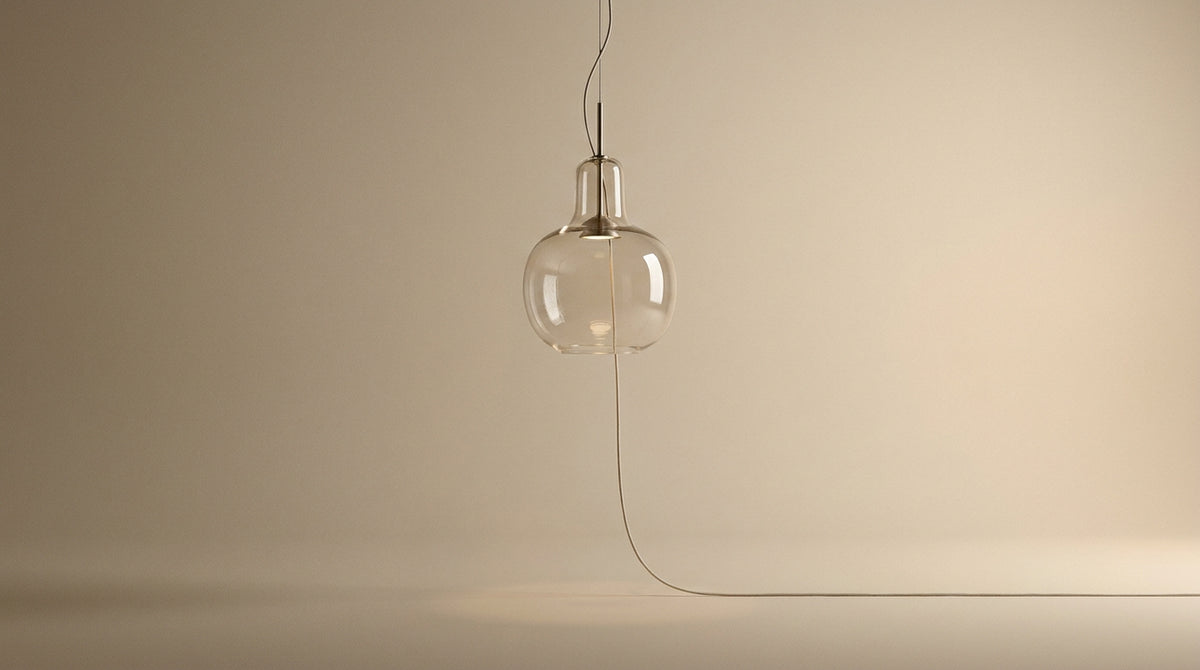
Start by measuring the tabletop: a pendant 40 to 50 cm in diameter suits a round table of 110 to 130 cm. Then set the drop between 60 and 80 cm above the table surface, and choose a colour temperature of 2700 to 3000 K. Material and finish come only after that.
Italian design pendant light: what does it really change in a room?
A pendant changes how a room reads: a low volume above the table creates an anchor point, and the light falls on faces and materials rather than on the floor. Across a survey of 250 references in our catalogue on 3 November 2026, 42 % declare a suspended mounting. It is the fixture that structures a living space the most.
Italian design is not about a label but about three details: the thickness of the glass, the fineness of the metal, and the way the source disappears into the volume. To get a sense of the main currents before deciding, browse our selection of design lighting: it gives the basic bearings in a few minutes.
Light fixture definition: what the word really covers
A light fixture means the complete unit: source, socket, diffuser, structure, fixings. A pendant is a fixture carried by a cable or rod from the ceiling. A lampshade is only an add-on part on one or the other. Confusing the three leads to buying a format that does not sit right.
What Italian material changes in the light
On the same survey of 250 listings on 3 November 2026, 82 % declare metal and 38 % glass. This combination explains the luminous signature: glass diffuses, metal draws the silhouette. The shop counter shows 53,960 references on the same date, all categories combined, which leaves room to compare the two materials side by side.
What size should a pendant be?
Aim for a diameter close to one third of the table width, never more than half. Under 40 cm, the pendant looks lost above a 130 cm tabletop. Beyond 60 cm, it takes over the view and gets in the way of serving. In between, the tabletop stays usable and the room breathes.
Pendant above a round table: the right diameter
A round table is more forgiving than a rectangular one: a diameter equal to one third of the tabletop is enough, provided you respect the drop. These benchmarks come from the shop listings, not from a theoretical calculation.
| Round table | Pendant diameter | Drop above the tabletop |
|---|---|---|
| 90 to 100 cm | 35 to 45 cm | 70 to 75 cm |
| 110 to 130 cm | 40 to 55 cm | 65 to 75 cm |
| 140 to 160 cm | 55 to 70 cm | 60 to 70 cm |
At what height should the drop be set?
Set it between 60 and 80 cm above the tabletop. A pendant is looked at sitting down, not standing up: that position gives the right measurement. The most common fault remains a pendant too wide for a small tabletop, whatever the style, and our guide to the pendant light revisits the shapes that are the most forgiving.
- 60 to 65 cm above an island or counter, so you can see your plate without lowering your head
- 70 to 75 cm above a dining table, the value that suits most dining rooms
- 80 cm and more in a large volume, only if the diameter exceeds 55 cm
- Wheel or slider to adjust, set before final fixing
Colour temperature is chosen in the same move: 2700 K for a warm light that flatters wood and amber glass, 3000 K for a sharper rendering on a work table. Our article on warm or cold light helps decide when the room is undecided.
If two diameters are still in doubt, the Designix team decides with you in the Vaulx-en-Velin shop: simply talk to a Designix adviser to settle the measurement on a plan or a photo.
Italian design glass pendant: what the material changes in the light
Blown glass does not project the same light as an opaque diffuser: it lets it through, tints it slightly and sends it back onto the walls. Amber glass warms, smoked glass softens without yellowing. That is why a glass pendant is chosen as much with the source off as on. Our selection of glass pendants is precisely meant to be viewed in both states.
Which light for a living room and a dining room?
A pendant above the table, a wider point for the living room: two sources are enough in a living space if the diameters are ranked. The living room accepts a low volume and subdued light, the dining room needs a tighter beam 75 cm above the tabletop.
For the table, a 45 cm model set at 75 cm holds up to six place settings. Our selection of dining room lighting covers the usual formats, from discreet to the most generous.
Long tables and through rooms need a different calculation, detailed in our guide to the dining room pendant.
Italian design pendants to see switched on
 Pendant light | Interlacia
 Pendant light | Nivara
 Pendant light | Ysandre
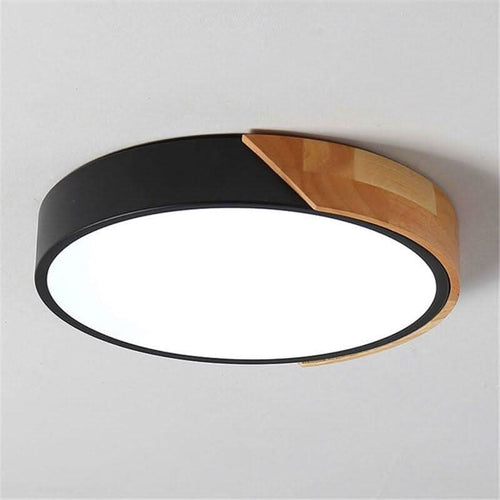
 Ceiling light | Bruna
 Living room floor lamp | Hyra
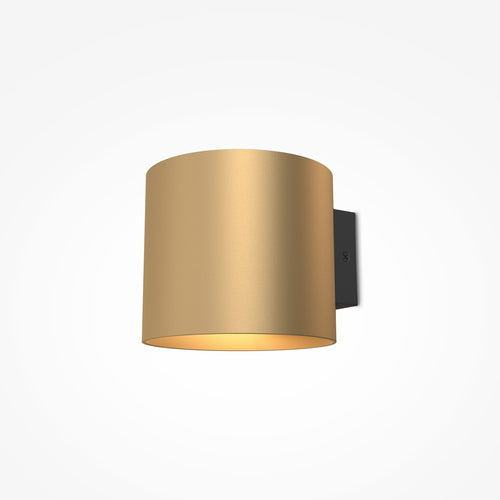
 Wall light | Sveva
See the whole selection: Alternative to Luminaire.fr: design lighting shop | Designix
If the whole room needs rethinking, our page on the living room lighting project sets the priorities in order: picture, table, reading.
Design pendant light for the living room
In a living room, a pendant is not placed in the centre by default: it goes above the area where people sit, or set back if the sofa is off-centre. A diameter of 45 to 60 cm suits a 25 to 35 m² living room without overwhelming it. Our guide to the living room design pendant details the off-centre sofa cases.
When the ceiling stays bare and only general light is missing, a low, wide living room ceiling light completes the pendant without doubling the anchor point.
Italian design pendant for the bedroom
In a bedroom, you want low light, never in the line of sight when lying down. A pendant of 30 to 40 cm above the bedside tables, or a pair of small ones, is a good replacement for a central ceiling light. For extra light, our collection of Italian design bedside lamps completes the setup.
Kitchen: pendants by zone
Above an island, allow one pendant every 60 to 80 cm, aligned on the axis of the worktop, 75 cm above it. Two small models are better than one large one: the light is spread and nothing blocks the view towards the room. Our kitchen chandelier selection lends itself to these alignments.
How to install and adjust it?
Switch off the power at the breaker, identify the three conductors of the DCL box, then hang by the central screw. Most models are height-adjusted by a wheel or cable slider: adjust before screwing on the cover, never after. Our article on the height-adjustable pendant gives the ranges depending on the mechanism.
- IP20: 94 % of the survey of 250 listings on 3 November 2026, so dry rooms only
- IP44: 2 % of the survey, which allows use near a water point
- 2-year warranty: 85 % of the survey, 5 years for 12 %
- Dimmer declared: 24 % of the survey, to be checked listing by listing
How to install a pendant on a DCL box?
A DCL box is the standard ceiling connection point: three terminals (live, neutral, earth) and a central fixing screw. The connection is made without a visible connector block, and the pendant screws directly onto the cover. Without a box, you need a hook and a suitable cable. The full procedure is described in our tutorial to install a suspended light.
Which light to put on a beam?
On a beam, forget the DCL box: use a hook screwed into the wood or a fixing collar. Allow a cable 30 cm longer to keep a correct drop under the beam, and check the load the wood can take. The result is often higher up than on a smooth ceiling, which suits older volumes well.
Before drilling, unsure about the size? The Vaulx-en-Velin shop displays the models switched on, and the shop's Google review listing can be checked in one click.
In stock · shipping costs shown at checkout · up to 30% off in your cart
Ready to turn inspiration into reality?
Tell us about your room, your style and your budget, and we will show you the pieces that truly suit your project.
Get guidance in 30 seconds →