
Linear lighting: how to choose the right one for each room
This article is also available in French: Luminaire en longueur
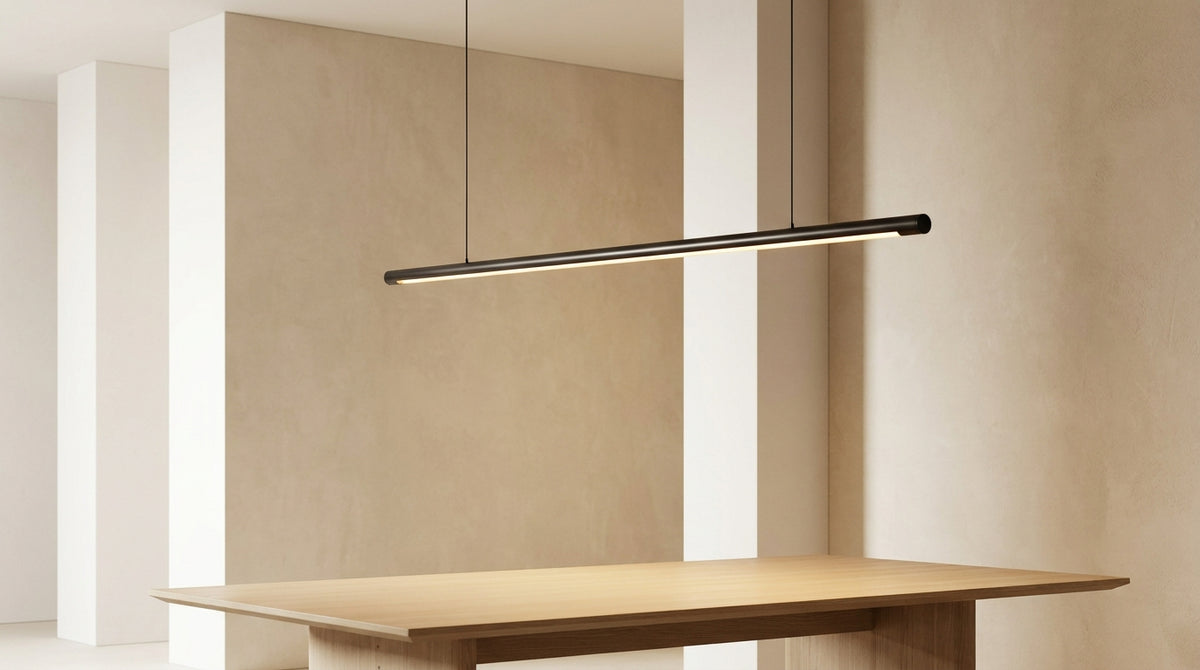
A table that extends, an island that is quite long, a narrow hallway: a central light point always leaves the ends in the shadows. A linear light fixture corrects this imbalance by spreading the light across the entire width of the surface, rather than concentrating it in the middle.
It remains to be seen what length to order, at what height to hang it, and what style to choose for each room. This is precisely what product pages do not tell you, and this guide provides the answers in numbers.
What is a linear light fixture?
A linear light fixture is a light whose body stretches horizontally—as a bar, tube, or strip—to cover an elongated surface rather than a single point. You will find them as linear pendants, long ceiling lights, or wall sconces, often with integrated LEDs or several aligned sources.
This format dominates as soon as a space is longer than it is wide. In our catalog, the linear pendant family brings together these bar-style models designed for a table or island. The Tube shape is common: based on a survey of 250 pendants in our catalog as of September 20, 2026, it represents 29% of the items, and the pendant mount accounts for 38%.
LED technology powers 78% of this same survey, which explains the slim profile of these fixtures: an LED source takes up only a few centimeters in thickness, where a traditional bulb would require a bulky lampshade. Almost all these pieces are IP20 rated (94% of the survey), meaning they are intended for dry indoor areas.
What length should you choose for a pendant light over a table?
Aim for a length of about two-thirds the width of your table or island. For a 200 cm table, a bar of 120 to 140 cm illuminates the entire surface without overhanging. Keep at least 15 cm free at each end to maintain balanced proportions and even light.
This two-thirds rule applies to a single, elongated source. If you prefer several small round pendant lights, count on having one light point every 40 to 50 cm, aligned along the axis of the table. To refine the relationship between the room and the fixture, this guide on finding the right dimensions remains valid beyond just chandeliers.
Once the length and height are set, do you have doubts about your configuration? You can check with a Designix advisor before making your final decision.
Which linear light fixture for a living room or dining room?
In the dining room, a linear pendant is placed above the table and becomes the room’s focal point of light. In the living room, it is reserved for a specific area: a dining corner, a console, or the end of a long sofa. Contemporary or modern styles are the most versatile, both of which dominate our survey.
For a dining table, look toward a dining room light fixture designed to be seen from quite close up, with a neat finish along the entire bar. The guide on how to choose the perfect dining room light details the most common proportion mistakes.
Where will your linear light fixture go?
In the living room, a linear bar often coexists with accent lamps and wall sconces. The key is stylistic unity: it is better to match lighting styles around the same family of materials, with metal and glass topping our survey. For a living space, a designer pendant for the living room sets the tone without overcrowding.
Our linear pendants to style at home
 Natural Light Pendant | Erel
 Dallas Gold Pendant Light
 Puntes Gold Pendant Light
 Erich Silver Pendant Light
 Chic and Modern Chandelier | Lueur Fluxion
 Erich Gold Pendant Light
See the full selection: Lighting, Home Lighting, Online Lighting Store
The kitchen is the other major arena for the linear format. Above a countertop, a continuous light strip eliminates shadows; our guide on lighting a kitchen island covers appropriate heights. On a wide island, the question becomes how to align several pendants over an island at regular intervals.
At what height should a linear light fixture be set?
Set the bottom of the light fixture about 75 cm above the tabletop. This distance illuminates guests without glare or blocking the view from one end to the other. Above an island, go up to 80 or 85 cm; in a hallway, keep at least 2 m below the lowest point.
These values assume a standard ceiling height of about 2.50 m. Under a higher ceiling, raise the pendant slightly so as not to isolate the table from the rest of the volume. Most models can be adjusted using a cable or rod during installation.
Also, think about the light source itself. The most common base in our survey is the E27 (29%), but many bars feature direct LED integration: verify this before buying, as it determines how you will replace it later. This reminder on the right bulb base helps avoid unpleasant surprises.
One final adjustment—ambiance: above a table, a warmer light flatters meals, whereas a workspace benefits from a more neutral hue. Choosing the right light temperature changes the effect as much as the fixture length.
Regarding these choices, the Designix selection is commented on by buyers: their feedback can be viewed on our Google business profile before you decide.
In stock · shipping costs shown at checkout · up to 30% off in your cart


Ready to turn inspiration into reality?
Tell us about your room, your style and your budget, and we will show you the pieces that truly suit your project.
Get guidance in 30 seconds →


