LED downlights: choosing the right one, room by room
This article is also available in French: Downlight LED
Allow around 100 lumens per square metre of floor area, then check three things before buying: the clearance available above the ceiling, the colour temperature (2700 K or 3000 K indoors) and compatibility with the dimmer already installed. Diameter, finish and beam angle come next.
What is an LED downlight, and what does it change in a room?
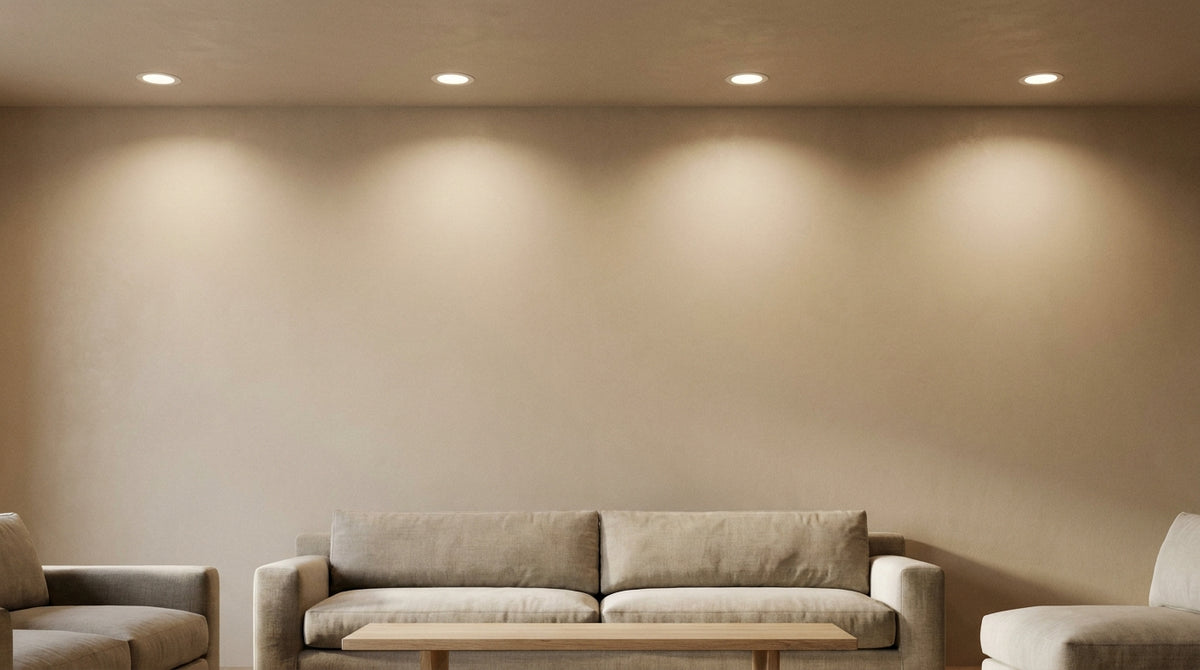
An LED downlight is a ceiling-recessed fixture whose light source shines downwards. It replaces the single central point with several discreet points: the fixture fades away, the light remains, and the room gains both depth and clarity.
What does the word downlight mean?
English describes the action: projecting light downwards. In everyday use it refers to a recessed ceiling fixture, as opposed to a surface-mounted one. The term is more evocative than a literal translation, which says little about how the fixture actually works.
Light is never chosen in isolation from a scheme. A downlight is selected alongside the materials, colours and furniture around it, the way you build a living room lighting plan: first the effect you want, then the hardware.
Recessed, surface-mounted or adjustable: three ways to place the light
- Recessed: only the trim stays visible, the rest sits within the ceiling depth.
- Surface-mounted: the unit stays visible, which solves the case of ceilings with no void.
- Adjustable: the beam pivots to aim at a wall, a bookshelf or a worktop.
- Fully recessed: the optic fills the entire depth of the substrate, without protruding above it.
A well-prepared ceiling takes a regular alignment, and recessing spotlights in a living room is planned before the first cut, not after.
What is the difference between a spotlight and a downlight?
A spotlight aims, a downlight washes. A spotlight produces a narrow beam, often adjustable, to pick out an object or a detail. A downlight projects a wider, more even cone, designed to cover a whole surface without creating a bright patch.
Does a spotlight still have a place in a home?
Yes, for highlighting a precise point: a piece of art, an alcove, a plant. The downlight takes over as soon as a whole living area needs lighting. The two are often combined in the same room.
Downlight or spotlight: which to choose when renovating?
The downlight, if you are redoing the ceiling or if the existing cut-outs are large. The adjustable spotlight, if you want to correct badly placed lighting without opening up the substrate again. The cut-out you already have often decides for you.
Many older installations move from halogen to an LED source of the same diameter: replacing a halogen spotlight with an LED then takes less work than you might think.
Which LED downlight for which room?
Every room imposes two constraints: the amount of useful light and protection against moisture. A living room is fine with IP20 and warm light, a bathroom requires at least IP44, a kitchen needs a wide beam above the worktops.
| Room | Temperature | Ingress protection | Beam |
|---|---|---|---|
| Living room | 2700 K to 3000 K | IP20 | Wide and diffuse |
| Kitchen | 3000 K to 4000 K | IP20, IP44 near the sink | Wide above the worktop |
| Bathroom | 3000 K to 4000 K | IP44 minimum, IP65 near the shower | Narrow above the mirror |
| Entrance and hallway | 3000 K | IP20 | Grazing along the wall |
| Bedroom | 2700 K | IP20 | Indirect or very diffuse |
Once the room is identified, three filters remain: temperature, protection and beam. The recessed LED downlights can be browsed by exactly these criteria.
IP65 LED downlight: which rooms require it?
Above a shower or a bath, splashing water calls for a high rating. An IP65 resists jets and is installed in the most exposed zones. Elsewhere in the room, an IP44 is often enough, and spotlights in a bathroom are counted differently from a living room, balancing modelling light and mirror light.
4000K LED downlight: when neutral white makes sense
4000 K leans towards neutral white, almost cool. It earns its place in a kitchen, garage or office, where fine detail is read. In a living room or bedroom, 2700 K or 3000 K rests the eye. The rest comes down to white or yellow light, a choice that changes how a room feels.
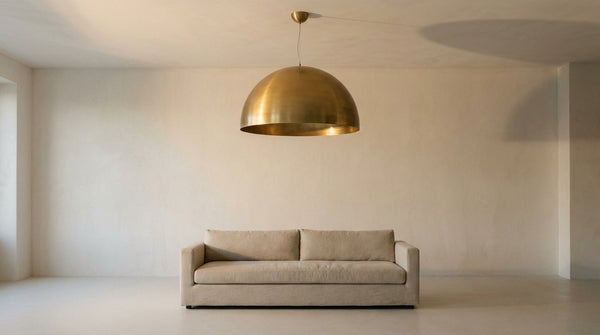
In a kitchen, a 4000 K downlight above the worktop pairs well with a pendant light hung higher up, each playing its part.
Circulation areas deserve separate treatment. A narrow hallway copes badly with centred points: a grazing light that guides the step works better, as set out in an entrance, hallway and staircase lighting plan.
How powerful is an LED downlight?
Wattage tells you almost nothing. Two 8 W downlights can produce 600 or 900 lumens depending on their efficiency. Think in lumens per square metre: it is the only measure that truly predicts how a room will look.
Which LED downlight do you need?
Are 1,000 lumens enough?
Over 10 m², 1,000 lumens give 100 lux, a correct general lighting level for a living room or hallway. Over 25 m², the same amount drops to 40 lux and the room looks dull. It all depends on the area: this is arithmetic, not opinion.
How many ceiling downlights by floor area?
One downlight comfortably lights 2 to 3 m² in a standard ceiling. Allow four points for 10 m², six to eight for a 20 m² living room. The calculation of how many spotlights per m² is then refined by ceiling height and wall colour.
Still torn between two colour temperatures or two cut-out diameters? Describe your room to the Designix team and leave with the right reference.
Which mounting for which ceiling?
It all depends on the clearance available above the surface. A plasterboard ceiling takes a recessed fixture without difficulty; a concrete slab or an old ceiling with no void requires surface mounting, unless you build a box.
How do you measure the clearance above the ceiling?
Measure the free height between the surface and the structure. The optic unit and its driver often need more depth than the source itself. The cut-out diameter of a spotlight is read from the product data sheet, never with a tape measure.
Layout matters as much as the model. Regular spacing avoids dark zones and overlaps; the distance between ceiling spotlights is calculated from the mounting height and the beam angle.
Where no clearance exists, a surface-mounted LED ceiling light replaces the downlight without deep drilling.
If you would rather keep the recessed look, the recessed downlight collection can be sorted by depth, a criterion that rules out half the false good ideas straight away.
How do you choose a dimmable LED downlight without getting it wrong?
Three elements must speak the same language: the downlight, its driver and the dimmer. A non-dimmable model wired to a dimmer flickers or switches off in steps. It is the leading cause of returns, and it is settled before purchase.
Check the dimmer's minimum load, its technology, and the compatibility stated by the manufacturer. A poorly matched dimmable spotlight behaves worse than a basic model.
In stock · shipping costs shown at checkout · up to 30% off in your cart


Ready to turn inspiration into reality?
Tell us about your room, your style and your budget, and we will show you the pieces that truly suit your project.
Get guidance in 30 seconds →