Lampshade size: the right proportion with the lamp base
This article is also available in French: Taille abat jour par rapport au pied de lampe
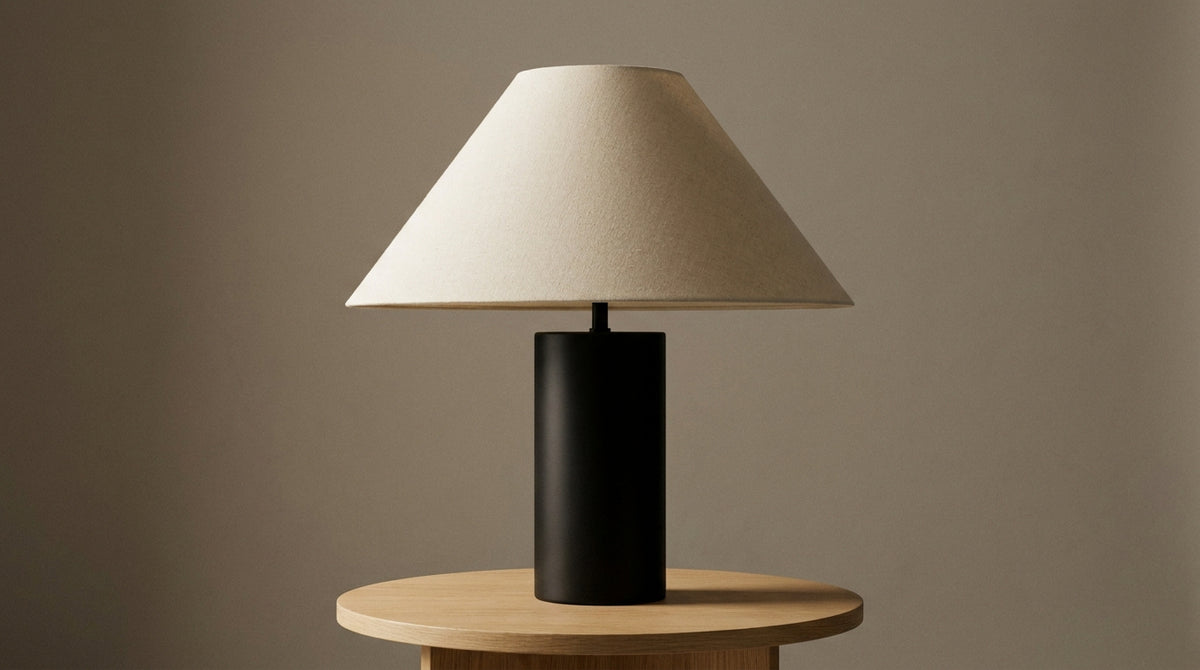
Take three measurements on your lampshade: the bottom diameter, the top diameter and the height. The bottom should extend about 5 cm beyond the socket on each side, and the height should stay close to one third of the base height. These three measurements are enough to decide.
How do you calculate the dimensions of a lampshade for a lamp?
Take the total height, from the bottom of the base to the top of the socket: the lampshade takes up about one third of it. For the bottom diameter, count twice the width of the base at its widest point. The top diameter, for its part, matches the socket, not the base.
Lampshade size in relation to the lamp base
Our collection of lampshades for table lamps has 789 references as of 30 September 2026: you are not facing a binary choice. The bottom diameter is read on the base, never on the stem, and a base that flares out calls for a wider lampshade than a straight base of the same height.
| Base shape | Bottom diameter | Lampshade height |
|---|---|---|
| Round or ball | 1.5 to 2 times the base diameter | about one third of the total height |
| Stem, column, slender base | 2.5 to 3 times the base diameter | one third to one half |
| Floor lamp | 1.5 to 2 times the base | one quarter to one third |
Beyond 45 cm, you no longer simply place the lampshade, you install it: a lampshade 50 cm in diameter belongs to large spaces, hallway or living room.
Lampshade size in relation to the lamp
A lampshade narrower than the body of the lamp leaves the bulb in the field of view. The complete silhouette must fit into a regular cone, wide at the bottom and clean at the top.
- Bottom diameter: at least one third more than the widest point of the base
- Top diameter: at least the width of the socket
- Height: one third of the lamp, from the base to the top of the socket
- Overhang: the top of the lampshade covers the bulb without touching it
What the third does not say: the socket and the seated eye
The socket decides more than the rule. In a survey of 31 references from our lampshade collection as of 30 September 2026, the E27 base is declared on 97 % of the listed products. Your lampshade will therefore almost always take a wide screw bulb.
E27 base bulbs cover this need, including the filament version, whose warm tint forgives a thick fabric.
The second decision, the one no rule measures: the height of the bottom of the lampshade. Seated on the sofa, it must fall above the line of sight, otherwise the bulb dazzles. A bulb wattage for a living room that is too high is hard to compensate for behind a thin fabric.
If you prefer to validate your measurements before ordering, you can ask for advice on a proportion: give us your three measurements, and we will reply on the shape to choose.
Which lampshade for which lamp base?
The base dictates the shape before the colour. A wide, round base supports a wide, short lampshade, a slender stem calls for a taller and more open format. In a survey of 31 references from our collection as of 30 September 2026, the round shape stands out on 58 % of the survey, the tube on 16 %, the teardrop on 10 %.
Lampshades to proportion with your lamp base
 pleated white fabric pendant light, oval shade Ø 60 cm | Velina
 K1068RS grey linen lampshade
 Black arc wall reading light, Ø60 fabric shade | Noctis
 Black Scandinavian floor lamp, cork shade, living room reading light | Stang
 Light rattan designer chandelier | Calya
 Black Zig-Zag 4253ZW floor lamp with white linen shade – a unique design and functional use
See the whole selection: Lampshades: Pendant, Table Lamp and Floor Lamp
Lampshade and round or ball base
A ball accepts a lampshade wider than itself, provided the bottom stays open: the light runs towards the floor and lights the base instead of crushing it. This is the case with the frosted glass balls fitted to many bedside lamps.
The slightest discrepancy shows to the naked eye. An lampshade for a round base is chosen by keeping the ball entirely visible, never half swallowed by the fabric.
Lampshade and slender base, stem or column
A slender stem supports a tall, wide lampshade without looking heavy: the contrast between the thin line and the fabric creates the character. This is the case with large table lamps, where the lampshade often exceeds 35 cm in diameter and forms half of the silhouette.
On a wide body, surface is needed: a large lampshade avoids the mushroom effect.
Lampshade and floor lamp
On a floor lamp, the lampshade is seen from a distance: it is the only part of the light whose size is perceived from the sofa. A format that is too small makes a mushroom, a format that is too large crushes the room.
- Diameter: close to that of the base
- Bottom of the lampshade: above the line of sight, once seated
- Material: linen or fabric for ambient light, glass for a sharper sparkle
What system is used to fix a lampshade?
Three systems cover almost all lamps: the spider, the ring socket and the patere. You tell them apart by turning the lampshade over, where you see either metal arms, a threaded ring, or a single stem.
Socket, spider, patere: how to recognise yours
- Spider: two or three metal arms in the centre of the opening, on which the lampshade rests
- Ring socket: a threaded ring around the socket, onto which the lampshade is screwed
- Patere: a central stem under the socket, tightened with a wing nut
- Clip: two blades that clip onto the bulb, reserved for small formats
The top diameter of the lampshade must match the system in place: a spider that is too wide lets light through the top, a ring that is too tight will not screw on.
How to put a lampshade on a lamp base
With the lamp switched off and the bulb removed, the operation takes a few minutes and requires no tools.
- Cut the power before removing the old lampshade
- Remove the bulb so as not to force the socket
- Present the lampshade flat before tightening
- Tighten by hand, never with pliers, on a ceramic or metal socket
The details of assembly depend on the system, and the complete method to install a lampshade comes down to one check: the bottom must stay parallel to the floor.
Which lamp base are you going to dress?
What is the standard height of a floor lamp?
Most living room floor lamps peak between 150 and 180 cm from the floor, reading models between 140 and 160 cm. The figure that matters is that of the seat: once seated, the bottom of the lampshade must stay above the line of sight.
Lampshade size on a floor lamp
On a tall body, the lampshade takes up one quarter to one third of the total height, often 35 to 45 cm in diameter. An assembled model gives the scale better than a tape measure: our selection of floor lamps lets you compare several proportions at a single glance.
Tall base: raise the lampshade rather than shrink it
A tall body does not call for a smaller lampshade, but for a lampshade placed higher. Reducing the diameter darkens the room and brings the bulb back into the field of view.
- Extended stem: the most discreet correction
- Raised socket: when the stem is fixed
- Taller lampshade: preferable to a narrower lampshade
The measurements to aim for depending on the room are detailed in our guide to floor lamp height.
Once the proportion is right, the atmosphere remains: linen diffuses a warm light in the living room, glass lets through a sharper sparkle.
This second character can be seen in our choice of glass light fittings, useful when the lampshade mainly serves to reveal a material.
To judge a fabric in person, our Designix Google listing lets you find the address of the workshop in Vaulx-en-Velin.
In stock · shipping costs shown at checkout · up to 30% off in your cart


Ready to turn inspiration into reality?
Tell us about your room, your style and your budget, and we will show you the pieces that truly suit your project.
Get guidance in 30 seconds →