50 cm diameter lampshade: how to choose it and fit it
This article is also available in French: Abat jour 50 cm de diamètre
Measure the widest opening of your current lampshade, then compare that figure with the height of your lamp base. At 50 cm in diameter, everything comes down to proportion, not size. Next, check the bulb holder: in a survey of 27 lampshades from our catalogue on 26 September 2026, 96% were E27.
How do you choose a 50 cm diameter lampshade?
A 50 cm diameter lampshade is chosen first by its fitting, then by its shape, and only then by its colour. The diameter is just one measurement: what decides it is the relationship between that width and the height of the base that carries it.
Our 50 cm diameter lampshade comes as a pendant, table lamp and floor lamp, in a collection of 789 references on 26 September 2026. The accompanying decorating advice and inspiration sets out the pairings room by room.
50 cm lampshade for a floor lamp
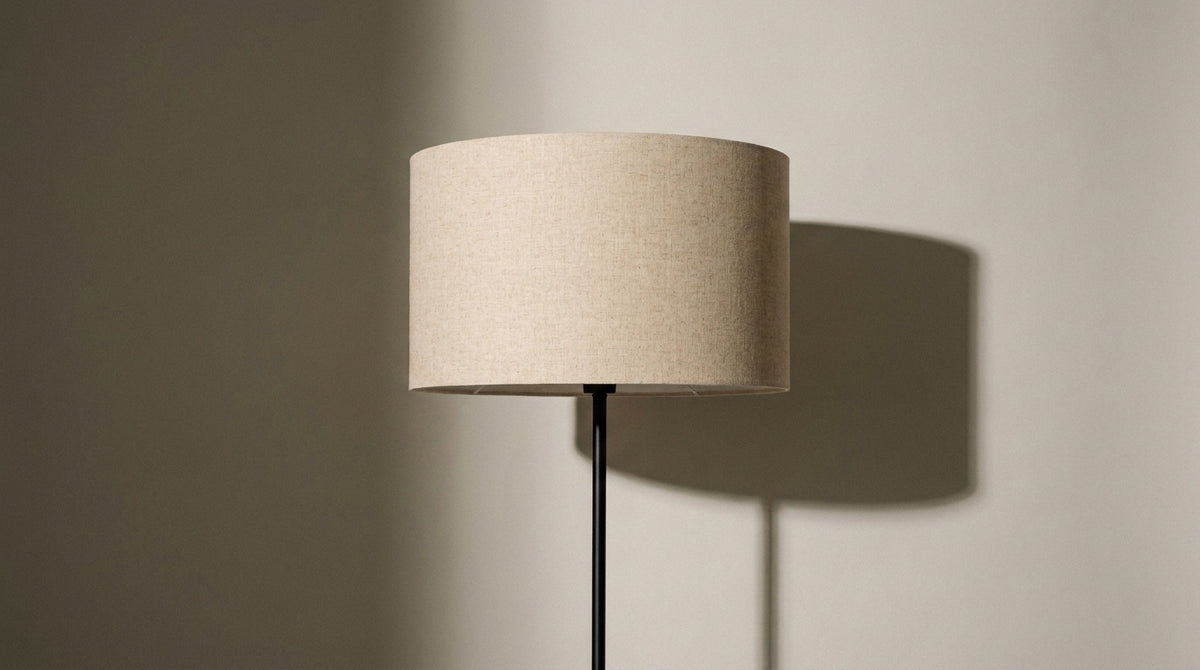
On a floor lamp, a 50 cm lampshade becomes the dominant volume of the light. It is the format that works in a deep room, with a tall, slim stem: the eye travels up and the floor stays clear.
A tall, narrow base copes badly with a 50 cm shade in thick fabric. Linen or openwork metal let the light through and lighten the silhouette. For larger diameters, our article on the large lampshade takes over.
50 cm lampshade for a table lamp
On a table lamp with a short base, 50 cm becomes bulky: the shade quickly reaches eye level when you are seated. The format suits tall bases, such as reading lamps, and rooms where the lamp stays out of the way.
How do you measure and check that a 50 cm lampshade will fit your base?
Take three measurements: the diameter of the lampshade's lower opening, the height of the bare base and the distance between the top of the base and the bottom of the bulb. A 50 cm lampshade will fit if the lower opening is at least equal to the diameter of the base and the bulb holder remains accessible.
Conical or cylindrical 50 cm lampshade: what is the difference?
A cone sends the light downwards and lets only a small part back up. A cylinder casts a wide halo on the walls. At 50 cm, the shape changes everything: the cone lightens, the cylinder asserts.
- Cone: light concentrated downwards, above an armchair or a table
- Cylinder: wide, diffuse halo, for a tall base and a deep room
- Oval: same width, less visual mass, practical against a wall
- Dome: closed silhouette at the bottom, soft and enveloping light
50 cm high lampshade: the proportion to respect
The height of the lampshade matters as much as its diameter. A 50 cm shade must cover the bulb holder and part of the bulb without reaching down to the base. Too short, it leaves the bulb holder visible; too long, it overwhelms the base.
The reference point for floor lamp height is taken from the floor, never from the base: it is the line of sight when seated that decides.
If you are still unsure about the proportion between your base and a 50 cm lampshade, get in touch with our team: a photo and two measurements are enough to decide.
How do you fit a lampshade to a lamp without forcing it?
A lampshade is fitted by the bulb holder, never by the bulb. Unscrew the ring, place the lampshade on its support, screw it back without tightening fully: the whole assembly must stay stable and still be able to turn by hand.
50 cm diameter lampshade and E27 cap
In a survey of 27 lampshades from our catalogue on 26 September 2026, 96% have an E27 cap, 96% are IP20, 96% are guaranteed for 2 years and 96% are CE certified. A 50 cm shade is therefore almost always fitted to the wide screw bulb holder, the one used by the most common types of bulb.
IP20 means dry indoor use. A 50 cm diameter lampshade should not be placed in a damp conservatory or outdoors. Weight matters too: a lined 50 cm shade pulls harder on the ring than a small format, so tighten by hand and check that no wire touches the bulb.
If you are looking for the complete light rather than the lampshade alone, our selection of designer lighting brings together bases, pendants and ceiling lights. For a room where the light should stay soft, see which light for the bedroom. The selection is reviewed by buyers, whose feedback remains public on our Google listing.
How do you choose the material: linen, metal or velvet?
Linen filters and warms the light, metal directs it, velvet absorbs it. At 50 cm in diameter, the surface is large: the material is as visible as it is illuminating. So you choose it for the atmosphere it creates, not only for its shade.
| Material | Light effect | Where it works |
|---|---|---|
| Linen | Softens, warm and matte | Living room, bedroom, light interiors |
| Metal | Directs, reflects, strong contrast | Kitchen, study, industrial style |
| Velvet | Absorbs, low and soft light |
Related reading
In stock · shipping costs shown at checkout · up to 30% off in your cart


Ready to turn inspiration into reality?
Tell us about your room, your style and your budget, and we will show you the pieces that truly suit your project.
Get guidance in 30 seconds →