Paper garlands: how to make them and light them well
This article is also available in French: Comment faire des guirlandes en papier
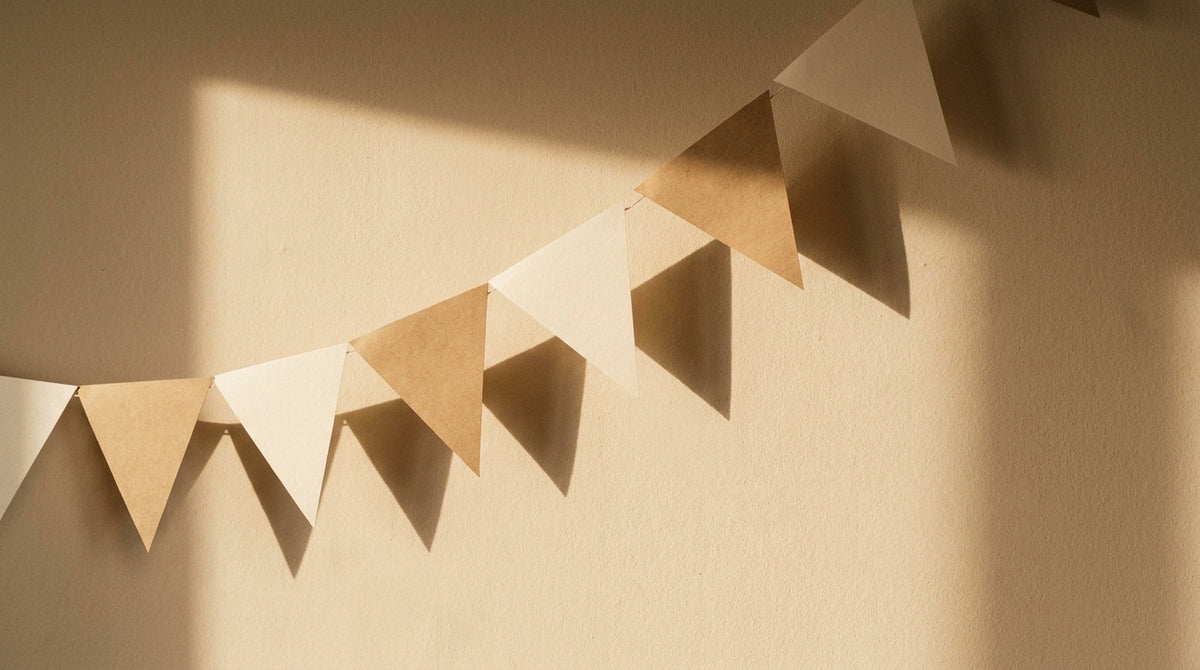
Cut the strips to a regular width, measure the wall length before gluing, then keep the light source away from the paper. A garland rarely fails because of the folding. It fails because it was cut too short and lit too close.
How do you make a paper garland?
Allow one strip per pennant and a thread about a third longer than the wall. Cut to a constant width, assemble by folding or gluing, then space the pennants along the thread before fixing. Preparation decides the result, not dexterity.
Folding can go wrong and be redone; cutting does not forgive guesswork. If you prefer a ready-made look, the LED string lights collection brings together models ready to hang, with a thin cable that disappears on a light wall.
Which paper for a garland that does not sag?
A thick paper, such as kraft or card stock, keeps its curve. A thin paper marks every fold and droops on itself within a few hours.
- Thick kraft: holds the pennant straight and ages without tearing
- Thin printed: perfect for patterns, best kept for flat garlands
- Crepe: supple and generous in volume, but it sags
- Light card: for pennants that must stay rigid
How do you measure the length before cutting?
Lay the thread along the wall, mark the end by hand, then remove it. Add about a third for slack and for the thickness of the folded pennants.
- Eye level: a simple reference for a purely decorative garland
- Skirting line: for a garland hung low, along the wall
- Corners: cut before each angle rather than bending
The same assembly is used to make a pendant light, where paper becomes a shade and the question of heat comes back to the fore.
Crepe paper, kraft or thin printed paper: which to choose?
Kraft for hold, crepe for volume, thin printed for colour. None is better: each solves a different problem. What shows most on a wall is precisely mixing them without a rule.
How do you keep a garland from creasing in storage?
Roll it loosely around a tube, pennants facing outward, and store it flat rather than hanging.
- Cardboard tube rather than a box: the curve stays regular
- Tissue paper slipped between two rows
- Label on the tube with the length, so you do not have to measure again when rehanging
How do you combine two papers without cluttering a wall?
One plain for the bulk, a single pattern for the accent, and rarely two patterns on the same length. The wall colour decides: on a dark background, light paper is enough to create contrast.
- Two shades maximum per garland
- One pattern, one plain: never two prints side by side
- Off-white as a link between two coloured papers
The rest depends on how you hang it, detailed in this guide to integrating a string light with elegance. On a shop wall or in a hallway, the spirit of a minimalist Christmas window display also works at home: little paper, well-placed light.
How do you light a paper garland?
A low-consumption source kept at a distance: that is what protects the paper. Heat dries it out, ultraviolet light yellows it, and a filament pressed against a thin sheet browns its surface. The light should illuminate the garland, never heat it.
Which colour temperature does not yellow the paper?
A neutral white, or a soft warm white. Too cool, the light turns whites blue and hardens creams. Too amber, it tints the paper so much that the original colour can no longer be distinguished.
- Neutral white: the most faithful on ivory and pastel paper
- Soft warm white: flattering on kraft and card
- Cool white: avoid near cream paper
The choice works as for any room, and this comparison of white or yellow light helps you decide before buying. Adjustable intensity also changes things, especially with a dimmable LED that you turn down in the evening.
Cool LEDs or warm bulb: what browns the paper?
It is the heat, not the tint. A filament bulb placed against a thin sheet browns its surface. An LED stays cool even when it shines warm, which makes it the only truly paper-compatible source.
| Source | Effect on paper |
|---|---|
| LED | Lights without heating, no discolouration over time |
| Filament or halogen | Heats, dries out and browns a sheet placed too close |
One borderline case comes up often: very thin paper, tissue or crepe, accidentally placed against a hot bulb. The sheet does not catch fire; it warps and browns in patches before anyone notices. Proximity is the only real danger.
At what distance should the light source be placed from the paper?
Far enough that after a few minutes your hand feels no heat on the sheet. The distance is adjusted by touch, not by the metre: move it away as long as the paper stays cold.
- Loose wire: the garland hangs, air circulates around the source
- Non-conductive support: wood or painted metal rather than wire stretched against the paper
- Ventilation: a closed volume traps heat, a floating garland does not
String lights and lighting to dress a wall, a table or a headboard


Our catalogue has 56 references in the LED string lights collection, recorded on 27 September 2026. Enough to find the length and tint before getting out the scissors. For the rest of the room, choosing a designer light follows the same criteria: temperature, intensity, distance. A successful garland also contributes to a warm atmosphere with light, never the other way round.
How do you hang a string light without drilling?
Three families of solutions are enough: adhesive on a smooth wall, a clip on an existing support, a tension rod between two points. The choice depends on the surface and the weight of the garland, not on the length.
Indoors: adhesive hooks, clips, rods
On paint or tiles, a well-degreased adhesive hook holds a light garland. On a fragile wall, better to clip the garland into a moulding or a tension rod, without gluing anything.
- Adhesive: smooth walls only, applied to a clean, dry surface
- Clip: moulding, skirting board, curtain rod, no trace when removed
- Tension rod: the most even for a long garland
The same logic applies to a fixed light point: this tutorial for installing a wall light without drilling details the fixings that leave no mark.
Outdoors: what withstands wind and rain
Wind decides more than rain. A garland stretched horizontally becomes a sail: it flaps, sags, then falls. On a pergola, fix it flush along the structure rather than across it.
- Protection rating: choose a model stated as suitable for outdoor use, without assuming the rating
- Short fixing: one point roughly every two pennants
- Reduced slack: less free wire, less wind catch
- Taking it down: bring the garland in before a heavy storm, paper does not recover
A party table or a hallway wall is handled differently: a table lamp brings light right down to the decor, while a illuminated wall Advent calendar fills the wall without drilling anything.
If you prefer to start from a base whose result is already under control, compare with the selection of LED string lights before cutting; for a whole-room project, the simplest is to contact the Designix team with a photo of your wall, on {{client.contactPhone}}: we will reply on the length to aim for and the right light temperature. Customer reviews are available on our Google listing, with no fixed figure inside this article.
Where will your garland live?
On the same subject
In stock · shipping costs shown at checkout · up to 30% off in your cart


Ready to turn inspiration into reality?
Tell us about your room, your style and your budget, and we will show you the pieces that truly suit your project.
Get guidance in 30 seconds →