How to fit a lampshade without getting the fixing wrong
This article is also available in French: Comment installer un abat jour

How to fit a lampshade without getting the fixing wrong
Check the fixing before you order: a screw ring, a slide-on frame or a three-arm spider. Note the diameter of the socket, on a survey of 31 lampshades from our catalogue as of 28 September 2026, 97% are E27, then remove the bulb: the lampshade goes on without forcing.
What is the system for fixing a lampshade?
Three mountings cover almost every lamp: the ring that screws onto the thread of the socket, the frame that slides around it, and the three-arm spider that rests on the bulb holder. It is not the lampshade that decides, but the lamp. Check its mounting before buying.
How do you fix a lampshade on a socket?
Unplug, remove the bulb, place the lampshade on the socket, then screw the ring back on by hand. A quarter turn is enough: tightening with pliers splits the metal or marks the linen.
The thread cannot be guessed, it has to be measured. On a survey of 31 product pages from our catalogue as of 28 September 2026, 97% state an E27 base, E14 being in the minority and often supplied with a reducer. To compare the two, our guide on bulb size and base lists the diameters.
How do you install a lampshade on a lamp?
On a table lamp, the central frame of the lampshade covers the socket from above. Unscrew the ring or the cap, slide it on, tighten again: the hold comes from the contact between the ring and the socket, never from adhesive.
A frame that is slightly too wide turns around the socket. A reducer ring, in rubber or metal, solves the problem in seconds.
Ring, frame or spider: how do you choose?
| System | How it holds | When to choose it |
|---|---|---|
| Screw ring | A threaded ring screws above the lampshade, onto the socket | Exposed socket, table lamp, lampshade with a central ring |
| Slide-on frame | The metal frame rests on the socket and tightens from below | Cylindrical or conical lampshade, hanging or wall mounting |
| Three-arm spider | Three arms rest on the bulb holder, a central ring locks it | Large wide lampshade, bulb visible under the skirt |
The material changes the light as much as the shape. On the 31 product pages surveyed as of 28 September 2026, linen accounts for 52% of references, metal 26%, fabric 23% and glass 13%. Linen filters and softens, glass lets the filament show through. The collection of lampshades with a ring, frame or spider can be browsed material by material.
Is a ring missing, is the thread marked, does the diameter not fit? The help and after-sales service identifies the part from a photo of the socket.
How do you install a ceiling lampshade?
Switch off the power at the circuit breaker, remove the old light fixture, refit the bracket onto the existing fixing point. The constraint does not come from the lampshade but from the ceiling: it carries the load, and it decides the screws.
How do you wire a ceiling lampshade?
Blue goes to neutral, brown or black to live, green-yellow to earth. The connection is made on the terminal block of the DCL box, never on bare wires left hanging.
Our guide to installing a chandelier on a DCL box details the order of operations, from removal to testing.
A properly connected light fixture does not flicker and does not heat up at the contact point. Before screwing back, fill the old holes: a plate that does not sit flat holds badly.
For the full version, from identifying the wires to the final fitting, the article on putting a lampshade on the ceiling covers every step.
What is the maximum weight of a chandelier I can fix to a plasterboard ceiling?
A plasterboard sheet alone does not carry a heavy light fixture. The load must go back to the slab or the joists, or be taken up by a toggle fixing suited to the thickness of the board. An adhesive hook does not fall into this category.
The weight can be guessed when unpacking: linen on a fine frame weighs almost nothing, thick glass much more. On the 31 product pages surveyed as of 28 September 2026, 58% of lampshades are round, and these wide volumes demand a firm anchor.
The pendant lights that go on a simple hook are those with a lightweight lampshade, fabric or linen. The rest are screwed into the bracket.
How do you hang a pendant light without drilling?
An adhesive hook holds a string of fairy lights, not a light fixture connected to the mains. Without drilling, you reuse an anchor point already in place: an existing ceiling hook, an exposed beam, an already plugged wall bracket.
The same logic applies to a wall light without drilling: you use what exists rather than creating something new.
A pendant light needs clear height under the lampshade. A ceiling light needs none.
LED ceiling lights suit hallways and low rooms, where a pendant would bump against shoulders.
Lampshades in linen, fabric, metal and glass, with a ring or a frame
 pleated white fabric pendant light, oval lampshade Ø 60 cm | Velina
 K1068RS grey linen lampshade
 Black arc wall reading light, fabric lampshade Ø60 | Noctis
 Black Scandinavian floor lamp, cork lampshade, living room reading light | Stang
 Light rattan designer chandelier | Calya
 Black Zig-Zag 4253ZW floor lamp with white linen lampshade, a unique design and functional use
See the whole selection: Lampshades: Pendant, Table Lamp and Floor Lamp
Is earthing a light fixture mandatory?
Earthing is mandatory on a class I light fixture, the one whose metal casing is conductive: the green-yellow wire then connects the body of the fixture to the earth of the installation. On a class II fixture, with double insulation, it does not exist and is not connected.
The case of a class II light fixture
Class II can be recognised by the symbol of two nested squares, on the label or the instructions. The protection comes from double insulation, not from a wire. On the 31 product pages surveyed as of 28 September 2026, 97% carry CE certification and 97% an IP20 protection rating: two details that inform, without replacing the identification of the wires.
Two wires or three wires: how do you know?
Two wires coming out of the ceiling indicate an installation without earth, which requires a class II light fixture. Three wires, one of them green-yellow, and a metal light fixture is connected to earth.
In doubt, a photo of the cable outlet settles it. You can ask the team by describing the socket and the wires: compatibility is checked before the order, not after delivery.
The shop's customer reviews, kept permanently up to date, can be consulted with one click on the Designix Google listing.
How do you choose the size of the lampshade before fitting it?
The diameter of the lampshade is set by that of the base, its height by the use: short for a bedside lamp, taller for a reading light that comes down below the line of sight. Too narrow, the lampshade crushes the base; too wide, it swallows it.
What size lampshade for which lamp base?
The diameter of the lampshade is roughly at the height of the base, and its lower opening must cover the widest part of the base. The proportion between the lampshade and the base is judged from a metre away, never with your nose against it.
On the 31 product pages surveyed as of 28 September 2026, 52% declare a black colour and 58% a round shape. These round volumes forgive an undersized lampshade poorly.
For tall or wide bases, our article on the large lampshade gives the references to follow.
What height for a pendant light above a table?
The bottom of the lampshade must stay above the eye line of the guests. The simplest method: stand near the table, the lower edge of the lampshade should be at eye level. Lower, the light crushes faces; higher, it lights the room instead of the table.
In a dining room, the lampshade is therefore set on this reference, and a large dining room chandelier gains presence without dazzling.
Nothing prevents going a little lower above a round table, provided the edge of the lampshade stays out of the guests' field of vision.
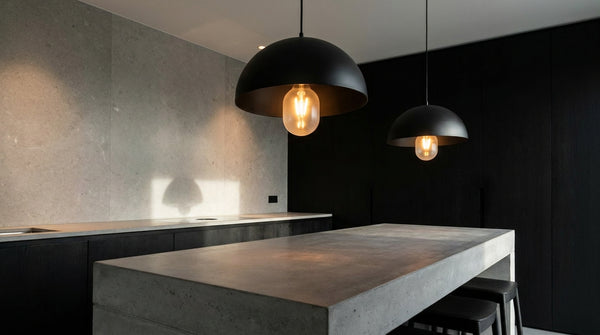
Above an island, a kitchen pendant is set rather at worktop height: you light the action, not the room.
What should your lampshade go on?
Fitting, step by step
Unplug, remove the bulb, slide on the lampshade, screw the ring on by hand, put everything back. In that order, and without forcing at any point.
- Switch off the power at the circuit breaker and check that it is off.
- Remove the bulb to free the thread or the frame.
- Present the lampshade in line with the socket, without turning it.
- Slide on the central ring, then screw the ring on by hand.
- Put the bulb back and check that no part of the lampshade touches the bracket.
- Restore the power and test the stability by lightly touching the lampshade.
A fabric or linen lampshade deforms if the ring is tightened crooked. The check is done from below, against the light: a misalignment shows immediately.
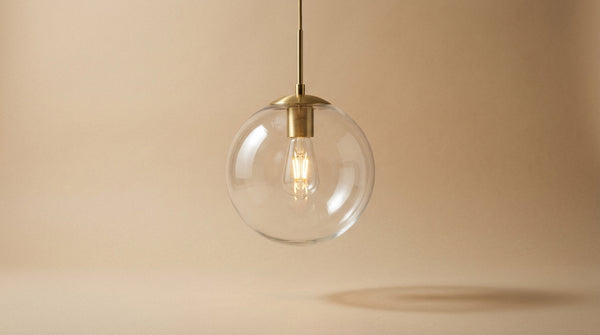
Glass, for its part, is dusted with a damp cloth without dismantling, which explains the place it holds in living rooms. Glass light fixtures simply need to be handled with both hands when the lampshade is wide.
Fabric requires more method, cold and dry, without product sprayed directly on the fibre. Our guide to cleaning a fabric lampshade details the movement.
In stock · shipping costs shown at checkout · up to 30% off in your cart


Ready to turn inspiration into reality?
Tell us about your room, your style and your budget, and we will show you the pieces that truly suit your project.
Get guidance in 30 seconds →