How many lumens for a dining room? The method
This article is also available in French: Combien de lumens pour une salle à manger

Measure the table first, not the room: its length decides the number of light points. Allow a general ambience of around 150 lumens per square metre, then a denser cone over the tabletop, two to three times higher. Spread this second level over two or three aligned sources rather than a single pendant.
How many lumens for a dining room?
Start from the number of guests, not the square metres. A table for six needs two aligned sources, each lighting three places. The rest of the room gets diffuse light at mid-height, to avoid faces in shadow. Surface area only comes in afterwards.
If the dining room opens onto the kitchen, treating both spaces together avoids doubling the light points. Renovating a kitchen open to the dining room should be thought of as a single lighting scheme, not two.
Calculating by surface area remains useful when the room is through-room or L-shaped. To lay the foundations, our guide to calculating the amount of lighting needed runs through the full chain, from surface area to number of points.
How many lumens per m² of dining room?
Allow 150 lumens per square metre for general light, and two to three times more over the table area. The number of lumens per m² remains a starting reference, to be corrected according to height and materials. An 18 m² room therefore starts at around 2,700 lumens for ambience.
Once the total is set, the question becomes the number of points. Our collection of dining room lighting brings together pendants, chandeliers and ceiling lights on one page, so you can compare several families before deciding.
Are 2000 lumens a lot?
Concentrated on a single point above a table for six, 2000 lumens are blinding. Spread over three sources, they create comfortable meal lighting. It is the number of points that decides, not the total.
| Guests | Light points | Target total over the table |
|---|---|---|
| 2 to 4 | 1 to 2 | around 1,000 lm |
| 6 | 2 | around 1,500 lm |
| 8 and more | 3 | around 2,000 lm |
What is the best lighting for a dining room?
Three levels, not one. A diffuse general light for moving around, a table light directed at the plates, an accent light on a sideboard or a wall. The meal is played out on the second; the other two exist only to make it bearable and the room legible.
Which ceiling light for a dining room?
A ceiling light works when nothing can hang above the tabletop, or when the room is a passageway. Choose a slim one, with no low volume, so as not to close the view between guests.
- Thickness: a few centimetres are enough, a low model crushes the table.
- Diameter: half the table width, beyond that it takes over the whole room.
- Diffusion: frosted glass avoids the harsh spot in the centre of the tabletop.
- Dimmer: essential as soon as a single fixture carries all the lighting.
The flattest models are easy to spot in our LED ceiling light selection, designed for rooms where height is lacking.
What the colour of walls and tabletop changes
A dark wall and a glass table reflect less light upwards. The same fixture appears weaker there, without anything being broken. The difference between lux and lumens shows most clearly here: what matters is the light received on the tablecloth.
| Environment | Coefficient to apply |
|---|---|
| Light walls and ceiling, light wood table | 1 |
| Coloured walls, medium floor | 1.2 |
| Dark walls, dark ceiling or glass table | 1.4 |
Dining room open to the living room: how to distribute
An open room reads as two zones, not one. The table light stays low and directed; the living area keeps its own, higher and wider. Without this separation, the two spaces light each other up.
For the living area, our article on lighting a living room effectively details the heights and wattages that keep their distance.
If your dining room opens onto the kitchen or the volume has changed, a survey of the room saves more time than a calculation. You can describe your room to us, from Vaulx-en-Velin or remotely, and we start from the real thing rather than a standard model.
Do 1000 lumens light well?
Yes for four guests, no for eight. 1000 lumens gathered above a small table give a crisp, legible light. The same 1000 lumens in a large room with dark walls drown in the ambience, without anything seeming abnormal at first glance.
What 1000 lumens give depending on the source
The same amount of light does not render the same depending on the bulb. Four parameters decide the result.
- Temperature: 2700 K for a meal, 3000 K at most in a very white room.
- CRI: at least 90, otherwise food turns grey.
- Base: E27 under a pendant, GU10 in a directional spotlight.
- Diffusion: an opaque shade concentrates, frosted glass spreads.
Base and wattage overlap: our guide to bulb wattage for a dining room covers the useful equivalences.
Above 3000 K, the table takes on an office look. White or yellow light: the right reference point is lower than you might think.
High ceiling and dark walls: when the reference shifts
Every extra metre of height dilutes the light before it reaches the tablecloth. Under a ceiling over three metres, the pendant goes lower, it does not get longer. A dark wall adds a correction of the same order as in the table, to be applied once, not twice.
What is the main constraint of your dining room?
What is the trendiest light fixture for the dining room?
Translucent materials and organic shapes dominate: blown glass, woven rattan, fine metal. What matters, however, is not the style but the line of sight. A fixture that hides faces may follow fashion, but it will ruin every meal.
Pendant, chandelier or ceiling light: which family to choose
- Pendant: one or more points aligned above the table, the most flexible solution.
- Chandelier: a centrepiece, best reserved for wide tables and high ceilings.
- Ceiling light: when nothing can hang above the tabletop.
- Wall light: as a complement on a bare wall, never as the main source.
Our dining room pendant selection covers the two most requested families, from the single model to the three-point bar.
Over a round or very long table, the chandelier changes everything. Dining room chandeliers give the diameters that work without crushing the tabletop.
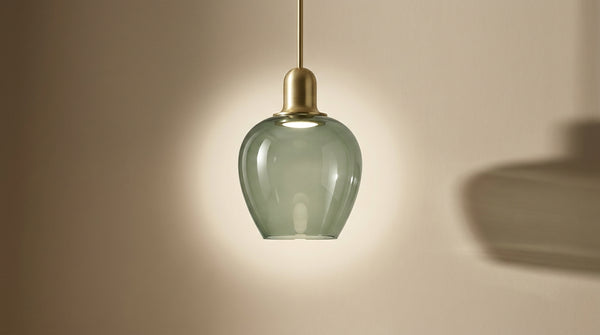
Translucent shades play a special role: they let light through and keep the room legible. A glass fixture lights widely without descending into the middle of the field of vision.
At what height should a pendant be hung above the table?
Allow 75 cm between the bottom of the shade and the tabletop for a table where people remain seated. This height takes the fixture out of the field of vision without lighting the tablecloth from the side. Beyond that, the light goes to the sides and the centrepiece darkens.
One family at a time, then the format: our selection of design lighting for the dining room lets you compare diameters on a single page.
How to adjust the light throughout the meal?
Plan for a dimmer from the start, on the table line at minimum. Aperitifs are taken at full power for moving around, the main course at half for reading the plates, dessert almost off. A dining room without variation forces a choice between seeing well and being comfortable.
The dimmer, from aperitif to digestif
- Dimmable: the mention appears on the bulb, not on the fixture.
- Compatibility: an old dimmer may buzz with a recent LED.
- Low minimum: check that the light really goes down, not just by half.
- A single control: beyond two dimmers, they stop being used.
Our article on dimmable LED explains what to check before ordering, base and compatibility included.
Should everything be on the same dimmer?
No. The table light and the general light are adjusted separately. A successful dinner lowers the first and raises the second when coffee arrives: this offset gives the impression of a room that follows the meal instead of lighting it.
On the same subject
In stock · shipping costs shown at checkout · up to 30% off in your cart


Ready to turn inspiration into reality?
Tell us about your room, your style and your budget, and we will show you the pieces that truly suit your project.
Get guidance in 30 seconds →