Fabric light fixtures: soft light, room by room
This article is also available in French: Luminaire en tissu
What does a fabric light fixture really change about your light?
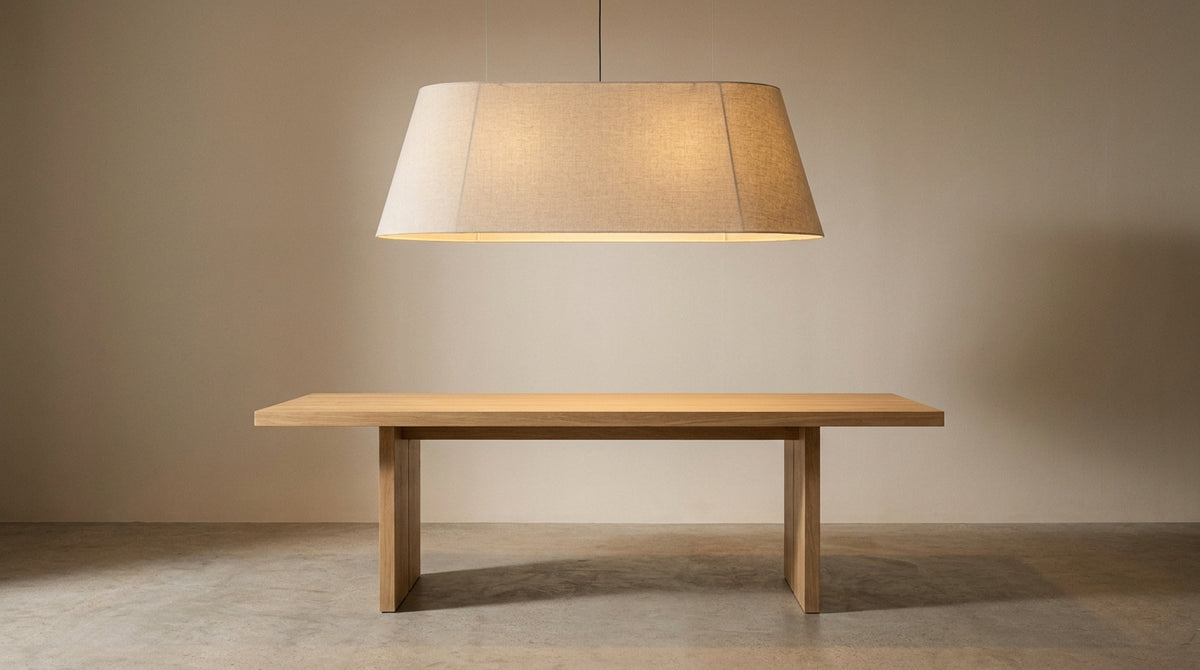
Fabric does not decorate light, it filters it. A fabric stretched over a frame turns a point source into a soft pool of light: no more harsh glare on the table, no more visible bulb when you look up. Neither raw metal nor clear glass does that.
In our survey of 250 references dated 6 October 2026, suspended mounting accounts for 45% of listings and wall mounting 36%. Choosing a fabric lampshade therefore rarely means setting it on a piece of furniture.
If you are redoing the whole room, our living room lighting project starts from these mounting heights and from how the table is actually used.
Fabric pendant above a table
A pendant light fixture in fabric drops into your field of view without blocking it. The canvas throws light sideways: guests are lit, not ringed by shadow.
- Diameter: the shade stays narrower than the tabletop, never wider.
- Clearance: the bottom of the shade passes above the eye line of a seated person.
- Socket: in the survey of 250 references, 26% take an E27, 21% an integrated LED, 14% an E14.
- Dimming: 25% of the same survey state a dimmable output.
A fabric lampshade that does not dazzle
On a table lamp, the shade hides the bulb and cuts direct glare. That is what makes evening reading comfortable, provided the canvas is opaque enough.
- Lined cotton or linen: prevents the bulb showing through the weave.
- Bottom edge: it drops below your eye line when you are seated.
- IP20: 94% of the survey carries this rating, enough in a dry room, not enough in a bathroom.
What are the trending living room light fixtures in 2026?
Fabric is back through beige and linen, carried by ball and round shapes. In the survey of 250 references dated 6 October 2026, the ball shape covers 30% of listings and the modern style 81%, but beige only 15%. A beige fabric light fixture remains a rare choice, not an easy one.
Pendant, chandelier or ceiling light for the living room?
A chandelier dressed in canvas structures a large room without weighing it down.
A round pendant lights a reading corner, an LED ceiling light stays discreet above a low sofa.
In a bedroom, a fabric bedroom chandelier replaces a bare ceiling source.
Which light colour with a fabric lampshade?
A 2700 K bulb behind a beige canvas gives an amber light; at 3000 K, the result stays warm but crisper. Our article on white or yellow light details this setting by use: meals, reading, work.
Linen, Japanese or coloured fabric pendant: which fabric to choose?
Linen for its fine weave, cotton for its opacity, silk for the warmth it throws back. The Japanese style plays on folds and geometric shapes, the coloured one on a shade that tints the whole wall. The right fabric is the one that lets you read without squinting.
Fabric pendants and lampshades from the house
 Pendant light fixture | Bravara
 Pendant light fixture | Harmonie Florale
 Pendant light fixture | Mirdanissa
 Ceiling light fixture | Dorica
 Ceiling light fixture | Cylira
 Living room floor lamp | Foglia
See the whole selection: Alternative to Luminaire.fr: designer lighting shop | Designix
Linen fabric pendant: what the weave changes
Linen lets light through between its fibres, which produces a slightly mottled result, very different from opaque cotton. Our linen lampshades play on that irregular transparency.
- Linen: visible weave, soft textured light.
- Cotton: more even diffusion, bulb better hidden.
- Silk: warm reflections, delicate care.
- Coloured: the shade of the canvas colours the wall, not just the lampshade.
Fabric or smoked glass: which diffuser?
Clear glass leaves the bulb visible and throws reflections; smoked glass softens but stays cold. A smoked glass pendant and a beige canvas side by side in the evening do not give the same atmosphere at all.
Fabric never adds a metallic glint. That is why pendant light fixtures in canvas pair so well with light wood or a terracotta wall.
How to care for a fabric light fixture without damaging it
Dust dry, with a soft brush or a vacuum on the lowest setting, and never wet the canvas. A stain is blotted, not rubbed. And if the canvas stays marked, the cover can be replaced more easily than you might think.
Dusting without lifting the weave
- Soft brush: dry, from top to bottom.
- Vacuum: brush nozzle, lowest setting, without pressing.
- Water: never, it marks the canvas and warps the frame.
- Frequency: as soon as dust becomes visible on the weave.
Our guide to cleaning a fabric lampshade details the motion, linings included.
A stain on a fabric lampshade
Blot with a barely damp microfibre cloth, from the edge towards the centre, then let it air dry. If the ring persists, it is better to change a lampshade's fabric than to keep at it with stain remover.
How to choose without getting it wrong: the in-store method
Bring the tabletop measurement, not a photo. Then do the two checks that matter: the light on your hand at working height, and the canvas examined up close under the final bulb. Fabric is judged switched on, never on a shelf.
Measure before choosing
The height of the base, the diameter of the tabletop and the distance from the wall set the format. Our article on the right lampshade proportions covers these benchmarks for round bases, the most common.
Before ordering, have the size and drop of the fixture checked by the team: getting your choice validated saves a return trip over a centimetre.
The two checks, fabric and light
- Light: bring your hand close to the edge of the shade, the shadow should stay soft, with no hard edge.
- Fabric: look at the weave up close, under the bulb that will go in the lamp.
- Rating: IP20 on 94% of the survey of 250 references, so dry rooms only.
- Warranty: 2 years on 89% of the survey, 5 years on 9%.
Once the fixture is in place, the atmosphere is set by the dimmer more than by the number of sources. Our guide to creating a warm atmosphere gives the settings room by room. The selection is also reviewed by buyers on the company's Google listing, available online.
Which fabric light fixture suits your room?
Related reading
In stock · shipping costs shown at checkout · up to 30% off in your cart


Ready to turn inspiration into reality?
Tell us about your room, your style and your budget, and we will show you the pieces that truly suit your project.
Get guidance in 30 seconds →