Long outdoor string lights: the guide
This article is also available in French: Guirlande lumineuse extérieur grande longueur
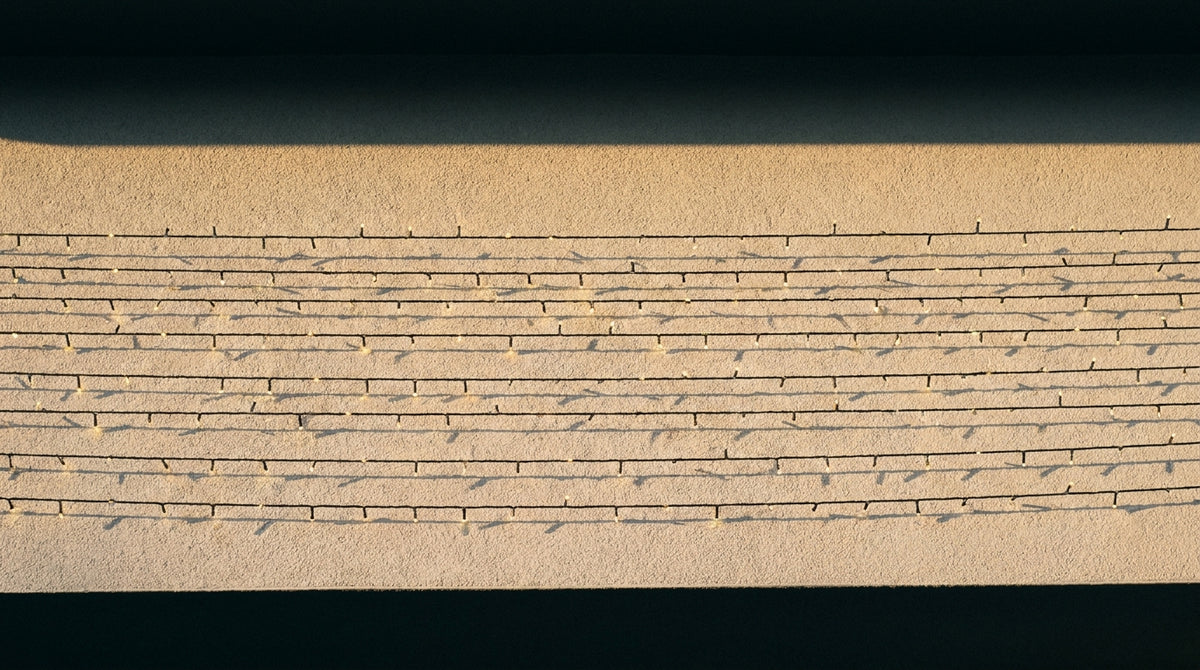
Connect sections rather than looking for a single-run string light: whether it is 50 m or 100 m, the power supply is chosen according to the actual distance to the socket. Allow for an attachment point every 50 cm and check the protection rating before ordering.
How long should outdoor string lights really be?
Measure the length of the run, then add 10 to 15% for corners and returns. A house facade often needs 20 to 40 m; a garden is handled in several sections connected to each other. The useful length is measured with a tape measure, never from the product listing.
[[IMG:façade-soir]]The comparison above settles the power question. If you are starting from scratch, LED string lights remain the basis: low consumption, little heat, and long series without modification.
50 metre outdoor string lights: measure the run before buying
Follow the actual path of the line, gutter included: a bend uses up length and requires an attachment point. On a 12 m facade, 50 m is quickly reached with the outward run, the return and the roof overhang.
This is also the moment to look at fixings: a balcony and terrace renovation incorporates them cleanly before the line is installed.
For the most economical festive runs, our guide to long outdoor Christmas string lights details the routes that avoid unnecessary extension leads.
100 metre outdoor string lights: why connecting beats a single run
Beyond 50 m, a single-piece string light becomes heavy to tension and impossible to repair if the line breaks. Connecting sections keeps control: 100 m, even 200 m, is built in series, each section powering the next.
Calculate the total load before plugging in. A 100 m string light with 1000 LED does not run on just any transformer, and the limit comes from the combined power, not the number of metres.
The visual result depends on the wire voltage: a few pointers for integrating string lights elegantly are worth more than one extra metre.
Solar or connectable outdoor string lights: which to choose?
Connectable handles distance, power and duration: it is the basis for a long length. Solar suits isolated spots with no nearby socket, provided you accept softer brightness and a battery life that follows the sunshine.
Large solar outdoor string lights: what a panel can really power
A small panel powers a short line, not 100 m of LED. Solar shines on a railing, a gate or an isolated pergola, where running a power supply would cost more than the string light itself.
To light a wider area without a cable, an outdoor solar lamp placed on the ground complements the line.
And if the socket is simply too far away, a rechargeable lamp post charges indoors then goes outside in the evening.
A line on its own lights an outline; it is the whole that changes a terrace. Outdoor lighting for the terrace and garden planned by zones avoids the permanent Christmas tree effect.
Long LED outdoor string lights: series connection
In series, each section plugs into the previous one via a waterproof connector. In a survey of 69 references from our catalogue as of 29 September 2026, LED technology is stated on 84% of the survey: the choice is therefore rarely between LED and filament, but between two qualities of LED.
Keep a spare section. If a burnt-out bulb breaks the line, you have to find it and replace it, and knowing the types of bulbs and bases avoids buying at random.
The outdoor garden decoration collection has 2006 references as of 29 September 2026: enough to find the line that suits the facade rather than the other way round.
Outdoor string lights: the Designix selection


Which protection rating and light colour for outdoors?
Do not go below IP44 for outdoor string lights, and aim for IP65 if the line stays exposed to rain. On colour, a warm white around 2700 K dresses a facade, a neutral white lights more sharply, multicolour is kept for festivities.
IP44, IP54, IP65: the threshold not to go below
The protection rating describes resistance to dust and water. In a survey of 69 references from our catalogue as of 29 September 2026, IP65 is stated on 43% of the survey and IP44 on 14%. In other words, the most common outdoor level is also the most demanding.
- IP44: under a roof overhang, sheltered from direct rain
- IP54: covered terrace, occasional splashes
- IP65: exposed facade, driving rain, watering
- IP67: heavily watered area, poolside
Along a fence or a wind-exposed wall, the requirement goes up a notch. The rest of the outdoor luminaire on the same terrace benefits from following the same rating.
Warm white, neutral white or multicolour: choose according to the facade
A warm white around 2700 K warms stone and wood. A neutral white around 4000 K gives a sharper, almost graphic line on a light render. Multicolour embraces the party and does not sit well left on next to fixed lighting.
| Rendering | Temperature | Where it works |
|---|---|---|
| Warm white | 2700 K | Stone facade, wood, old shutters |
| Neutral white | 4000 K | Contemporary terrace, light render |
| Multicolour | Variable | Festivities, tree, gate |
To match the string light to the rest of the facade, our guide to white or yellow light helps you decide.
Where should your outdoor string lights go?
How do you install outdoor string lights over a long distance?
First tension a support wire from one fixed point to the other, then hang the string light on it: it is the support that holds the line, not the electrical cable. A point every 40 to 50 cm removes the sagging effect.
Fixing without drilling on render, a gutter or a railing
Gutter hooks and cable ties avoid drilling into new render. On a railing, a wide tie spreads the pressure; on a wall, a stainless steel screw with a suitable plug holds better than adhesive.
- Gutter hook: fits without drilling, removes without trace
- Cable tie: perfect on a handrail or metal railing
- Stainless steel screw and plug: on concrete or brick, the safest hold
- Support wire: holds the line, never the power cable
If you are still hesitating between solar and connectable, you can describe your setup to us in two lines and we will point you to the right model.
Tensioning without sagging: tension, angle by angle
Tension the support wire before attaching the string light to it, and mark a support at each corner: that is where the line slackens and the coils spread apart. The pointers for hanging string lights without sagging also apply to a facade.
The rest of the facade deserves the same care: an outdoor lamp post at the foot of the terrace extends the line without weighing it down.
When the string light stops, an outdoor wall lamp near the door takes over and avoids the shadow zone.
In stock · shipping costs shown at checkout · up to 30% off in your cart


Ready to turn inspiration into reality?
Tell us about your room, your style and your budget, and we will show you the pieces that truly suit your project.
Get guidance in 30 seconds →