Lux vs lumens: lighting each room correctly
This article is also available in French: Difference lux lumens
1 lux = 1 lumen per m². A lumen measures what a bulb emits, a lux what actually reaches your table, your worktop or your wall. Note the lumens stated on the packaging, divide by the surface to be lit, then compare with the lux level suited to the room.
Lux vs lumens: what really changes?
The lumen is the light leaving the source, the lux is the light reaching a surface. A 1000 lumen bulb does not light a room the same way depending on height and distance: it is the lux, on the floor or on the table, that decides whether the room is comfortable.
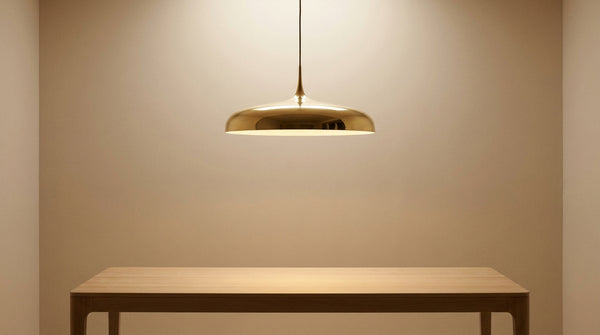
Two 800 lumen fixtures do not give the same room. One placed on a console, the other hung two metres up, and the floor receives clearly less light in the second case. The lumen has not changed, the lux has. That is what makes a packaging figure insufficient for choosing.
A living room is not calculated like a hallway: our lighting advice always starts from how the room is used before talking about power.
If the notion of lux remains abstract, our simple explanation of lux covers it with everyday situations.
How to convert lumens into lux?
Divide the lumens by the floor area, in square metres. A thousand lumens falling on ten square metres give 100 lux, provided all the light reaches the surface. In practice, a shade, a high mounting height or a dark wall consume part of it.
- Mounting height: doubling the distance divides illuminance by four
- Opaque shade: concentrates the lux beneath it and leaves the rest in shadow
- Light walls: reflect light and raise the overall level
- Number of sources: three points of 700 lumens are better than a single 2100 lumen one
What is the difference between lux, lumen and candela?
The candela describes intensity in a single direction. It is used for spotlights and floodlights, not for pendants. A very narrow 500 lumen spotlight sends many candelas onto a small circle, whereas a wide-diffusion fixture spreads the same 500 lumens across the whole room.
| Unit | What it measures | Where to read it |
|---|---|---|
| Lumen (lm) | Total flux emitted by the source | Bulb packaging |
| Lux (lx) | Light received by 1 m² of surface | Calculated, or measured with a lux meter |
| Candela (cd) | Intensity in a single direction | Technical sheet of a spotlight |
This also explains why the same flux gives a focused or a soft atmosphere: a design fixture is judged as much on the shape of its diffuser as on its stated power.
How many lumens to light a 20 m² room?
Count 2000 lumens for a 20 m² living room aimed at 100 lux, meaning two or three sources of 600 to 800 lumens rather than one central point pushed to the maximum. The details of the calculation are in our method to calculate the lighting of a room.
| Use | Target level | What it changes |
|---|---|---|
| Hallway, entrance | 50 to 100 lux | Move around without lighting the whole house |
| Living room, lounge | 100 to 150 lux | Read and talk without glare |
| Kitchen worktop | 300 lux | Chop without cast shadow |
| Desk, reading | 300 to 500 lux | Hold the page without strain |
| Bedroom, before sleep | 50 to 100 lux | Ease the way into sleep |
A well-sized LED ceiling light provides the base light, lower sources do the rest.
100 lux in lumens: how to set up the calculation?
One hundred lux over twenty square metres require 2000 lumens, since 100 × 20 = 2000. Spread that sum: two 700 lumen pendants above the table, a 600 lumen floor lamp in the opposite corner. How it feels then confirms the result, you squint when it is too much, you guess colours when it is not enough.
How many watts is 5000 lumens?
Around 50 W in LED, against several hundred watts in halogen for the same light. The watt measures consumption, not the flux produced. That is why the watt per m² reference has given way to the lumen in lighting calculations.
- LED: the same light for about five times fewer watts than a halogen
- LED filament: similar efficiency, vintage bulb look
- Halogen: many watts, a lot of heat
- Watt per m²: reference abandoned in favour of lumens
If you would rather have your illuminance calculations checked before ordering, our team helps you frame each room: simply contact us.
What lux changes in decor, room by room
Lux decides the look as much as the comfort. At 100 lux, a living room stays soft and materials read without harshness; at 300 lux, the kitchen becomes crisp and shadows leave the worktop. So the target level differs according to what you do in the room.
Across a sample of 237 references from our catalogue as of 28 September 2026, 83% mention the living room and 69% the bedroom. These two rooms account for most projects. Of 169 listings in the same sample, 71% state LED technology, which makes the stated flux reliable in most cases.
What lux level in a kitchen or a living room?
The kitchen requires 300 lux on the worktop, so a dedicated source rather than a distant ceiling light. A kitchen fixture placed 70 cm from the worktop reaches this level with about 600 lumens.
In the living room, the level drops back to 100 or 150 lux and the points are multiplied: pendant above the sofa, wall light, floor lamp in the corner. This accumulation creates zones rather than uniform lighting.
When the room is being renovated, our living room and main room renovation service integrates the light points into the plan instead of adding them afterwards.
How many lumens for a bedroom?
A bedroom is thought about the opposite way to other rooms: you look for less lux, not more. Fifty to a hundred lux are enough to move around, and two separate low sources are better than a central ceiling light. The references by room size are detailed in the lumens for a bedroom.
White or yellow light: which temperature to choose?
2700 K for a living room or bedroom, 3000 K for a kitchen or desk, 4000 K and above for a workshop. Two close temperatures can coexist in the same room, 2700 K and 3000 K for example; too large a gap is immediately visible.
Which room do you want to light correctly?
Fixtures and bulbs by target illuminance


Base, IP, dimming: what to check before ordering
Check three lines on the technical sheet: the bulb base (E27, E14, GU10, G4), the protection rating (IP20 in a dry room, IP44 minimum in a wet room) and compatibility with a dimmer. These three points decide whether the installation goes without surprises.
Which bulb base size to choose?
Across a sample of 237 listings from our catalogue as of 28 September 2026, 178 state a base: E27 and LED tie at 21%, E14 at 10%, G4 at 9%. E27 remains the format that leaves the most choice among bulb types, from filament to high-power models.
G4 is found in small wall lights and compact fixtures, GU10 in adjustable spotlights. These two formats are not interchangeable, so it is better to check before ordering.
Diameter is measured in millimetres and cannot be guessed: our guide on bulb base size gives the correspondences.
IP20, IP44, IP65: which for which room?
IP20 suits dry rooms, IP44 protects against water splashes, IP65 withstands rain. Of the 193 listings in the sample that state a rating, IP20 accounts for 75%: most of the range is designed for a dry interior. In a bathroom, wall lights must on the contrary show IP44 minimum.
Then there is dimming: of the 79 listings in the sample that take a position, 24% state it and 9% exclude it. A dimmer-compatible chandelier changes the atmosphere of a living room without adding a single lamp.
To confirm a reference, the simplest way is to look at what other buyers received: our Google listing gathers the feedback left by customers.
In stock · shipping costs shown at checkout · up to 30% off in your cart


Ready to turn inspiration into reality?
Tell us about your room, your style and your budget, and we will show you the pieces that truly suit your project.
Get guidance in 30 seconds →