Best solar outdoor wall light: the selection guide
This article is also available in French: Meilleur applique extérieur solaire
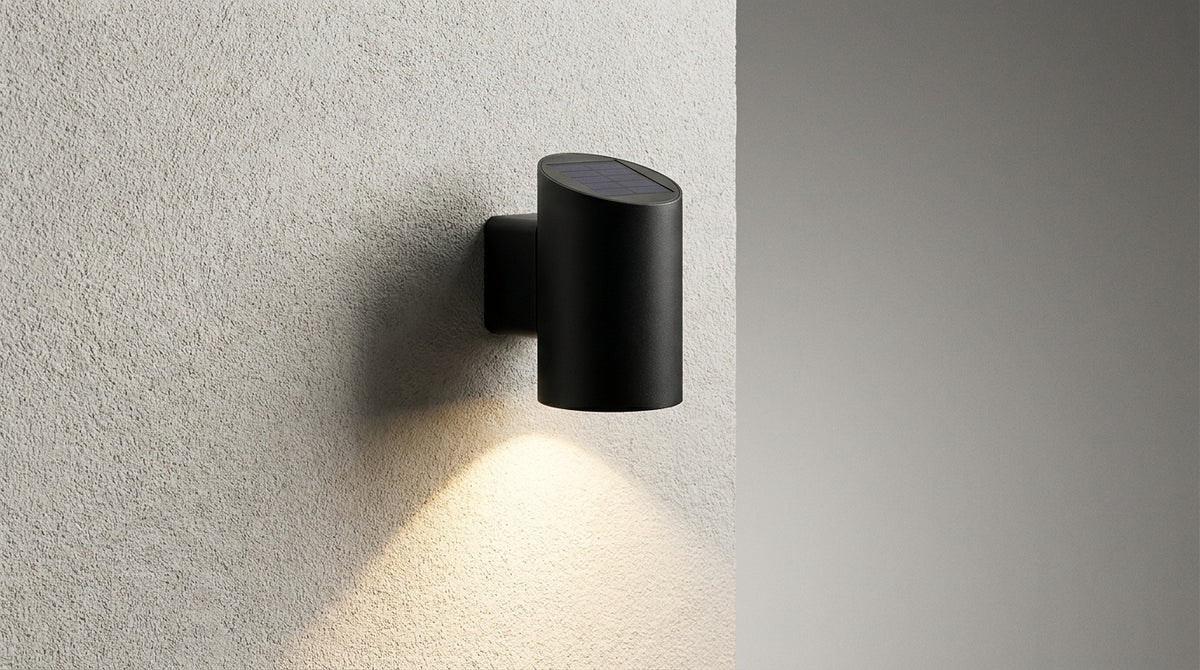
Mount the wall light between 1.80 m and 2.20 m from the ground, with the panel facing due south and clear of any plant shade or roof overhang. Reserve solar for walls that receive at least five hours of direct sunlight: elsewhere, a wired wall light will shine every evening, regardless of the weather.
Solar is not the only answer. On a north facade, under a porch or behind a shared wall, a outdoor wall lamp running on 230 V switches on at dusk, every evening, with no need to watch the sky. This collection brings together 447 references as of 28 September 2026, from the discreet model beside a door to the wide format that lights a whole driveway.
Across a survey of 38 of these listings, 3% mention solar technology, 53% an IP65 rating and 100% wall mounting. Solar therefore remains a niche, and it is reserved for the locations that deserve it.
How do you choose outdoor solar lighting?
Three criteria decide it: the wall's actual sun exposure, the overnight runtime and the protection rating. A panel that receives five hours of direct sunlight lasts a full night; below that, the lamp dims around two in the morning and solar disappoints.
How does a solar garden lamp work?
No cable, no trench: the photovoltaic panel charges a battery during the day, a dusk sensor switches the lamp on in the evening, and the battery drains until dawn. The chain loses energy at every step, and it is the panel's surface area, never the LED's stated wattage, that decides the runtime.
Four things drain a battery before daybreak:
- Cast shade from a tree, an awning or a gutter, even two hours a day
- Permanent standby mode, which draws power without lighting anything
- December and January, when the sun stays low and the nights grow longer
- A dirty panel: dust and bird droppings cost more than an overcast sky
That is why a solar wall light is chosen on the position of its panel before its style. A model whose sensor stays in the shade of a roof overhang will never light properly, whatever its spec sheet says.
If your wall never sees direct sunlight, describing your facade to us in a few photos is enough: our team will reply and point you to the solution that will last, solar or wired.
Standalone solar or wired LED: which should you choose?
Solar wins on a wall facing due south, far from any power supply; wired wins everywhere else, and it depends neither on the season nor on how clean the sensor is.
On a shaded facade, a wall lamp powered at 230 V uses a few watts per evening and lights at constant intensity, including in January.
An outdoor solar lamp is justified when running a line would be heavy: a gate pillar, a shed at the bottom of the garden, a boundary wall. The rest of the time, it promises more than it delivers.
And if any doubt remains about the company advising you, the verifiable reviews on the Designix listing are freely available.
What LED wattage for outdoor solar lighting?
Allow 300 to 600 lumens for an entrance, a garage door or a small balcony, and up to 1000 lumens for a courtyard or a wide driveway. With solar, the wattage shown is misleading: it is the battery capacity that decides how long the lamp lasts.
What lighting power for outdoors?
The right question is not the wattage, but what you want to see. A tight beam draws a path; a wide beam lights a whole facade without dazzling the neighbour.
| Use | Target flux | Colour temperature |
|---|---|---|
| Entrance, door | 300 to 600 lm | 2700 K to 3000 K |
| Terrace, driveway | 600 to 1000 lm | 3000 K |
| Courtyard, wide facade | 1000 lm and above | 3000 K to 4000 K |
Beyond flux, colour temperature changes everything: 2700 K warms pale stone and wood, 4000 K draws sharp outlines on gravel. Before falling for a shape, check this point: it is what will decide whether the light fitting looks warm or clinical on your facade.
Which battery for a solar lamp?
Almost all solar wall lights contain a sealed lithium battery, rarely a replaceable AA battery. The point to check is simple: a battery stated as replaceable doubles the lamp's lifespan, a soldered battery condemns it the day it no longer holds a charge.
- Lithium-ion for efficiency, LiFePO4 for longevity and cold
- Capacity in mAh to read before the LED wattage, never the other way round
- Separate panel when the wall is in shade but the roof is in sun
Across our survey of 38 outdoor wall lights as of 28 September 2026, 47% of listings state an integrated LED, and 29% a replaceable E27 socket: the second family can be repaired, the first is replaced.
Which wall light for a terrace?
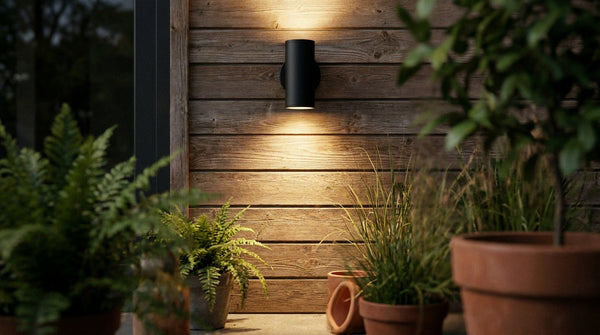
A terrace wall light grazes the wall, not straight ahead. Mount it at least 1.80 m high, aimed downwards or towards the ground, and place one on each side of a door rather than a single one in the centre.
The house wall is the best support: it protects the casing from the rain and the light bounces onto the terrace instead of heading off into the garden. That is where a well-positioned outdoor light fitting beats a string of lights.
What is the best outdoor lighting with a solar sensor?
For a passage, a presence sensor beats a fixed light: it saves the battery and only lights when someone is there. Allow a range of a few metres, and set the timer short.
The setting matters more than the spec sheet: too long a timer drains the battery, too wide an angle triggers on passing animals. An outdoor light with sensor set tightly lights better and lasts all winter.
What height for mounting an outdoor wall light?
Between 1.80 m and 2.20 m from the ground for ambient lighting, higher if you want to widen the cone. Too low, it dazzles; too high, it only lights the wall.
The wall light height is set case by case, depending on how far the awning projects and how far back the terrace sits.
For installers, centre distances, plans and product sheets can be found in the trade area reserved for professionals.
Then there is the evening question: what light does to a terrace changes more than the style of the lamp. Our feature on outdoor lighting details the scenes that really work.
Outdoor wall lights: the selection
 Outdoor Wall Light | Urbano Brillante
 Round Outdoor Wall Light | Halo
 Design Outdoor Wall Light | LuminMotion
 Outdoor Wall Light for Terrace | Terralux
 Design Outdoor Lamp with Sensor | SécuriLuxe
 Modern Outdoor Light Fitting | Eclat
See the full selection: outdoor wall light, outdoor wall lamps
What is your case?
Which solar outdoor wall light should you choose?
A solar wall light is chosen first on its exposure, then on its finish. Across a survey of 38 outdoor wall lights in our catalogue as of 28 September 2026, 79% state aluminium, 45% glass, 74% black and 39% white.
Two figures to keep in mind: 71% of the survey is guaranteed for 2 years and 29% for 5 years. On a lamp exposed to frost and UV, the longest warranty often says something about the care taken with the materials.
- IP65 for a wall exposed to driving rain
- IP44 is enough under an awning or a roof overhang
- Aluminium rather than plastic to withstand salt and frost
- Glass or acrylic: glass ages better, acrylic resists knocks
To go beyond the standard catalogue, wall lights with a strong style stand out quickly: only 8% of the survey state an original style, which makes it the real room for personalisation.
On the same subject
In stock · shipping costs shown at checkout · up to 30% off in your cart


Ready to turn inspiration into reality?
Tell us about your room, your style and your budget, and we will show you the pieces that truly suit your project.
Get guidance in 30 seconds →