How to fit a lampshade on a ceiling socket: the guide
This article is also available in French: Fixer abat jour sur douille plafond
How do you fit a lampshade on a ceiling socket?
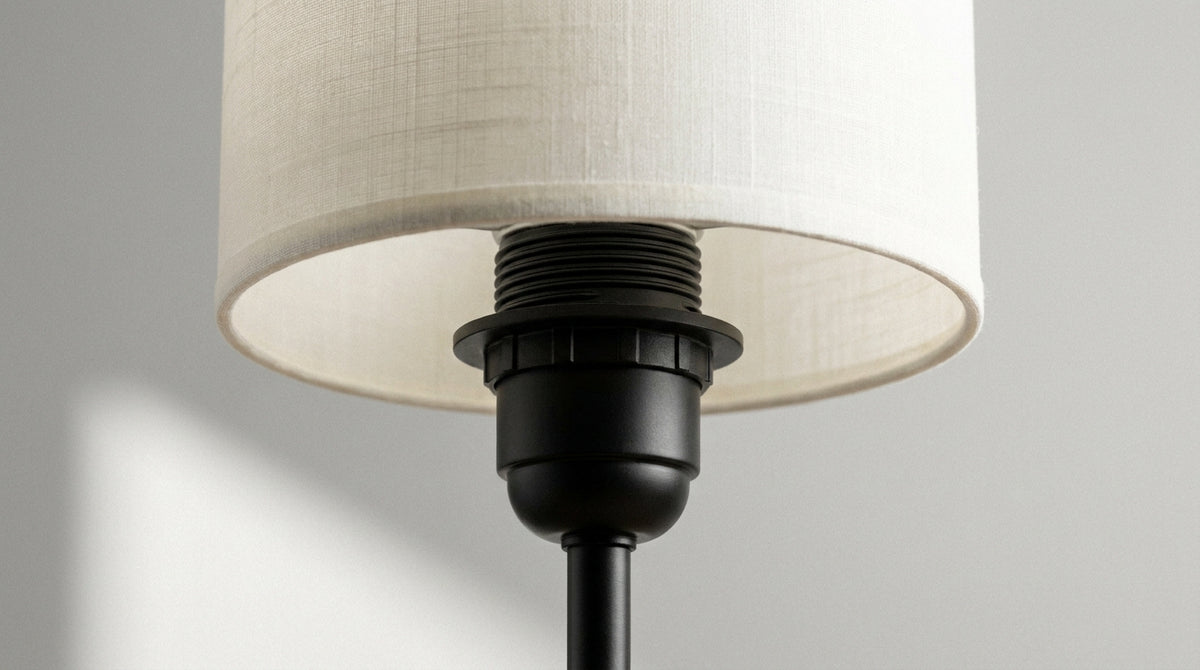
Switch off the power at the circuit breaker, unscrew the socket ring, slide the lampshade over the thread, then tighten by hand. The job takes a few minutes when the socket is accessible and the lampshade hole is the right diameter. A hole that is too wide can be fixed with a reducer ring, without drilling.
Choosing a lampshade for a ceiling socket comes down first to two measurements: the diameter of the central hole and the weight. Colour, shape and material are decided afterwards, once the lampshade is in place in the room.
Which fitting: screw ring, adapter or clip?
Three fittings cover almost all ceiling sockets. A single measurement decides between them: the diameter of the lampshade hole.
| Fitting | When to choose it | What to check |
|---|---|---|
| Screw ring | Lampshade with a central hole, threaded E27 socket | Hole diameter, condition of the thread |
| Adapter or reducer ring | Hole wider than the original thread | Inner diameter, weight of the lampshade |
| Clip | Lampshade without a hole, fitted onto the bulb | Bulb shape, low weight |
The clip suits small lampshades and globe bulbs. Beyond that, the screw ring remains the most stable fixing. The step-by-step method is set out in our guide to installing a lampshade.
How do you fit a lampshade on a DCL socket?
On a DCL box, nothing screws onto the socket: the lampshade or pendant hangs from the hook on the box, then the cover clips back on. Unclip the cover, take out the hook, locate the terminal block, and keep the power off until everything is back together.
The full procedure, connections included, is in our article on installing a light on a DCL box.
How do you fit a lampshade to the ceiling without drilling?
A lampshade can be fitted to the ceiling without drilling as soon as the fixing point already exists: hook in place, DCL box, suspended cable. You add no holes, you reuse the support. Switch off the power, then check that this support holds the real weight of the whole assembly, ring included.
The real issue is not the fixing, it is the load. A linen lampshade often weighs less than it looks, a glass lampshade much more. The full method for fitting a lampshade to the ceiling starts with that weighing.
How do you fix a light to the ceiling without drilling?
Four solutions exist, and none of them needs a drill bit.
- Existing hook: the pendant light hangs on it, the cable runs through the cable clamp.
- DCL box: the hook and terminal block are already in the ceiling, all that is left is to connect.
- Suspended cable or track: the load is spread over a support that is already anchored.
- Socket adapter: the lampshade slides onto the socket in place, without touching the ceiling.
The connection is made with the power off and often comes down to two wires in a terminal block. This wiring is set out in the guide to wiring a ceiling light.
For a room where nothing is provided in the ceiling, the simplest option remains the pendant light without drilling, plugged into a switched socket.
When a hook and a bar become necessary
The hook becomes necessary as soon as the lampshade exceeds what a socket can take: large diameter, glass, multiple assembly. The bar, for its part, spreads the load over two anchor points when the lampshade is wide and heavy.
For a heavy fitting, the method is described in our article on fixing a chandelier with a hook.
A large living room chandelier never hangs on a socket alone anyway: it calls for the hook, and therefore drilling.
Which fitting do you expect in the ceiling?
Which lampshade should you choose for a ceiling socket?
Two criteria decide before style: the diameter of the central hole and the weight of the lampshade. In a survey of 31 references from our catalogue, as of 28 September 2026, 97% show an E27 base, an IP20 protection rating and a 2-year warranty. A lampshade that is too heavy sits poorly on a simple ring.
The collection has 789 references on the same date, from round to teardrop, from linen to glass. When the room needs more light output than a lampshade alone, an LED ceiling light spreads the light better across the ceiling.
What height for a lampshade?
Height is set by use, not by a tape measure. A lampshade is placed low enough to hide the bulb when you are seated, high enough not to block your guests' view. Above a table, a dining room light sits at eye level, never directly in the line of sight.
On a ceiling socket, finally check that the bulb goes in without forcing: our article on identifying an E27 base avoids a mistake during fitting.
Linen, metal or glass: what the material changes
- Linen: soft, enveloping light, the most common material in the survey.
- Metal: directs the light down onto the worktop, useful above an island.
- Glass: lets light through, best kept for bulbs that are not too dazzling.
- Velvet or fabric: absorbs part of the light output, the atmosphere becomes softer.
In the same survey of 31 references, 52% are linen and 26% metal. Linen spreads the light around the room while metal concentrates it downwards. A designer light in black metal and a linen lampshade therefore do not tell the same story above a table.
Lampshades for ceiling sockets: our selection
 pleated white fabric pendant light, oval lampshade Ø 60 cm | Velina
 K1068RS grey linen lampshade
 Black arc wall reading light, fabric lampshade Ø60 | Noctis
 Black Scandinavian floor lamp, cork lampshade, living room reading light | Stang
 Light rattan designer chandelier | Calya
 Black Zig-Zag 4253ZW floor lamp with white linen lampshade – a unique design and functional use
See the whole selection: Lampshades: Pendant, Table Lamp and Floor Lamp
Which mistakes should you avoid before tightening the ring?
Three mistakes come up again and again: forcing a damaged thread, loading a socket with a lampshade that is too heavy, turning the power back on before testing. The ring is tightened by hand, without pliers. A new lampshade is no excuse not to check the condition of the socket that receives it.
What weight can a DCL box support?
The permitted weight is the one stated by the box manufacturer, and it is compared with the real weight of the lampshade, ring and bulb included. Put the lampshade on a kitchen scale: the material is deceptive, the figure is not. Beyond that, an anchored hook takes the load.
If the weight or the condition of the box leaves you unsure, the safest option is to have the fitting checked before drilling: you can contact us, and we will tell you in two minutes whether your setup holds.
The right steps: switch off, check, test
- Switch off: breaker down, then check with a tester before touching the wires.
- Check: thread, ring, terminal block, and no bare wire sticking out.
- Tighten: by hand, until the lampshade no longer moves by a millimetre.
- Test: turn the power back on, switch on, then switch off again before any adjustment.
A second-hand lampshade needs one more check: socket and fabric age together. Our tutorial on changing the fabric of a lampshade covers this specific case. Before you travel, our Google listing remains available online.
In stock · shipping costs shown at checkout · up to 30% off in your cart


Ready to turn inspiration into reality?
Tell us about your room, your style and your budget, and we will show you the pieces that truly suit your project.
Get guidance in 30 seconds →