Accent lighting: the finishing touch for the living room
This article is also available in French: Les Lumières d'Accentuation : la Touche Finale de Votre Salon

Allow 30 to 50 cm between the light source and the object you want to highlight, and use a warm white bulb, between 2700 K and 3000 K. Beyond that, the halo spreads and the object drowns in the ambient light. Below that, the pool of light becomes harsh. It is the distance that creates the accent, not the price of the fixture.
What are the 3 types of lighting in a living room?
A living room is lit in three layers: general lighting sets the base level, task lighting illuminates a specific activity, and accent lighting highlights a precise point. It is the third that gives the room its character, and the one people forget when choosing their living room lighting.
- General lighting: a ceiling fixture or large pendant, it carries the room without a marked direction.
- Task lighting: used for reading, cooking or moving around, and judged by how it works in practice.
- Accent lighting: a narrow beam on a painting, a bookshelf, a wall relief.
What is general lighting really for?
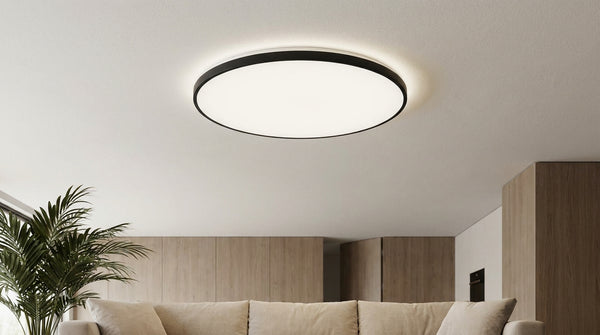
It makes the room usable and removes dark areas. Its common flaw: being pushed so strong that it flattens the other two layers. A discreet general light in the evening lets the accent lighting regain depth.
What is the difference between task and accent lighting?
Task lighting answers a need, accent lighting answers a glance. Remove the second and the living room remains usable, simply flatter. Accent lighting: definition and role takes this layering mechanism step by step.
How do you light a living room well?
Stack the three layers and set each source separately. A successful living room shows a discreet general light, two or three accents, and a task light near the sofa. The number of fixtures matters less than how they are distributed. For a larger project, living room and main room renovation covers the whole space, partitions and wiring included.
How do you distribute light in three layers?
Start from the corners, not the centre. Each zone gets its own source, and the general light handles the rest.
- Reading corner: a low source, aimed at the seat.
- Gallery wall: two small wall lights are better than one large single halo.
- Room entrance: a discreet point avoids the black hole at the end of the sofa.
Two or three accents are enough in an ordinary living room. The detail of the layers is covered in lighting your living room in 3 layers.
Is dimming essential?
It changes everything in the evening, but it remains a minority in the product listings. In a survey of 249 references from our catalogue as of 30 September 2026, 27% mention dimming. So check that line before ordering. A dimmable bulb makes up for it, if the fixture accepts one.
What are the trend lighting fixtures for the living room in 2026?
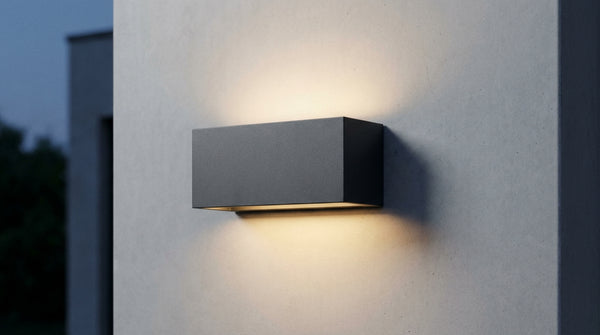
Soft shapes dominate: in the same survey of 249 references as of 30 September 2026, 39% show a globe shape and 30% a tube shape. Wall mounting is growing to 40%, ahead of pendants at 33%. An LED ceiling light remains the most understated base.
Which accent fixture for which effect?
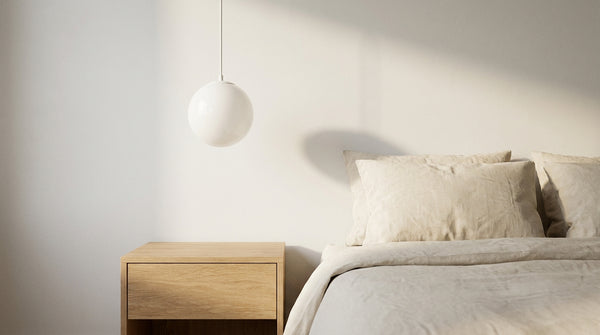
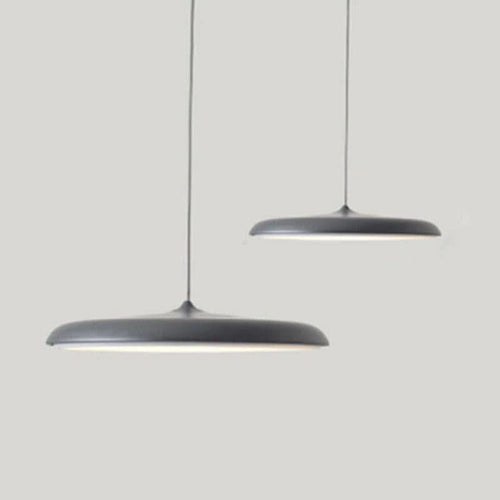
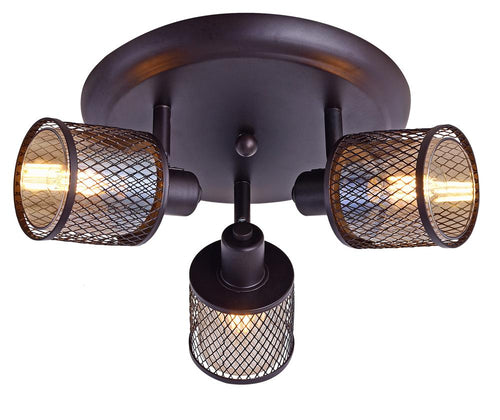
The choice comes down to the beam, not the style. A narrow beam for an object, a wide one for a wall, a movable one for a reading corner. A living room pendant hung low brings the source closer to the subject; a diffused fixture, on the other hand, creates an atmosphere and accents nothing.
How do you light a painting or a gallery wall?
Aim at the top of the artwork, never its centre: the light travels down and reveals the relief. A wall light placed 20 to 30 cm above the frame, tilted downwards, is enough for a framed piece.
For a wide canvas, a single wall light creates two uneven zones. Two sources spaced a third of the total width apart are better.
The picture light format answers exactly this case: lighting a painting with a picture light is done as close to the frame as possible, without spilling onto the wall.
Which fixture for the reading corner?
A floor lamp with an opaque shade drops the light onto your lap without dazzling. Place it on the opposite side to your writing hand, with the shade at seated shoulder height. The goal is not to light the room, only the page.
E27, E14 or GU10 socket: what do the listings say?
The socket guides the shape of the beam and the ease of maintenance. Of the 232 references in the survey that declare a socket:
- E27: 26% of the survey, the most common format, compatible with the widest range of bulbs.
- LED: mentioned on 22% of listings, no bulb to replace.
- E14: 15%, a reduced format for small wall lights.
- GU10: 11%, the best suited to narrow beams.
Do not overpay for protection along the way: 98% of the survey is IP20. An IP rating protects against water and dust, not the lighting of a painting.
What remains is the real rendering, which is judged on site. Designix's Google listing gathers the verifiable customer reviews left after installation.
Accent lighting for the living room
 Kitchen wall light for living room | Orvio
 Glam 1-light white pendant, opal glass
 Cosmo 9-light black pendant, amber glass
 Lotus 6-light black and grey pendant
 Cosmo 6-light black pendant, amber glass
 Nova 5-light black pendant, opal glass
See the full selection: Living room lighting: modern and design for your interior
Which colour is ideal for living room lighting?
Warm white, between 2700 K and 3000 K. This range renders natural tones without yellowing and ages best in a living room. Below that, the room turns orange; above 3500 K, the atmosphere cools and the accent loses its warmth.
Which colour rendering index should you aim for?
Aim for a CRI of at least 80, and 90 for a painting or coloured textile. Below that, reds and blues dull, and the highlighted object loses its appeal. The figure is on the packaging, next to the temperature. The choice between white or yellow light is then decided room by room.
2700 K or 3000 K: how do you decide?
- 2700 K: evenings, warm materials, wood and brass.
- 3000 K: very bright rooms, white walls, need for legibility.
- 4000 K: reserve for worktops, never for accent lighting.
Keep the same temperature across all three layers, otherwise the lit zones contradict each other.
At what distance and height should an accent be placed?
Allow 30 to 50 cm between the source and the object with a 40 to 60 degree bulb, and 60 to 90 cm with a 25 degree beam. The narrower the beam, the further back the source can go. The tilt matters as much as the spacing.
At what height should a wall light be placed?
Above a painting, 20 to 30 cm from the top of the frame. To light a walkway, allow 1.80 m from the floor. The logic is the same as for a classic wall light height: you start from the eye, not the tape measure.
How do you adjust the beam angle?
- Beam: aimed down and towards the wall, never into the room.
- Glare: if the frame shines, move the source 20 cm to the side.
- Check: step back three metres; if you can see the bulb, the angle is too wide.
| Type of accent | Spacing | Direction |
|---|---|---|
| Framed painting | 20 to 30 cm above the frame | Downwards, around 30 degrees |
| Bookshelf | 40 to 60 cm | Grazing, towards the back of the shelves |
| Reading corner | Shade at seated shoulder height | Towards the lap, never towards the eyes |
Before drilling, have your accent's distance and height checked: the Designix team reviews your layout point by point. You can talk to the team about your layout before getting the drill out.
One last thing to decide: does your living room lack light, or contrast?
Which element of your living room do you want to highlight first?
In stock · shipping costs shown at checkout · up to 30% off in your cart
Ready to turn inspiration into reality?
Tell us about your room, your style and your budget, and we will show you the pieces that truly suit your project.
Get guidance in 30 seconds →