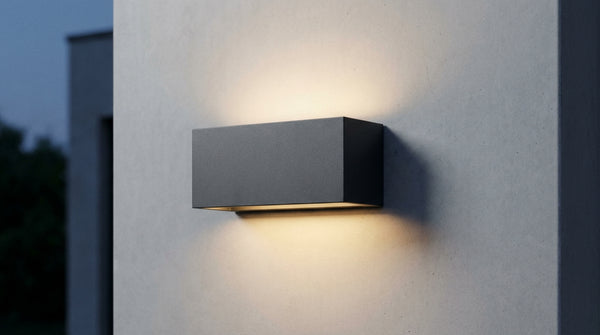
3000K spots: the warm light that suits every room
This article is also available in French: Spots 3000K

What is the difference between 3000K and 4000K?
The number measures colour temperature, never power. The higher it goes, the more the light leans towards blue. At 3000 K, the white is warm, slightly golden; at 4000 K, it becomes neutral and more direct. The first sets a mood, the second lights a task.
What does the "k" on a bulb mean?
The k is the kelvin, the unit of colour temperature. It describes the tint of the white and nothing else. It says nothing about the amount of light, which is read in lumens: a 3000 K bulb can be discreet or powerful. The choice between white or yellow light therefore comes down to this single number.
3000K, 4000K, 6000K: what changes on the wall
The same floor changes character depending on the tint cast on it. That is why a living room lighting project is decided in this order: the tint, then the layout, then the models.
| Temperature | Effect on the wall | Where it is used |
|---|---|---|
| 2700 K | very warm white, almost amber | bedroom, reading corner, table lamps |
| 3000 K | warm golden white | living room, dining room, bedroom, hallway |
| 4000 K | neutral white | worktop, office, garage |
| 6000 K | cold bluish white | workshop, technical outdoor areas |
The switch happens around 3500 K. Below that, the room warms up; above it, it turns neutral.
Which room will these 3000K spots live in?
The 3000K bulbs in our catalogue can be read sheet by sheet: base, output, warranty, recommended room. It is the shortest way to decide between two similar references.
Is 3000K a good light for a living room?
Yes, it is the safest tint for a living space. It lights without bleaching faces and leaves warm materials intact. In a review of 21 references from our 3000K Bulbs collection on 6 October 2026, the Living room room is declared on 76% of them.
What 3000K does to woods and textiles
A light oak, a raw linen, a green velvet: 3000 K warms them instead of dulling them. 4000 K brings out the grain but cools the beiges. This tint also keeps consistency with table lamps and avoids two different whites on the same wall, the detail that separates controlled interior decoration from lighting placed at random.
Where 3000K disappoints
On a worktop, a desk or a garage, the warm tint tires the eyes faster when reading and lacks contrast on small print. Three rooms therefore call for another white. The rest of the house can stay at 3000 K without a visible break, hallway included.
A living room lit only by spots remains bare. Adding an LED ceiling light or a low light source gives a second level of atmosphere, often for very little work.
Cut-outs and height are prepared before drilling: installing recessed spots in the living room is decided on the plan, not on the ladder.
How many ceiling spots, and at what distance from the wall?
Allow one source per 1.5 to 2 m² in circulation areas, and go down to 1 m² where you read or cook. For the effect on the wall, keep the first spot 50 to 70 cm from the partition: any closer, the light climbs and leaves a patch.
Count by zone rather than by room
A living space is divided into three zones: the sofa, the table, the circulation. A spot that lights the table well often overlights the sofa. Count zone by zone, then check the total: the method for working out how many spots per m² is explained in detail, and it avoids a ceiling covered in spots.
The distance to the wall that avoids the patch
A spot too close to a partition draws a hard cone above a shelf. Keep the same interval between two neighbouring spots and between the spot and the wall. The distance between ceiling spots is measured with a tape measure, before drilling, never after.
Spacing that is too wide leaves dark zones between two cones, too tight multiplies cast shadows. The simplest approach is to mark the points on the floor, under each future location.
If the plan does not work, simply write to us: with the width of the room and the ceiling height, the layout can be calculated with no obligation.
Once the count is done, it remains to choose the model: the 3000K bulb collection can be filtered by base and by room, which avoids ordering a reference that will not fit.
Dimmable 3000K spot: what should you check before buying?
Three points: an LED-compatible dimmer, a bulb whose sheet states dimming, and a base identical to that of the fixture. A 3000 K spot not designed for dimming flickers or hums on a dimmer. This information is read before purchase, not after installation.
Dimmer and LED spot: the sticking point
An old dimmer, designed for halogen, dims poorly below 20% with LEDs: the light jumps, whistles or switches off suddenly. The problem almost always comes from there, rarely from the bulb. Knowing what a dimmable spot is therefore comes down to a mention on the sheet: dimming "yes" or "no".
The rest of the time, you really do lower the light in the evening: a 3000 K at 30% is enough to watch a film without switching off the room. For this use, a model among the GU10 dimmable LED bulbs is chosen on the same sheet, checking the stated compatibility.
IP20 inside, IP65 outside
Of the 21 references reviewed from our 3000K Bulbs collection on 6 October 2026, the IP20 rating is declared on all of them. That is an indoor rating. Under a canopy, on a terrace edge or in a damp room, you need a sealed model: sealed outdoor bulbs meet this case.
The base decides the rest
In the same review, the E27 base comes out at 43%, G9 at 24%, E14 and G4 at 19% each. These bases are mainly found in fixtures with sockets. A recessed spot, on the other hand, is chosen in GU10 or GU5.3 depending on the installation voltage, 230 V or 12 V.
Before ordering, check the socket on the removed fixture: GU10 bulbs are recognisable by their two wide pins, a G4 reference by its thin pins.
3000K spots and bulbs: the collection selection


Then comes style: in a contemporary interior, a fixture matching the spots avoids a patchwork effect. A pendant above the table, a few wall lights, and light becomes a deliberate choice.
When doubt remains about a finish or a compatibility, the reviews published on our Google listing describe these choices in real situations, once the light is on.
Checklist before buying
Four lines to tick: the tint, the output in lumens, the base, the protection rating. Add the warranty: in the review of 21 references on 6 October 2026, it is 2 years on 62% of them and 5 years on 38%. The CE mark appears on all the references reviewed.
In stock · shipping costs shown at checkout · up to 30% off in your cart


Ready to turn inspiration into reality?
Tell us about your room, your style and your budget, and we will show you the pieces that truly suit your project.
Get guidance in 30 seconds →