Kitchen lighting trends 2025: light that follows your movements
This article is also available in French: Tendance luminaire cuisine 2025
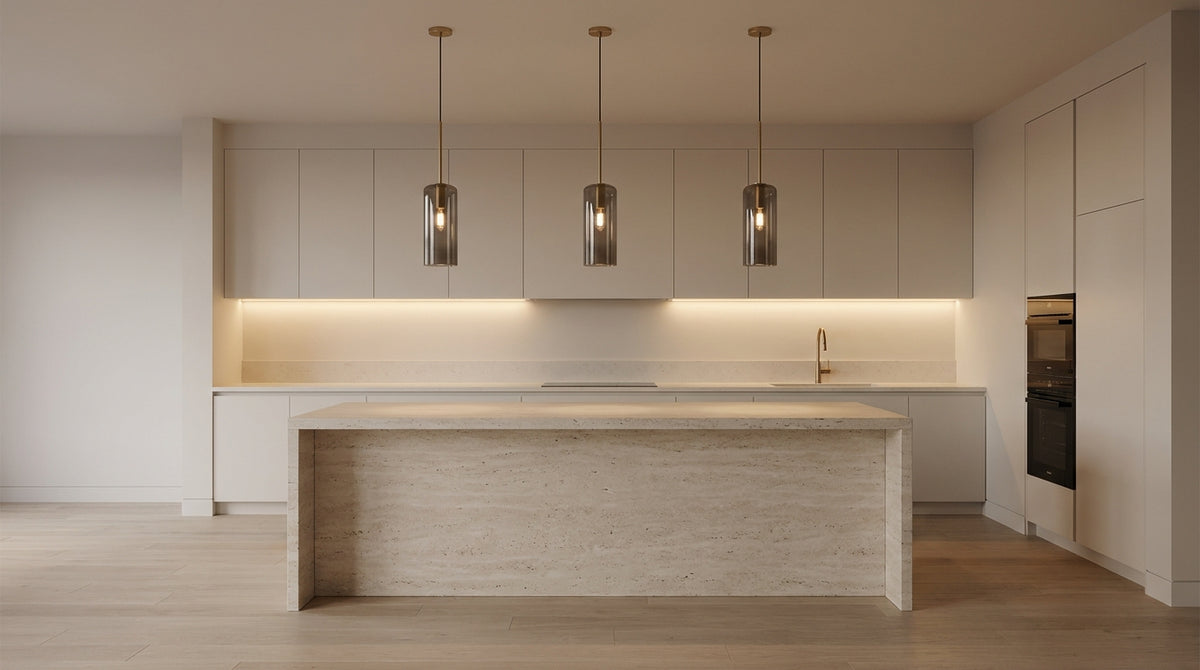
Start at the top: a line suspended above the island, dedicated lighting for the worktop, a ceiling light you lower a notch. Set these three layers before choosing a model. This order decides whether the room works, far more than the design of the fixture.
What are the kitchen lighting trends for 2025?
Three choices dominate: the linear pendant above the island, matte finishes and LED everywhere. On a survey of 250 references from our Kitchen Lighting collection as of 28 September 2026, suspended mounting accounts for 62% of the survey and the modern style for 77%.
Light travels from the ceiling down to the worktop. A kitchen redesigned around this single principle changes its look without a single cabinet moving, and this is often where a kitchen and dining room renovation begins.
Island pendants: the line that structures the room
Two or three aligned points are better than one central volume. The line guides the eye, marks the boundary with the living room and hangs low enough to actually light the space.
| Worktop length | Points | Diameter per point | Spacing |
|---|---|---|---|
| 1.20 m | 1 | 30 to 40 cm | none |
| 1.80 m | 2 | 25 to 30 cm | 60 to 70 cm |
| 2.40 m | 3 | 20 to 25 cm | 50 to 60 cm |
Mounting height is set between 75 and 85 cm above the worktop, never lower or you will be dazzled as soon as you lean over. A kitchen pendant is chosen on these measurements, not on the lifestyle photo.
Over a wide island, a linear island pendant usefully replaces three separate points, with a calmer line when seen from the living room.
Matte white, matte black, gold: the finishes that last
Matte ages better than gloss in a kitchen: fewer marks, fewer reflections on the cabinet fronts. Three shades carry the survey.
- White: 66% of the survey of 250 listings as of 28 September 2026. It disappears into a white ceiling and lets the light do the work.
- Black: 58% of the survey. It draws a crisp line above a pale island.
- Gold: 48% of the survey. It warms matte fronts without competing with them.
The kitchen lighting trend question often comes down to a single colour carried across every zone rather than three mixed finishes.
Once the zones are set, the rest comes down to the model: our kitchen lighting is browsed by use, not by catalogue.
What is the ideal lighting for a kitchen?
Three layers, no more: a general light on the ceiling, functional lighting on the worktop, ambient lighting you can dim. Aim for the total lumens suited to the surface rather than a single central point.
The three-layer method
- Layer 1, general: ceiling light or spotlights, for a background light that never works alone.
- Layer 2, functional: the worktop, ideally lit from under the cabinet, at hand height.
- Layer 3, ambient: wall light, strip or table lamp, switched on alone in the evening.
This method avoids the most common mistake: lighting the centre of the room while you cook at the edges. It is applied room by room in our kitchen lighting ideas.
How many lumens should you plan for by surface?
The usual rule stays simple: around 300 lumens per square metre for general light, more above the worktop.
| Kitchen surface | General light guide |
|---|---|
| 6 m² | around 1,800 lm |
| 10 m² | around 3,000 lm |
| 15 m² | around 4,500 lm |
These guides are recalculated according to ceiling height and wall colour. The full calculation is in our guide how many lumens for a kitchen, useful before ordering.
If your kitchen opens onto the living room and you are still hesitating between two moods, the simplest thing is to describe your kitchen to us: we reply on the heights and temperatures to use before you buy anything.
What is the ideal light colour for a kitchen?
2,700 K above the table, 3,000 to 4,000 K at the worktop. Two temperatures in the same room do not clash if they stay separated by zone: one warms the meals, the other renders colours accurately when you cook.
2,700 K above the table, 3,000 to 4,000 K at the worktop
- 2,700 K: warm white, reserved for the table and evening meals.
- 3,000 K: the compromise of an open kitchen, neither yellow nor clinical.
- 4,000 K: neutral white, for the worktop and chopping.
The white or yellow light question is settled by the colour of the cabinets as much as by the use of the room.
Colour rendering index, what changes on a tomato
A high colour rendering index makes reds accurate and greens believable: a ripe tomato does not turn dull brown. Aim for a CRI of at least 80, and 90 above the worktop.
LED technology accounts for 90% of our 250 listings surveyed as of 28 September 2026. The issue is therefore no longer the type of source, but the quality of that source.
In your kitchen, what holds you back the most today?
Which type of fixture is best suited to a kitchen?
The under-cabinet light first: it is the one used every day. Then the pendant above the island, the wall light on free walls, the spotlight for blind zones. A ceiling light alone lights the room without ever lighting the worktop.
Under the upper cabinet, the lighting used every day
A linear strip under the upper cabinet removes the shadow of your body on the chopping board, exactly where a ceiling light casts the opposite. It fits onto an existing cabinet without touching the worktop.
Watch out for water: in the survey of 250 references as of 28 September 2026, 98% are IP20, so keep them away from the sink. Our guide LED strip under the kitchen cabinet details the zones that tolerate humidity.
Wall lights and spotlights: when the ceiling is not enough
- Wall light: it frees the wall above the worktop, useful when no upper cabinet carries a strip.
- Recessed spotlight: keep it for walkways and zones without cabinets, with a narrow beam.
- Ceiling light: it carries the general layer and is dimmed low in the evening.
A kitchen wall light is placed between 40 and 60 cm above the worktop, facing downwards to avoid glare.
For background light, a dimmable LED ceiling light avoids installing two fixtures in a small room.
Pendants and ceiling lights for a well-lit kitchen


Open kitchen onto the living room: how to harmonise the two moods?
Keep the same family of light and separate the spaces by intensity, not by colour. The kitchen stays around 3,000 K, the living room drops to 2,700 K on its low points. The eye reads continuity, each zone keeps its use.
Two moods, a single family of light
- Same dominant temperature: 3,000 K in the kitchen, 2,700 K on the sofa side, never mixed within the same zone.
- Separate intensities: each zone switches on and dims independently.
- A visible break point: the chandelier above the table marks the boundary.
This transition is prepared at the planning stage, along with the choice of kitchen lighting.
Above the table, a kitchen chandelier lowered to 75 cm from the worktop is enough to mark the limit between the two spaces.
The case of a 22 m² open kitchen
Take 22 m² open plan: three pendants aligned over the island at 3,000 K, a linear strip under the cabinet, a central ceiling light dimmed low, two additional points on the sofa side at 2,700 K. Each layer keeps its own switch, so you can cook without lighting the living room.
In the survey of 250 listings as of 28 September 2026, 18% mention dimming. In an open room, this is the criterion to look at before the shape of the fixture.
The rest is decided on site. Buyer reviews can be found on the Designix Google listing, and nothing replaces validating a lighting plan before buying.
In stock · shipping costs shown at checkout · up to 30% off in your cart


Ready to turn inspiration into reality?
Tell us about your room, your style and your budget, and we will show you the pieces that truly suit your project.
Get guidance in 30 seconds →