
Wrought iron floor lamps
This selection is also available in our French store: Lampes à poser sur pied en fer forgé
No products in this selection.
- Tracked delivery to your country Tracked delivery
- Secure payment at checkout Multiple payment methods
- 14 days to change your mind 14-day returns
- Secure payment Secure payment
Not sure of your style? Find it in 30 seconds
A few questions, and we will show you the pieces made for you.
Frequently asked questions
How do I choose the right product?
What are the delivery times?
Can I return an item?
Can I pay in instalments?
An interior that reflects who you are
Carefully selected pieces, shipped from our warehouses. Our team advises you before you buy, so you choose with confidence.
- Tracked delivery
- Pay in instalments, where available
- 14 days to change your mind
- Advice & showroom in Lyon, France
Start by measuring the height of the lampshade: placed next to a sofa, it should reach eye level when seated, so a stem that puts the light at shoulder height. The wrought iron then provides the design and finish that give this low light its character.
Which wrought iron floor lamp should you choose for a living room?
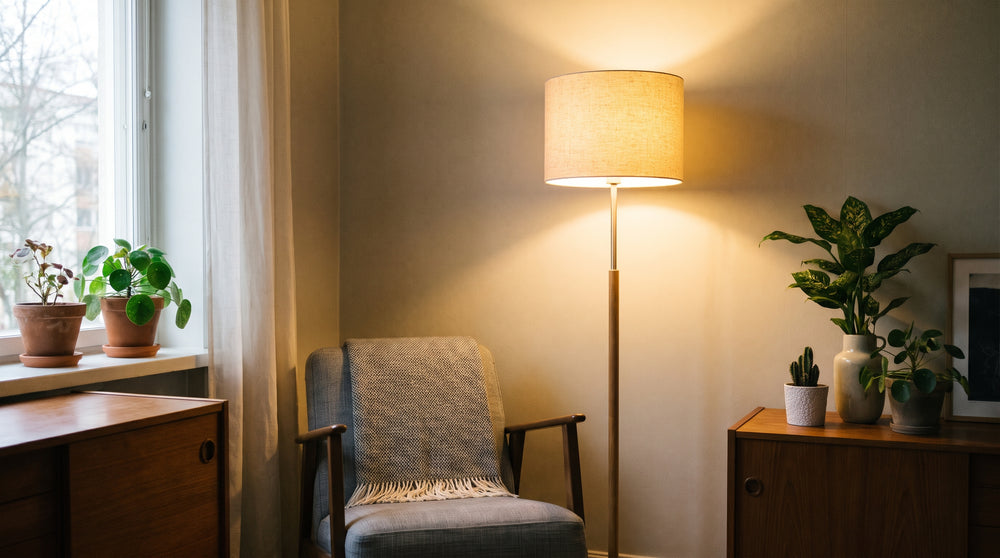
In a living room, this lamp replaces the ceiling light in the evening: pulled close to the sofa, it lights a book or an armchair without lighting the whole room. Two criteria decide before style does, the height of the stem relative to the seat and the free space left around the base. To gauge the proportions, compare with design table lamps for the living room.
Living room floor lamp: next to the sofa, in the corner or behind the armchair?
Allow for the space of the base before choosing the spot: a wrought iron stem works its design over its full height, so it needs a little distance to be seen. The free corner behind the sofa works well, provided you keep the switch within reach. Behind an armchair, prefer a slimmer stem so you do not block the way through.
Living room floor lamp: evening lighting without glare
Aim the shade so the light falls on the backrest or on a wall, never straight towards the eyes of whoever is seated. A low, side source is enough to read by, and it keeps the room dark enough for the television screen to stay comfortable. If the ironwork is very elaborate, it casts shadows on the wall, worth checking when you switch it on.
What light does a wrought iron floor lamp give?
The light comes from the shade and the bulb, not from the iron: a light fabric diffuses widely, a more closed and lower shade concentrates the beam towards the floor. The metal stem plays on reflections and on the shadows its design cuts on the wall.
Wrought iron floor lamp: direct light or light diffused by the shade?
A linen or cotton shade in light tones gives a soft, wide light: that is what suits an evening mood. An opaque, narrower shade directs the flow downwards and serves reading better. This collection contains no products for now, so no technical characteristic can be given here. To play with diffusion, look at linen table lamps and woven shades.
What the wrought iron design changes in shadows and reflections
A tight lattice, scrolls or a twist cast different shadows on the nearby wall, and that is often where the quality of the metalwork shows. Place the lamp thirty or forty centimetres from a light wall to read that design. A patinated finish returns a matte light, a lacquered finish returns sharp reflections.
How do you choose between wrought iron floor lamp models?
Three measurements can be compared from one product page to another: the total height of the stem, the diameter and material of the shade, the finish of the iron, patinated or lacquered. The socket type and the accepted wattage appear on the product page, never assume them from the photo.
Wrought iron floor lamp: the three dimensions to check
The total height decides the use: too low, it lights your knees; too high, it rises above the backrest and glares. The diameter of the shade must stay consistent with the size of the base, otherwise the whole looks unsteady. Finally, the cable length and the position of the switch matter as much as the design: a lamp placed far from the socket needs an extension lead. A slim, tall stem slips more easily behind a seat than a wide base.
Wrought iron floor lamps: straight stem, scrolls or lattice?
The straight stem and the sober lattice suit a calm interior and are barely noticed when switched off. Scrolls and twisted lines take up more visual space and are chosen for what they draw. Not to be confused with a floor lamp proper: the latter rises above the sofa and lights widely, whereas a lower floor lamp slips in next to an armchair. For a tall, slim stem, see the black versions for the living room.
Where should you place a wrought iron floor lamp in the home?
It goes where the ceiling light is not enough: end of the sofa, living room corner, next to a reading armchair, in a wide hallway or along a bedroom wall. Leave the width of a clear passage around the base, and check that a socket is within reach before settling on the spot.
| Room | Role of the lamp | Placement | To check |
|---|---|---|---|
| Living room | Evening accent light | End of sofa or free corner | Height of the shade relative to the seat |
| Bedroom | Reading and mood | Near the headboard, on the socket side | Cable length and accessible switch |
| Hallway or corridor | Light marker on arrival | Against a wall, out of the way | Stability of the stem and width of the base |
| Study | Side accent | Left or right of the screen | No reflection on the screen |
| Dining corner | Mood set back from the table | Near a wall or a sideboard | Side light rather than direct light on the tabletop |
Wrought iron floor lamp in a hallway or corridor
In a passage, stability rules: a wide base and a heavy stem stay in place when you brush past the lamp with a bag. Keep it against the wall, never in the middle of the path, and prefer a switch you can reach without bending down. A narrow corridor copes badly with a wide shade. See also the adjustable table lamps.
In the bedroom: next to the bed or in the corner?
Next to the bed, the lamp is for reading and must switch off without getting up: check the position of the switch on the cable or on the socket. In the corner, it sets the mood and leaves the bedside free. Models designed for the bedroom often favour more compact stems, and a black metal bedside lamp completes the set well.
How do you match a wrought iron lamp with the rest of the living room?
Wrought iron talks to raw wood, glazed ceramic, linen and gilded brass. Repeat its finish two or three times in the room, on a console, a frame or a bench, so the lamp looks chosen rather than left there by chance.
Old wrought iron bench, console or side table: creating a coherent series
A bench, a side table or a console in the same finish as the lamp stem is enough to create a series. Two wrought iron pieces in one room is enough: beyond that, the metal takes over and the light falls into the background. If the bench is patinated and the lamp lacquered, keep them apart.
Wrought iron and wood, ceramic or linen: which materials to pair?
Black metal warms up against raw wood, glazed ceramic brings a contrast between matte and gloss, linen diffuses a soft light. For light finishes, look at the ceramic pieces and the wood models.
| Paired material | Effect | Where to use it | To avoid |
|---|---|---|---|
| Raw wood | Warms the metal, workshop feel | Living room, hallway | Multiplying strong grains |
| Glazed ceramic | Contrast between matte and gloss | Bedside, console | Too many colours on one surface |
| Linen or cotton for the shade | Diffuses a soft light | Bedroom, living room | Fabric too thick, which darkens |
| Gilded brass | Warm glow, more precious feel | Living room, study | Stacking up golden finishes |
| Glass or crystal | Reflections and visual lightness | Living room, hallway | Direct source without a diffuser |
How do you clean a wrought iron lamp?
Unplug the lamp, then dust the stem with a soft, dry cloth, without abrasive product or scouring sponge. A barely damp cloth is enough on lacquered finishes, followed by immediate drying. Socket and switch always stay dry.
Cleaning the wrought iron stem without damaging the finish
In the hollows of a scroll or a lattice, a soft brush catches the dust where the cloth cannot reach. Once a month is enough, and twice a year for a patinated finish: water that stagnates in the hollows tarnishes the metal. Do not use steel wool or degreasing products on a worked finish.
Shade and socket: the maintenance not to forget
A fabric shade is dusted dry, with gentle suction or a lint roller, and never gets wet. Before handling the socket, cut the power: a visual check of the bulb and the wire is enough to spot a worn cable. For more delicate shapes, see the crystal table lamps.
How do you connect several lamps to a single power supply?
Add up the wattage of the bulbs in all the lamps and check that the total stays within what the power strip and the circuit accept. Avoid stacking power strip on power strip and running a cable under a rug. Beyond a few lamps on the same socket, have the installation checked by an electrician.
Adding up the wattages before connecting several lamps
The wattage is read on the packaging of each bulb, and the addition is done before plugging everything in, not after. A cheap power strip rarely states what it can handle: if the figure is missing, assume it is meant for very little. A cable that heats up or a smell of plastic means unplug everything.
Power strip, extension lead, dedicated circuit: when to ask an electrician
A cable crossing a passage is replaced by an extra socket, and a cord visible under a rug is moved. When several lamps and a more demanding appliance share the same supply, a professional decides. It is also the moment to check the cable length of each lamp. Design LED table lamps need little wattage, which simplifies the calculation.
How do you arrange ceiling spotlights when adding a floor lamp?
Recessed spotlights are aimed at walls, paintings or a worktop, never straight at a sofa or a bed where people sit. A floor lamp then brings the low light that is missing, and the two sources complement each other instead of competing.
Should you keep the spotlights when adding a floor lamp?
Keep them, but change their role: they light vertical surfaces and circulation areas, the floor lamp takes over on the seat and for reading. A ceiling fully switched off in the evening makes the room more intimate; that is a choice, not a rule. Design LED table lamps and gold and black finishes lend themselves well to this mix.
Ceiling spotlights: aim them at the walls rather than at the eyes
A spotlight tilted towards a light wall returns an indirect, grazing light that enlarges the room without glare. Tilted towards the seat, it creates a hard patch and shadows under the face. For a more sober interior, the modern lines for the living room and the Nordic register sit well with this wall lighting.
Frequently asked questions
What are the trends for floor lamps in 2026?
Current collections lean towards slim stems in black or patinated metal, light fabric shades and worked bases that remain visible. Wrought iron is coming back through its material and its design rather than through heavy ornament. A lamp is chosen for its light and its place, not for a trend.
What is an original floor lamp?
It is a lamp whose stem becomes a decorative element: wrought iron with scrolls, lattice, twisted line or patinated finish. The originality lies in the design of the base and in the way the shade lets it show, rather than in an accessory added afterwards.
How do you recognise an Italian design table lamp?
Italian design shows in the fineness of the lines, the proportions between the stem and the shade, and careful finishes such as brass, glass or lacquered metal. On a wrought iron lamp, this inspiration gives a more pared-back design than classic scrolls.
The most beautiful living room lamps, how do you choose them?
A beautiful living room lamp is first of all well proportioned to its room: stem height at sofa level, a shade neither too wide nor too narrow, light that illuminates without glare. The finish and the wrought iron design come after these three criteria.
Eating at a wooden table without a tablecloth: what light above the tabletop?
Without a tablecloth, the wood remains visible: light coming from the side brings out its grain, whereas a source too directly above creates reflections and hard shadows. A floor lamp placed set back, near a wall or a sideboard, complements the pendant above the table.
Ordering from Designix
The rest of the catalogue can be browsed in our lighting for the home, and to widen the comparison, see our living room table lamps.




