
Wooden floor lamps
This selection is also available in our French store: Lampes à poser sur pied en bois
No products in this selection.
- Tracked delivery to your country Tracked delivery
- Secure payment at checkout Multiple payment methods
- 14 days to change your mind 14-day returns
- Secure payment Secure payment
Not sure of your style? Find it in 30 seconds
A few questions, and we will show you the pieces made for you.
Frequently asked questions
How do I choose the right product?
What are the delivery times?
Can I return an item?
Can I pay in instalments?
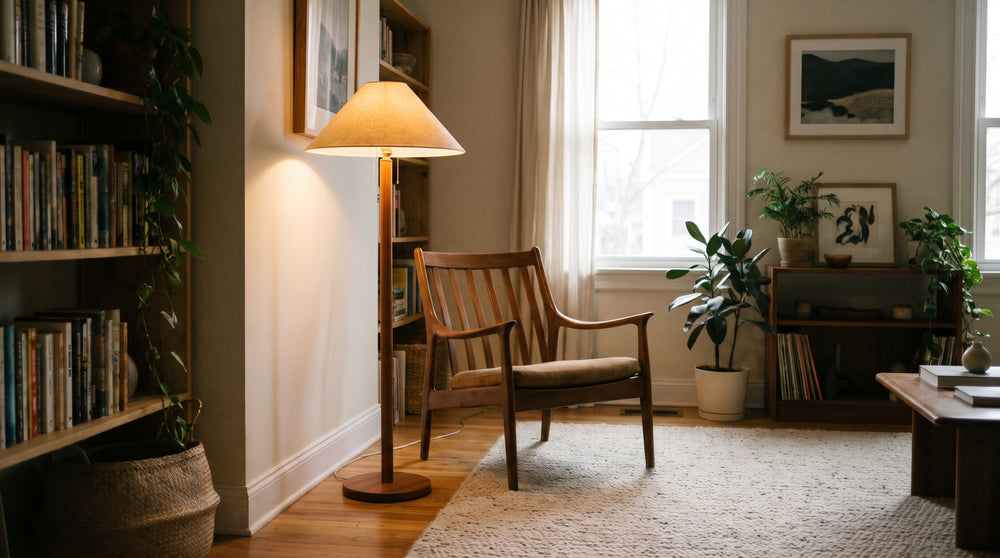
An interior that reflects who you are
Carefully selected pieces, shipped from our warehouses. Our team advises you before you buy, so you choose with confidence.
- Tracked delivery
- Pay in instalments, where available
- 14 days to change your mind
- Advice & showroom in Lyon, France
Allow one lamp on a stand per seating area: one at the end of the sofa, one near the reading armchair. The wooden stem brings the shade up to hand height and keeps the light low, soft, directed towards the floor or the wall. The wood sets the tone of the room, the shade sets the comfort.
What light does a wooden floor lamp give?
A wooden floor lamp lights the area where you sit, not the centre of the room: the source stays lower than a ceiling light and the light comes from the side. A fabric shade spreads it widely and softens it; a shade open towards the wall bounces it back as indirect light. The wood of the stem changes the look, never the amount of light.
Solid wood floor lamp: which shade for which mood?
This collection contains no products at the moment: no stem material, height, socket or finish is therefore available to show here. Choosing a tightly woven fabric shade, linen or thick cotton, remains a question of subdued light, but you will need to come back when wooden floor lamps are added. Linen shades give an irregular weave that softens slightly cool bulbs.
Warm or neutral light: which bulb to choose?
For a living room or a bedroom, stay around 2700 K to 3000 K: the light leans towards amber and rests the eye in the evening. A desk or a reading corner takes 3500 K to 4000 K, whiter, which keeps text sharp without tiring. Check the socket first of all, E27 for most stems, E14 on small formats. Designer LED lamps avoid heat build-up near a fabric shade.
Where to place a floor lamp in the living room?
Set it at the end of the sofa, near the reading armchair or in the corner that stays dark in the evening. It must be within reach without getting up, and its shade should sit above the eyes of a seated person: lower, the light hits the gaze; higher, it no longer lights the page. Models designed for the living room respect these working heights.
Tall floor lamp or floor lamp: what are the differences?
A tall floor lamp rises above the back of the sofa and washes the room widely; a floor lamp stays more compact and serves as local accent light. A living room with only a ceiling light gains from a tall lamp in the corner and a low lamp near the armchair, two levels of light instead of one. Designer floor lamps for the living room cover this second role.
How to light a reading corner without a ceiling light?
Place the stem behind the reader's shoulder, not in front: the shade then comes down to book height and the rest of the room falls into a restful half-light. An adjustable source, tilted towards the page, settles the question in one go. A light rug on the floor reflects a little light and avoids too harsh a contrast between page and wall.
Solid wood floor lamp or driftwood floor lamp: which to choose?
Solid wood gives a regular, heavy stem: it stands straight, wipes clean with a cloth and suits a living room where the lamp does not move. Driftwood keeps irregular curves and grain, each stem is different, more rustic, in its place in a seaside decor or a mineral interior.
Dark wood or light wood floor lamp: what effect in the room?
A light wood, oak or ash, brightens the furniture and pairs with linen, off-white and matte ceramic. A dark stained wood stands out against a pale wall, asserts the silhouette and accepts black metals; it also shows scratches more. Black versions play the same contrast with a more graphic finish.
Driftwood tall floor lamp: how to recognise real driftwood?
Wood that has spent time in water carries hollowed fibres, softened edges and uneven tones, never a regular grain. Run your hand over it: an irregular, slightly satin surface betrays the work of water and sand, a smooth and uniform look betrays an applied stain. Scandinavian style sometimes borrows these curves with straighter woods.
What height and footprint to allow for a wooden floor lamp?
The useful height is measured from the floor to the bottom of the shade: it must rise above the back of the sofa or the worktop it accompanies, otherwise the light goes into the fabric. Also allow for the footprint of the base and the space behind the furniture for the cable and the switch.
| Room | Placement | Stem height | Type of light | To avoid |
|---|---|---|---|---|
| Living room, sofa corner | at the end of the sofa or in the dark corner | above the back of the sofa | diffuse, fabric shade | a stem lower than the seat |
| Living room, reading corner | behind the armchair | shade above the eyes of a seated person | directed towards the book | dazzling the seated person |
| Bedroom | on a chest of drawers or a wide bedside table | short stem, shade below the bed base | warm and subdued | a source turned towards the bed |
| Desk | at the end of the worktop | shade at seated shoulder height | adjustable, no reflection on the screen | the source facing the screen |
| Hallway | near the console or the door | tall stem, narrow base | accent, left on in the evening | an unstable stem in the walkway |
Which stem for a small living room or a narrow corner?
Look for a slim stem and a wide but flat base: stability comes from the base, not from the diameter of the stem. A tall, narrow model slips into a corner of a few dozen centimetres without eating into the walkway. Models for the bedroom often adopt these compact proportions, also useful near a sofa.
How to check that a floor lamp will fit behind the sofa?
Measure the space between the back and the wall, then subtract room for the cable and plug, which need a few centimetres more than the base. A lamp tilted slightly forward gains even more depth. Small black bedside formats show the order of magnitude of a narrow base.
How to connect several lamps to a single power supply?
Several lamps can run from the same wall socket via a power strip or a socket rail, provided the current allowed by the circuit is not exceeded. Add up the wattage of the bulbs, not of the sockets. For a clean look, a socket controlled by a switch saves unplugging each lamp in the evening.
Power strip, socket rail or switched socket: which to choose?
A power strip is a stopgap under a piece of furniture, provided it stays visible and accessible. A socket rail, fixed to the skirting board, tidies the plugs and limits trailing cables. A switched socket suits a fixed installation: a wall switch turns everything on. In all cases, keep your hand on the plug to cut the power if anything heats up.
How to hide the cable of a floor lamp?
Run the cable down the stem to the skirting board, then follow the skirting board to the nearest socket, with an adhesive cable cover in the colour of the wall. A rigid cable cover or a discreet trunking holds up better over time. For adjustable models, adjustable models need a little slack at the joint.
Italian, Scandinavian or artisanal designer floor lamp: which style for a living room?
Italian design plays on sculptural shapes, slim stems and lacquered or metallic finishes; Scandinavian style stays with light woods, straight lines and simple fabric shades. Artisanal work favours raw wood and irregularities. A very designed lamp stands out, a sober lamp blends into the decor: the room decides.
The most beautiful living room lamps: on what criteria should they be judged?
Switched off first: proportion between stem and shade, a base heavy enough to hold at the first knock, a joint that does not creak when the object is lifted, an even finish under the hand. Switched on next: the pool of light must cover the seating area without dazzling. Style comes after, when these points hold. Designer wooden floor lamps are judged on the same markers.
What distinguishes an Italian designer floor lamp?
A silhouette drawn like an object, slim stems, deep lacquers or polished metals, and visible joints that are part of the design. The stem may leave the vertical, the shade may become a sphere or a cylinder set at an angle. The difference lies in the shape and the finishing detail, not in the light produced. See also modern floor lamps for the living room, which follow another logic, more geometric.
How to match a wooden floor lamp with the rest of the living room?
A wooden lamp is matched by picking up a tone already present in the room, table, shelf or frame, rather than adding one more wood. A dark stem pairs with black metals and light textiles; a light wood takes linen, off-white and matte ceramic.
Dark wood, black or gold: how to combine finishes?
Stay with two families of finishes per room, three at most. A dark wood with matte black and an ecru textile works; adding brass brings the whole closer to warm. Gold and black meet well on a neutral wall background. Gold and black versions give this contrast without multiplying materials.
What budget to allow for a wooden floor lamp?
Think in three levels: entry range, mid range and exceptional piece. The gap comes down to the wood, solid or veneered, the quality of the joint and the shade, often the most fragile part. A solid base and a simple shade hold up better than a light stem and a thin fabric. A white ceramic stem remains an alternative when the wood does not match the furniture.
How to care for a wooden stem and strip a varnish that has yellowed?
A wooden stem is dusted dry and fed once or twice a year with a suitable oil or wax, which limits marks and water stains. If the varnish yellows or flakes, it is removed with a stripper or progressive sanding, then the bare wood is protected again.
| Source | Socket | What it changes | To check before buying |
|---|---|---|---|
| Halogen bulb | E27, sometimes E14 | immediate warm light | heat given off near a fabric shade |
| LED with classic socket | E27 or E14 | less heat, longer life | colour temperature on the packaging |
| Integrated LED | no socket | nothing to change, fixed shape | source cannot be replaced |
| Dimmable bulb | E27 or E14 dimmer compatible | adjustable intensity in the evening | compatibility with the switch |
Caring for the wooden stem
Without product, sand by hand or with a sander, starting with a medium grit then refining, with regular extraction so as not to load the air. Sanding takes longer than a stripper but suits flat surfaces like a straight stem. The bare wood is then protected with an oil or a wax. Designer desk lamps are cleaned in the same way.
What to do about marks and water stains on varnished wood?
A white mark often comes out by rubbing along the grain with a cloth slightly soaked in linseed oil, then letting it dry. A dark mark, on the other hand, has gone into the wood: it needs local sanding and re-staining. Always test on a hidden side. For an associated metal base, metal desk lamps need only a microfibre cloth.
Designix reassurance: secure payment, tracked delivery, returns according to the shop's conditions and a customer service team you can reach to confirm a socket or a height before ordering. To compare lighting families, browse all our lighting collections and choose the room before the model.
Frequently asked questions
What is the difference between a floor lamp and a tall floor lamp?
Both start from the floor, but a tall floor lamp means a high stem, often above the back of the sofa, whose shade lights the room widely. A floor lamp is more compact and serves as accent light near an armchair or a console. In both cases, the wood of the stem defines the style.
How to choose a driftwood bedside lamp?
Look for a short, stable stem, whose shade stays below the height of the bed base so as not to get in the way when waking up. Driftwood brings irregular curves: check that the base is wide enough not to tip over at the first touch of a hand.
The most beautiful living room lamps, how to recognise them?
A beautiful lamp is judged first switched off: proportion between stem and shade, stability of the base, quality of the joint and of the wood. Switched on, it must light the seating area without dazzling. Style comes after, when these three points hold.
What is an Italian designer floor lamp?
Italian design is recognised by drawn silhouettes, slim stems, deep lacquers and visible joints that are part of the design. It treats the object as a decorative piece, where a standard model seeks to be forgotten. The difference lies in the shape, not in the light.
How to strip a varnished wooden piece of furniture?
Apply a wood stripper with a brush, remove it with a scraper before it dries completely, then finish with progressive sanding and careful dusting. Always test the product on a hidden area: two woods react differently to the same stripper.
How to recognise a cheap but solid wooden floor lamp?
An entry-level model can hold up if the stem is solid wood rather than veneered board, if the base is wide enough to stay upright and if the joint does not move when the lamp is lifted. Weight and finish often say more than the label.
Can you put a glass on a wooden table without a cloth?
An oiled or waxed table lets water and greasy stains penetrate less. Without treatment, a mat or a tray is better, especially on an old varnish that has lost its protective film.




