
Wicker lampshades
This selection is also available in our French store: Abat jours en osier

- Tracked delivery to your country Tracked delivery
- Secure payment at checkout Multiple payment methods
- 14 days to change your mind 14-day returns
- Secure payment Secure payment
Not sure of your style? Find it in 30 seconds
A few questions, and we will show you the pieces made for you.
Frequently asked questions
How do I choose the right product?
What are the delivery times?
Can I return an item?
Can I pay in instalments?

An interior that reflects who you are
Carefully selected pieces, shipped from our warehouses. Our team advises you before you buy, so you choose with confidence.
- Tracked delivery
- Pay in instalments, where available
- 14 days to change your mind
- Advice & showroom in Lyon, France
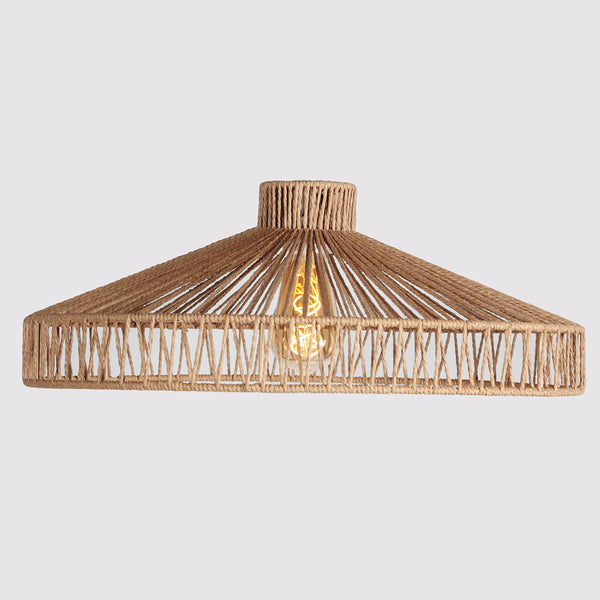
The weave filters the light: expect a striped, soft effect, more diffuse than stretched fabric, with an E27 socket and a 19 cm format to compare with the base of your lamp. This selection dresses a dining room pendant, a floor lamp or a table lamp, in cream braided cord on a metal frame, IP20, so for indoor use only. The collection brings together two models.
What light does a wicker lampshade give?
The weave filters and softens the light: the fibres let through a striped glow, softer than a stretched fabric lampshade. With an E27 socket and a beige or cream colourway, the effect stays warm and diffused around the lamp, without glare.
What a cream braided cord changes
The mesh of the weave lets light through in small points, drawing bright patterns on the wall or nearby ceiling. The cream tone warms the bulb's light and avoids too white a halo. If you want a more even light, the fabric models diffuse without a pattern, while the linen lampshades keep a finer weave.
Why the metal frame matters to the effect
The cord is laid over a metal frame that holds the round shape and keeps the weave even. A rigid frame stops the lampshade from warping with the bulb's heat and ensures an even diffusion all the way round, rather than one side brighter than the other.
Wicker lampshade: for which room and which base?
These lampshades are designed for the dining room, where the weave filters the light above the table. As the E27 socket is standard, the lampshade also fits a floor lamp, a standing lamp, a table lamp or a bedside lamp, provided you check the 19 cm format.
Wicker lampshade for a standing lamp and floor lamp
On a floor lamp, the lampshade is seen from a distance: compare its diameter with that of the base to keep a balanced silhouette. The 19 cm format stays compact, so it will suit a slim base best. The E27 socket takes a standard bulb, so it is easy to replace. To light a reading corner, also look at the pieces designed for the living room.
Wicker lampshade for a table lamp and bedside lamp
Placed on a piece of furniture or a bedside table, a compact lampshade lights without taking up the surface. The weave limits glare when you look at the lamp up close, which makes it comfortable for reading. Check the direction of the socket before buying, then browse the models for the bedroom if you are looking for a second matching light.
How to choose your wicker lampshade?
Three criteria are enough: the base and its socket, the lampshade format relative to the base, and the material, which decides the light effect. In this selection, the socket is an E27 and the format is 19 cm, two simple references to compare before buying.
| Base | What the light should do | What to check | Collection data |
|---|---|---|---|
| Pendant above a dining table | Light the table downwards | Socket, fixing, cable adjustment | E27 socket, 19 cm format, IP20 |
| Standing lamp and floor lamp | Light downwards, large volume | Lampshade diameter relative to the base | E27 socket |
| Table lamp | Complete a corner, low light | Compact format, socket orientation | 19 cm format, E27 socket |
| Bedside lamp | Close light, little glare | Small diameter, filtering material | Braided fibres, 19 cm format, IP20 |
| Terrace and outdoors | Withstand the weather | High protection rating | IP20: sheltered indoor use only |
What is the rule for choosing a lampshade?
Start from the base, not the style: note the socket type and the diameter of the base, then choose a lampshade whose bottom roughly lines up with the width of the base. A lampshade narrower than its base looks lost; wider, it unbalances the lamp. The 19 cm format in this selection suits a modest-sized lamp.
Which material for a lampshade?
The material decides the effect before the shape. A weave lets light through its mesh and creates a pattern; a stretched surface diffuses it without a design. A glass lampshade lights more directly. The cream braided cord model combines metal and cord, with a tight weave that stays even all the way round.
How to hang a lampshade from the ceiling?
For a ceiling light or a woven pendant, switch off the power at the breaker, fix the bracket to the ceiling in a solid material, connect the wires according to live and neutral, then fit the lampshade onto the socket. The height is then adjusted above the table.
Ceiling light and wicker pendant: what to check before drilling
First identify the type of ceiling: in a solid slab or a joist, the fixing holds directly; in plasterboard without a reinforcement, you need a suitable plug or an existing anchor point. Switch off the current at the breaker and check there is no voltage before touching the wires. If in doubt about the connection, call an electrician.
Adjusting the pendant correctly above the dining table
Adjust the cable so it does not obstruct the view of seated guests and does not hide the table: the pendant sits higher than a bedside lamp, in the zone where the tabletop is still visible. A woven lampshade casts a pattern on the ceiling, so leave some free space above.
Does wicker withstand rain?
No. The models in this selection are rated IP20: this protection covers contacts and dust, not water. A lampshade in braided fibres is therefore for indoor use, in a sheltered room. For an exposed terrace, you need a reference designed for outdoor use.
| Characteristic | Value | What it means |
|---|---|---|
| Socket | E27 | Standard E27 bulbs, easy to find |
| Protection rating | IP20 | Sheltered indoor use, no damp room or outdoors |
| Format | 19 cm | Compact format for a table or bedside lamp |
| Materials | Metal and braided cord | Rigid frame, natural weave |
| Colourway | Beige, cream, transparent | Warm, neutral light |
| Shape | Round | Even diffusion around the lamp |
| Style | Modern | Suits a contemporary interior |
| Main use | Dining room | Above the table |
| Warranty | 2 years | Selection covered by the Designix warranty |
What exactly does an IP20 rating protect?
IP20 means the light is protected against solid objects larger than 12 mm, so fingers and everyday dust, and offers no protection against water. It is fine in a living room, dining room or bedroom, but not in a damp bathroom or under a roof overhang exposed to rain.
Outdoor wicker lampshade: what solution?
For a terrace, balcony or garden, look for a light whose protection rating is designed for damp, not an indoor model moved under an awning. If you want to keep a natural feel indoors, the white and cream versions carry the same pale tone into another room.
What is the difference between rattan and wicker?
Rattan is a vine worked into a weave, wicker is a willow whose supple stems are used for the same crafts. Both give a natural, warm effect, and are chosen mainly for the fineness of the weave, the colour and the shape of the lampshade.
Two braided fibres, two origins
Wicker is harvested as fine stems that are bent after soaking; rattan, longer and more supple, is worked into strips. Once braided, both give an openwork surface that filters light in the same way. The difference shows to the touch: tighter or looser mesh, a paler or more honeyed tone.
What it changes when choosing
The choice comes down to the effect and the silhouette, not to a principle of strength. A tight weave hides the bulb more and gives a softer light; a loose weave leaves more marked patterns. The Bremen model in braided cord goes for evenness, while other collections turn to black for a sharper contrast.
| Material | Appearance | Light effect | Care |
|---|---|---|---|
| Wicker | Willow fibre, natural weave | Filtered, striped light | Dry dusting |
| Rattan | Braided vine, even mesh | Filtered, striped light | Dry dusting |
| Braided cord on metal frame | Tight weave, cream tone | Soft, diffused light | Soft cloth, without wetting |
| Linen and fabric | Stretched surface, opaque | Softer light, fewer patterns | Dusting or washing depending on the model |
| Glass | Smooth, transparent surface | Direct light, little filtering | Cleaning with a soft cloth |
How to make a homemade lampshade?
Start from an existing frame or bracket, measure the height and the circumference of the base to draw a template, cut the material leaving a margin, then glue or sew the fabric onto the frame. Braided cord needs a more even application than fabric.
How to change a lampshade's fabric?
Remove the lampshade from its bracket, take off the old fabric without twisting the frame, then cut the new material following the original shape, margin included. Stretch the top first, then the bottom, spreading the excess around. Work on a clean surface and check that the socket and bulb remain accessible once reassembled.
What equipment is needed to make a lampshade?
A flexible tape measure, a large sheet for the template, scissors or a craft knife, glue suited to the material, and a few clips to hold the fabric while it dries. Add a pencil and a ruler for drawing straight lines. For a weave, plan for patience rather than special tools.
How to make a lampshade template?
Lay the lampshade flat on a large sheet, follow the top and bottom circumference of the frame, then join the two following the slope. Add a margin of a few centimetres for gluing before cutting the final material. Test the template dry on the frame before gluing.
Cheap wicker lampshade: what really changes the budget
The budget depends mainly on the material and the fineness of the weave, not the style: a tight, even weave takes more work than a loose one. The current price is shown directly on each product page in the collection.
What pushes up the price of a woven lampshade
The number of strands, the evenness of the work, the finish of the frame and the tone obtained by natural treatment matter more than size. A more elaborate piece can be spotted by hand: even mesh, a clean join around the edge, a frame that does not wobble. A loose weave is still fine for occasional use.
Spotting an affordable piece without sacrificing sturdiness
On an affordable piece, check the rigidity of the frame, the cleanliness of the finishes and the fixing onto the socket: these are the points that decide its lifespan. The modern-style lampshades in our lampshade selection share this metal base, which limits unpleasant surprises.
Frequently asked questions about wicker lampshades
Where can I find a rattan lampshade?
In the collections of braided fibre lampshades: rattan and wicker are worked in the same way. Check the socket, here an E27, the protection rating, IP20 so indoor use, and the 19 cm format before comparing with your lamp.
Which glass lampshade for a bedside lamp?
A glass lampshade lets through much more light than a weave: it lights more directly and suits a bedside lamp placed near a book. In this collection, the weave filters the light and limits glare, with a standard E27 socket.
Can a wicker lampshade fit a floor lamp?
Yes if the socket matches, and the selection is E27, the most common format. On a floor lamp or standing lamp, above all compare the diameter of the lampshade with that of the base and the volume of the stand, to keep a balanced silhouette. See also the lighting department.
Can you put a wicker lampshade on a table lamp?
Yes, with an E27 socket and a format compatible with the base. A 19 cm format stays compact: it suits a table lamp on a piece of furniture or a table, where a wider lampshade would unbalance the whole. Check the fixing before buying.
How to care for a lampshade in braided fibres?
Dust dry with a soft cloth or a light brush, without wetting the weave. For embedded dust, use a vacuum cleaner on minimum power with a brush nozzle. To change the bulb, switch off the power and handle the lampshade by the frame rather than the fibres.
How to make a lampshade template?
Lay the lampshade flat on a large sheet, follow the top and bottom circumference of the frame, then join the two following the slope. Add a margin of a few centimetres for gluing before cutting the final material.
Choose, install, order
For a dining room, start with a round pendant in cream braided cord, E27 socket and 19 cm format: the weave filters the light above the table and draws a light pattern on the ceiling. For a bedroom or a reading corner, the same format fits on a table lamp. Then compare with the models suited to a baby's room if you are fitting out a second room, and browse our lighting catalogue to match the whole.
Every order is covered by secure payment, tracked delivery, returns and Designix customer service. The selection comes with a two-year warranty, and the current price is shown on each product page.




