
Waterproof LED battens
This selection is also available in our French store: Réglettes LED étanches
No products in this selection.
- Tracked delivery to your country Tracked delivery
- Secure payment at checkout Multiple payment methods
- 14 days to change your mind 14-day returns
- Secure payment Secure payment
Not sure of your style? Find it in 30 seconds
A few questions, and we will show you the pieces made for you.
Frequently asked questions
How do I choose the right product?
What are the delivery times?
Can I return an item?
Can I pay in instalments?
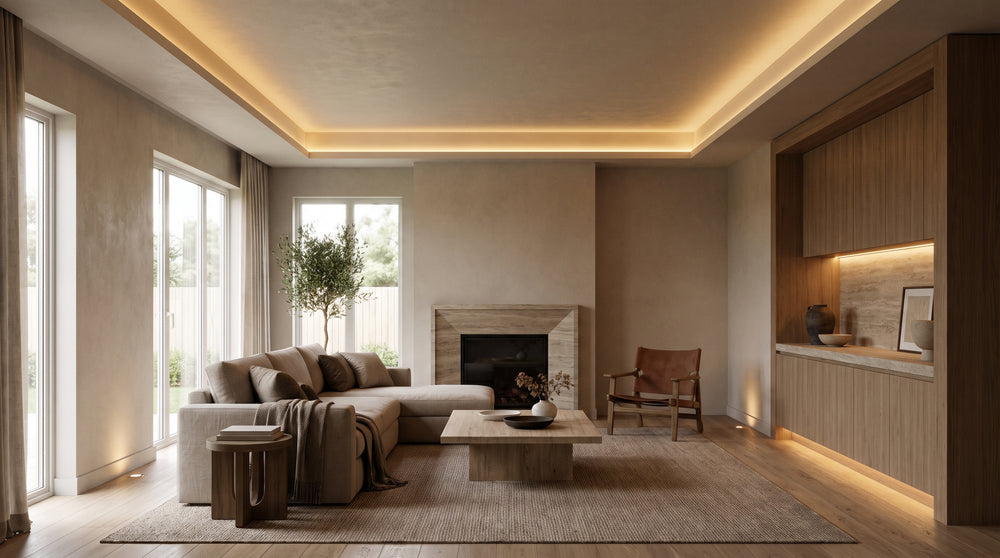
An interior that reflects who you are
Carefully selected pieces, shipped from our warehouses. Our team advises you before you buy, so you choose with confidence.
- Tracked delivery
- Pay in instalments, where available
- 14 days to change your mind
- Advice & showroom in Lyon, France
Choose the right batten on three concrete criteria: the length that covers the work area, the protection rating that matches the actual humidity of the room, and the colour temperature suited to the use. In a garage or utility room, a 120 cm IP65 model in neutral white handles most situations.
What is a waterproof LED batten and which rooms should it go in?
A waterproof LED batten is a linear light fixture whose housing and diffuser keep moisture and dust away from the components. It is mounted on the ceiling or as a surface fixture in a garage, workshop, utility room, bathroom or under a canopy. Its light spreads in a continuous line, with no hot spot and no marked shadow zone between two sources.
The light output matters as much as the protection: placed near a work wall, a LED batten lights the surface directly instead of diffusing from the centre of the room.
IP65 waterproof LED batten: what the rating really protects against
The first digit of the IP rating covers solids, the second covers liquids. An IP65 rating means a housing sealed against dust and resistant to water jets: this is the usual level for a garage, utility room or workshop. An IP44 rating only protects against splashes. Remember this benchmark: beyond IP65, you enter jet-washing territory, useful in a plant room. Battens rated IP65 cover most damp rooms in a home.
Garage, workshop, utility room, bathroom: the rooms that need a waterproof batten
Four situations justify a sealed housing: the garage where the air is dusty, the workshop where metal filings fly, the utility room where humidity lingers, the bathroom where water sprays. To equip a garage, length comes before everything else. For workshop lighting, aim for a continuous line above the workbench. A damp bathroom above all needs a rating consistent with the distance to the tub.
What length of waterproof LED batten should you choose: 40, 60, 120 or 150 cm?
Length is chosen according to the area to be lit and the space available. A short 40 or 60 cm model suits a cupboard, a worktop or a small utility room. Lengths of 120 and 150 cm cover corridors, garages and workshops, with more even light along the length.
| Length | Where to install it | What it changes |
|---|---|---|
| 40 cm | Cupboard, under a wall unit, small pantry | Lights a precise spot without spilling over |
| 60 cm | Utility room, worktop, short hallway | Covers a narrow work area |
| 120 cm | Single garage, workshop, corridor | Continuous light over a work station |
| 150 cm | Double garage, long workshop, storeroom | Limits shadow zones between two stations |
40 cm and 60 cm waterproof LED batten: the small linear fixtures
These formats are fitted where a round fixture will not fit: under a shelf, above a utility sink, in a narrow storage closet. Measure the length of the unit then leave a few centimetres on each side. A model that is too long overhangs and lights the wall rather than the surface.
120 cm and 150 cm waterproof LED batten: covering a garage or workshop
Over these lengths, the light spreads along the whole line and cast shadows decrease. For a car, a single 120 cm line above the work area is often enough. A double garage benefits from two parallel lines or a 150 cm length per bay. Mounting height matters as much as length: mounted very high, the light scatters.
Waterproof LED batten with motion sensor: what is it for?
The sensor switches the batten on as you pass and off after an adjustable delay, so you do not have to look for the switch with your hands full. It is useful in a garage corridor, a pantry, a cellar or a service entrance, and it limits consumption in passage areas.
Sensor built into the housing or separate control
A sensor housed in the profile avoids running a second cable and keeps a clean line on the ceiling. A remote control becomes worthwhile when the area to monitor is far from the fixture, or when several battens need to switch on together. Presence-detection models are often chosen for a pantry, and versions with a 220V-powered sensor simplify connection to an existing installation.
Adjusting the delay and detection range
Two settings make the difference between comfort and annoyance: the on-time and the sensitivity. A short delay suits a passage, a longer one suits a workshop where you stand still at the bench. Avoid aiming at a window, a radiator or an animal path: these are the three classic causes of false triggers.
What light for a waterproof LED batten: neutral white, cool white or warm white?
Neutral white, around 4000 K, remains the most versatile for a garage or workshop: it keeps colours accurate and is less tiring on the eyes. Cool white, bluer, suits technical work areas. Warm white is reserved for living rooms, such as a bathroom.
Neutral white or cool white: which to choose for working?
Cool white is generally above 5000 K, warm white around 2700 to 3000 K. At a station where you read instructions, spot a detail or sort parts, neutral white remains the best compromise. Cool white gives an impression of sharpness but hardens contrasts and is tiring over time. Warm white light suits a utility room treated as a living space.
Reading power and flux without getting it wrong
Compare models on power in watts and flux in lumens, but keep consistency in mind: a very low flux announced for a high power suggests a mis-entered label. In that case, go by the power and trust the light output. A batten that is too powerful in a small volume dazzles; two weaker points are better than one very intense one.
Waterproof LED batten or powerful LED ceiling light: which to choose?
A waterproof batten lights along its length, without cast shadow, and is fitted near the wall or worktop. A powerful LED ceiling light diffuses more widely from the centre of the room. In a garage or utility room, the batten has the advantage; in a living room or hallway, the ceiling light remains more decorative.
| Solution | Strength | Limitation | Room |
|---|---|---|---|
| Waterproof LED batten | Continuous linear light, protected housing | Fixed length, not cuttable | Garage, workshop, utility room |
| LED strip | Flexible, cuttable, fits anywhere | Less protected without a profile | Under-unit, niche, decor |
| LED ceiling light | Wide diffusion, decorative role | Less effective near a work wall | Living room, hallway, bedroom |
LED ceiling lighting: linear or point source
The choice depends on the shape of the room. A long, narrow room suits a line; a square room suits a central source. An LED ceiling light in the centre of a garage leaves the corner where you work in shadow, whereas a batten fitted thirty centimetres from the wall lights exactly where your hands are working.
In a living room, the wall light or chandelier remain decorative choices
A batten has no place above a sofa: it lights too directly and does not suit soft lighting. For living rooms, browse our lighting catalogue and look at wall lights or chandeliers. The batten keeps its technical role, reserved for service areas.
How to install and fix a waterproof LED batten to the ceiling or wall?
First mark the axis and the fixing points, drill, screw the brackets, then clip the profile onto its supports. Connection is made with the power off, on a junction box or a cable suitable for damp conditions, with the gland tightened. A spirit level avoids the effect of a line that slopes.
Ceiling mounting, surface mounting or under a cabinet
On the ceiling, two brackets are enough for a standard length; a third prevents sagging on a large format. For surface mounting, the batten is fixed above the worktop, at shoulder height so as not to cast the shadow of your hands. Under a cabinet, check that the clearance lets heat escape and that the cable does not rub.
Mains connection and sealing of cable entries
Switch off the circuit breaker before any work. The cable enters the housing through a gland: tightened correctly, it prevents water from running along the sheath. A sheath pulled too tight breaks the seal, too loose and it lets damp air in. Battens connected to the mains are fitted on a box or a switch, and rechargeable versions avoid wiring in a cupboard without a socket.
Can you cut a LED batten or a LED strip?
A rigid batten cannot be cut: its profile, diffuser and electronics are one piece. A flexible LED strip, however, is cut at the printed marks, every group of LEDs, with scissors, with the power off. The circuit is then closed with a suitable connector.
Cuttable LED strip: locating the cut points
The cut marks are printed on the strip, between two groups. Cutting elsewhere switches off the portion after the line. For a niche or a plinth, a LED strip or bar slips in where a rigid profile will not fit; measure the actual length and allow for a connection connector.
Rigid batten: choose the right length from the start
Since it cannot be cut, measure before ordering. Measure the free space between two walls or the length of the unit, then leave a margin. A recessed LED profile is chosen with its support: the ceiling cut-out must match the width of the housing exactly.
How to maintain a waterproof LED batten and avoid mistakes?
A soft, slightly damp cloth is enough; avoid abrasive products and direct jets on the seals. Also check that the gland remains tight, that the diffuser is properly clipped and that the batten is not placed in an area where the protection rating is no longer sufficient.
Cleaning the diffuser without damaging the seal
Switch off the power, then wipe a barely damp microfibre cloth over the diffuser. Solvents and alcohol dull the polycarbonate and harden the seal. Then check the clipping along the whole length: it is a weak point more common than the electronics themselves.
Common mistakes: overestimated IP, wrong length, fixing in a damp corner
Three mistakes come up again and again. Believing an IP44 will hold under a canopy battered by rain. Choosing a length for the room rather than for the work station. Fitting the batten in the coldest corner, where condensation drips. Any doubt about outdoor exposure is settled by looking at the models for lighting a covered terrace or the battens designed for outdoors.
Frequently asked questions
What is the difference between an IP65 and an IP44 waterproof LED batten?
IP65 indicates a housing sealed against dust and resistant to water jets, which covers a garage, utility room or bathroom. IP44 only protects against splashes: it is enough away from a water point, but not in a regularly wet area or under an exposed canopy.
Can a waterproof LED batten be installed outdoors?
Yes, provided you choose a protection rating suited to the exposure. Under a canopy or a covered terrace, a standard waterproof model is enough. On a facade battered by rain or near the coast, a higher IP is needed and you should check that the housing is UV-resistant, otherwise it yellows.
What length of waterproof LED batten for a garage?
For a single-car garage, a 120 cm batten placed above the work area already lights the essentials. A double garage benefits from two lines or a 150 cm length per bay. Mounting height matters as much as length: too high, the light scatters.
How does a waterproof LED batten with motion sensor work?
An infrared or microwave sensor detects movement and closes the circuit for an adjustable time, from a few seconds to several minutes. Range and sensitivity are set on the housing. The sensor must remain accessible and must not point at a window, a source of unnecessary triggers.
Does a 220V waterproof LED batten plug into a socket?
It depends on the model: some come with a cable and plug, others are designed for fixed connection to a junction box or switch. In a damp room, fixed connection is preferable, with a tightened gland and the power switched off before any work.
How to clean a waterproof LED batten without damaging the seal?
Switch off the power, then wipe a barely damp microfibre cloth over the diffuser. Solvents, alcohol and abrasive sponges dull the polycarbonate and harden the seal. Then check that the diffuser is reclipped along its whole length to maintain the seal.
Waterproof LED batten or neon: what changes with the switch to LED?
A neon tube requires a ballast and a starter, and its start-up is slower. A LED batten integrates the electronics into the profile: instant start, no flicker, and light that is easier to direct onto the worktop. The profile is also flatter on the ceiling.
Once the length and rating are chosen, all that remains is to check the space on the ceiling and the cable route. Browse the waterproof selection or the garage selection to compare formats, and find all our lighting if the room needs a central source instead.
Secure payment, tracked delivery, returns available and Designix customer service: your order is followed through to installation.




