
Wall garlands
This selection is also available in our French store: Guirlandes murales
No products in this selection.
- Tracked delivery to your country Tracked delivery
- Secure payment at checkout Multiple payment methods
- 14 days to change your mind 14-day returns
- Secure payment Secure payment
Not sure of your style? Find it in 30 seconds
A few questions, and we will show you the pieces made for you.
Frequently asked questions
How do I choose the right product?
What are the delivery times?
Can I return an item?
Can I pay in instalments?
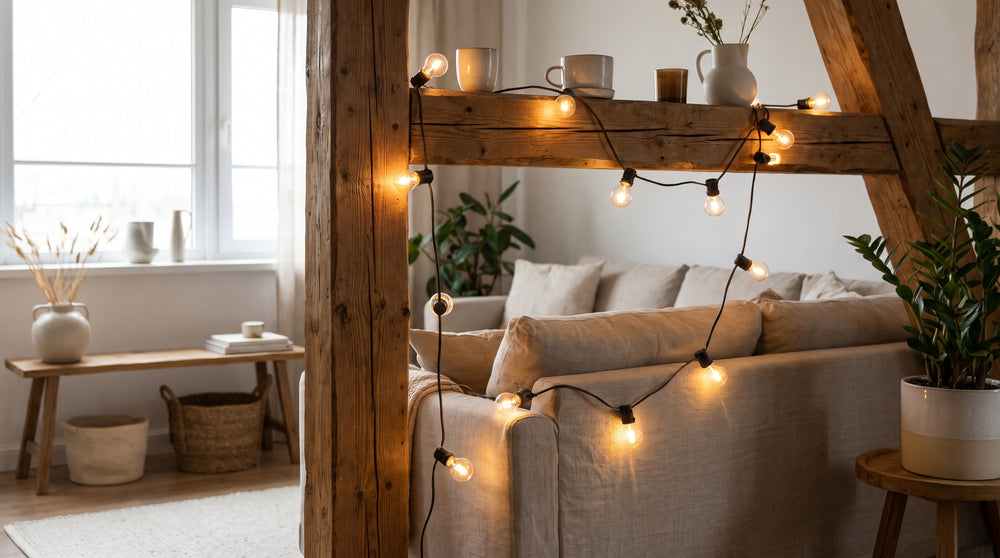
An interior that reflects who you are
Carefully selected pieces, shipped from our warehouses. Our team advises you before you buy, so you choose with confidence.
- Tracked delivery
- Pay in instalments, where available
- 14 days to change your mind
- Advice & showroom in Lyon, France
A wall fairy light string is fixed to the wall to trace a frame, follow a shelf or watch over a headboard. You choose it first on three points: the length of the run to the socket, the presence of a power supply nearby and the wall's exposure to humidity. The light colour comes next.
What is a wall fairy light string and what light does it give?
A wall fairy light string is a string of lights fixed to the wall rather than placed on a piece of furniture. Depending on the model, it traces a frame around a window, follows the line of a shelf or watches over a headboard. The light comes from small, closely spaced LEDs, in warm white or in colour.
Wall fairy lights: what you actually fix to the wall
The difference from a string laid out or stretched across a room lies in the cable: it runs along the wall, so it stays visible. On a plug-in model, this cable goes down to the socket; on a rechargeable model, it almost disappears. The switch matters as much as the run: placed at the end of the line, it forces you to unhook the wire every evening. Plan for it to be accessible, or choose a control at the start of the cable.
Wall strings: the grazing light that draws a frame
The closer the line is to the wall, the more the light stays grazing and highlights the material, the relief of a render or the edge of a shelf. Moved a few centimetres away, it spreads more widely and lights the room. Warm white (around 2700 to 3000 K) gives an end-of-day mood; coloured versions are more for a play corner or a party. In the evening, it is this low line that replaces the main ceiling light. To compare product families, browse the fairy lights and the LED strings.
Where to install a wall fairy light string in the home?
In the living room, above the sofa or along a bookcase; in an adult bedroom, as a night light behind the headboard; in the office, on the wall behind the screen; in a hallway or on a staircase, to accompany footsteps without dazzling. Each room calls for a different model, in length as in intensity.
Living room and adult bedroom wall strings: the walls seen in the evening
In the living room, the wall behind the sofa is the most looked at: a rectangular frame above the backrest, or a line that skirts a bookcase, structures the room without drilling four holes. In an adult bedroom, the string goes behind the headboard and acts as a night light: you then look for a moderate glow, not a luminous wall. An adjustable-intensity model settles the question.
Hallway, staircase and office: lighting a passage without installing a fixture
In a hallway, a continuous line along the passage is enough to guide without dazzling, provided the cable is kept out of reach of hands and bags. On a staircase, fix to a solid part of the wall, never on a stair nosing, and out of children's reach. In the office, the string lights the wall behind the screen: avoid it reflecting in the panel, offset it to the side. To place these models in the wider range, see wall and hanging fairy lights and our lighting world.
LED wall strings: which power supply to choose?
Three families stand out: the string plugged into a socket or a circuit, the low-voltage model with a transformer, and the string rechargeable by USB or solar. The choice depends above all on the presence of a socket near the wall, the length of the run and how often it is switched on.
Plug-in wall fairy lights: mains and low voltage
Mains power requires a nearby socket or a connection: the cable becomes part of the decor, to be accepted or hidden with a slim trunking. Low voltage adds a transformer, which must be housed and kept accessible without hiding it behind a fixed piece of furniture. In return, the cable is thinner and blends better into a pale wall. The mains-powered strings and the low-voltage strings cover these two cases.
Rechargeable or solar wall strings: when there is no socket
Without a socket, USB charging is the simplest solution: you unhook, recharge, rehook. The constraint is how often you recharge, to be planned according to use. On a balcony or a facade, solar avoids any handling, but its performance depends on the wall's actual sun exposure: a north wall will never give the same result as a south-facing wall. See the rechargeable wall strings and the solar strings for balconies.
Which protection rating for an outdoor wall fairy light string?
Outdoors, you look at the protection rating: IP44 resists water splashes and suits under an awning or on a covered terrace, IP65 withstands rain and dust on an exposed facade. Indoors, a model without a high rating is more than enough. The connection must stay sheltered in all cases.
IP44 or IP65: read the rating before hanging an outdoor wall string
A covered terrace wall receives splashes, not driving rain: IP44 is enough there. An unprotected facade, exposed to wind and showers, calls for IP65, and above all watertight connectors, because that is often where water gets in. The string can be perfectly protected while the socket stays uncovered: check the connection point before the wall itself. The IP44-protected models and the IP65 strings for facades can be compared on this criterion.
Indoors, damp rooms and balconies: the cases to check
In a bathroom or a cellar, ambient humidity justifies a protected model even without direct rain, and a socket away from water points. On a balcony, the wind drives rain further than you would imagine: treat it as outdoors. Finally, an indoor string left outside will not last a damp season.
Wall fairy light string or wall light: what to choose for each room?
A wall light is a fixed fixture, which requires an electrical supply at the wall and directs light upwards or downwards. A wall fairy light string often makes do with a socket and plays the decorative line. In a living room, a bedroom or a hallway, the two complement each other more than they compete.
Using a wall fairy light string where a wall light requires work
Installing a wall light means a recessed supply, so a chase or a surface cable. A string makes do with a socket, comes down when you leave and leaves only a few fillable holes: when renting, that is decisive. It does not light a reading surface, it underlines a line. The LED strings and the whole Designix catalogue let you compare the two approaches.
Using a premium-design wall fairy light string in the living room
When the wall must stay clean, everything comes down to the cable and the fixings: a thin wire, aligned clips, a colour close to the surface. A discreet string can then coexist with a wall light already in place, below it or as a complement, without the two competing for attention.
| Criterion | Wall fairy light string | Wall light |
|---|---|---|
| Electrical supply | A simple socket may be enough | Requires a power supply at the wall |
| Type of light | Small LEDs spread in a line | Single source, directed up or down |
| Installation | Hooks or clips, removable | Fixed to the wall, often permanent |
| Style | Decorative line, frame or row | A luminous object in its own right |
| Suitable rooms | Living room, bedroom, hallway, staircase, outdoor | Living room, hallway, staircase, headboard |
| Maintenance | Dry dusting of the cable and LEDs | Dusting of the shade |
Premium-design, art deco or art nouveau wall fairy lights: how to recognise them?
Style is read in the shape of the support and the finish: geometric lines and gold metal for the art deco spirit, plant curves and glass for art nouveau, a discreet cable and neat fixings for a premium look. The quality of a wall fairy light string is judged on these details, not on the number of LEDs.
Art deco and art nouveau wall strings: the signs that make the difference
Art deco plays with regular arches, straight lines and gold or brushed brass metals. Art nouveau prefers curves inspired by plants and glass supports. In both cases, the motif must stay readable from a distance: a simple, repeated shape holds up better than a busy design once placed on a three-metre wall.
Using a premium-design wall fairy light string without overloading the wall
One strong line per wall is enough. Align the line on an existing reference point (sofa backrest, shelf, frame) and keep a regular height: it is irregularity that betrays DIY, not the model. A cable in the colour of the surface disappears. To broaden your search, see the fairy lights and return to the lighting department.
How to hang and maintain a wall fairy light string?
First trace the run in pencil, check the length and the position of the socket, then fix with hooks suited to the surface. A regular height and a taut cable are enough. Dust dry, and check outdoor connections before each damp season.
Wall strings: fixing without drilling and keeping a straight line
Measure the planned run, then add the length needed to reach the socket: this is the most frequent mistake. Adhesive hooks hold on a smooth, clean wall, within the load limit stated by the manufacturer; they fail on crumbly render, a damp wall or outdoors when exposed. Test on a little-seen area before fixing everything.
Wall decoration: matching the string to frames and shelves
Run the line behind or under the frames rather than through them. Dry dusting of the cable and LEDs is enough for maintenance; water on the connectors is the usual cause of failures. Before the damp season, check the junctions of the strings for covered terraces and the strings without a socket.
| Room | Use of the wall | Preferred power supply | Protection rating | Point to watch |
|---|---|---|---|---|
| Living room | Frame above the sofa, outline of a bookcase | Mains or rechargeable | Indoor | Wall length and socket position |
| Adult bedroom | Night light behind the headboard | Rechargeable or low voltage | Indoor | Soft light, limited glow |
| Office | Wall behind the screen, shelf support | Mains with switch | Indoor | Reflection to avoid in the screen |
| Hallway and staircase | Continuous line, handrail or riser | Mains or rechargeable | Indoor | Fixing out of reach of hands |
| Covered terrace | Outdoor wall string | Mains or solar | IP44 minimum | Socket and connection sheltered |
| Exposed facade | Outdoor wall string | Protected mains | IP65 | Watertightness of connectors |
How to choose your wall fairy light string at a glance?
You start from the room and the wall: available length, presence of a socket, exposure to humidity, desired light colour. Then come the style and the discretion of the fixing. This sorting avoids buying a wall fairy light string that is too short, poorly protected or too bright for the room.
Summary: room, power supply, protection
In order: the wall and its length, the available power supply, exposure to water, then the desired look. A measured run plus the distance to the socket gives the minimum length. A nearby socket points to mains; a bare wall to rechargeable; outdoors to IP44 or IP65. Once this sorting is done, style separates the models.
What Designix guarantees on your order
Secure payment, tracked delivery, returns and Designix customer service: you order the length and protection rating that match your wall, and adjust if needed. To compare finishes, start again from the wall and hanging fairy lights and the whole Designix catalogue.
See the Designix lighting department
Frequently asked questions about wall fairy lights
Can you replace wall lights with a wall fairy light string in a living room?
Yes, provided the wall has a socket or the model is rechargeable. A wall fairy light string does not light like a wall light: it underlines a line and creates a mood, without directing light onto a reading surface. It therefore complements the living room lighting rather than replacing it.
Are there premium-design wall fairy lights?
The premium look is recognised by the finish and the discretion of the cable: brushed metal or brass support, neat clips, evenly spaced LEDs, warm white light. A model can look neat in a photo and show a thick cable or visible fixings once placed on the wall.
How to recognise an art deco or art nouveau wall fairy light string?
The art deco spirit is read in straight lines, regular arches and gold metals; art nouveau in curves inspired by plants and glass supports. In both cases, the wall fairy light string must stay readable from a distance: simple shape, repeated motif, cable blended into the wall colour.
How to install a wall fairy light string in a hallway or on a staircase?
The string is fixed at hand height or along the handrail, keeping the cable out of the passage and the socket accessible. On a staircase, each fixing point must hold on a solid part of the wall, never on a stair nosing. A nearby switch prevents leaving it on.
Can you put a wall fairy light string in an adult bedroom or an office?
Yes: in an adult bedroom, it acts as a night light behind the headboard or along a shelf; in an office, it lights the wall without casting a reflection on the screen. Favour warm white light and a model with a moderate glow, so as not to disturb sleep or reading.
Which LED wall fairy light string to choose for outdoors?
You choose the protection rating according to exposure: IP44 for a covered terrace or an awning, IP65 for a facade exposed to rain. The connection must stay sheltered and the connectors watertight. A wall fairy light string intended for indoors will not last a season outside.
How to hang a wall fairy light string without drilling?
Adhesive hooks or hanging clips are enough on a smooth, clean wall, provided the load stated by the manufacturer is respected. Avoid this type of fixing on crumbly render, a damp wall or outdoors when exposed. First test the adhesive on a little-seen area.
How many light points and what length of wall fairy light string to choose?
Measure the planned run, then add the length needed to reach the socket. Tight spacing gives a continuous line, wide spacing a more pronounced string effect. Better a slightly longer model, even if you gather the excess, than a string too short halfway up the wall.




