
Vintage orange table lamps
This selection is also available in our French store: Lampes à poser coloris orange vintage
No products in this selection.
- Tracked delivery to your country Tracked delivery
- Secure payment at checkout Multiple payment methods
- 14 days to change your mind 14-day returns
- Secure payment Secure payment
Not sure of your style? Find it in 30 seconds
A few questions, and we will show you the pieces made for you.
Frequently asked questions
What table size for how many people?
Which tabletop material should I choose?
Extendable or fixed?
How do I care for the tabletop?
The right furniture, in the right place
Check the dimensions with our fit checker and receive pieces made to last. Unsure? Our team will answer your questions.
- Tracked delivery
- Pay in instalments, where available
- 14 days to change your mind
- Advice & showroom in Lyon, France
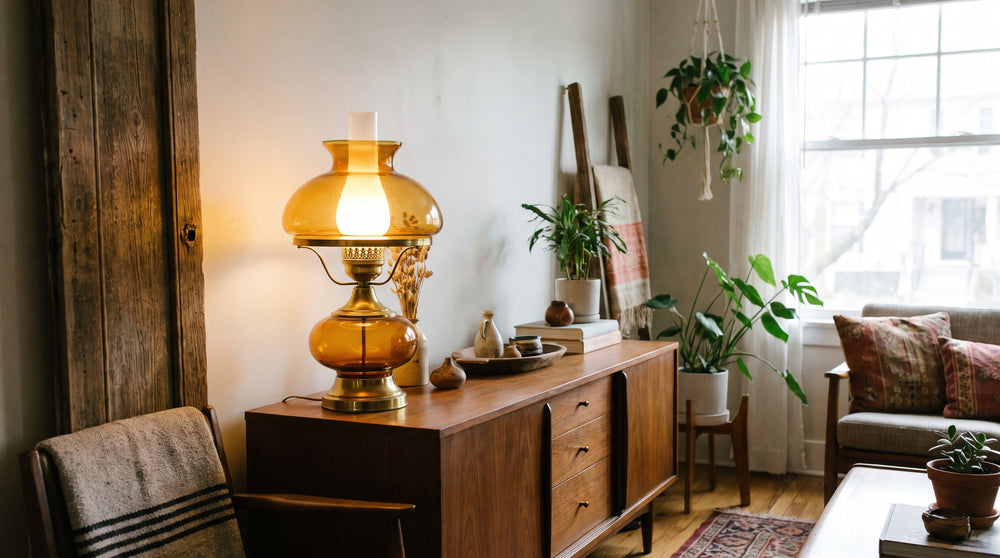
Start with the use: a low, wide shade for a reading corner, a sphere for a console, an adjustable arm for a desk. The vintage orange finish comes next, once you have checked the socket, the height relative to the furniture and where the cable runs.
- Choosing for the living room
- The colours that go with it
- Pairing with furniture
- Connecting several lamps
- Spotlights and accent lamp
- Which living room lamp style
- Where to place it
- Size, socket and light
Which vintage orange table lamp should you choose for your living room?
Start with the light: a vintage orange table lamp gives diffused light, with a round shade or a sphere that hides the bulb and spreads a warm glow into a corner. Then check three practical points: the stability of the base, the height relative to the furniture and where the cable comes out.
Vintage orange table lamp: the criteria that matter
This collection currently has no products: there is therefore no material, socket, height or shape to compare, and no selection criteria can be drawn from the range. To prepare a future purchase, compare the shapes in the design table lamps for the living room selection.
Retro orange table lamps: shapes and materials
A sphere diffuses light all around and suits a shelf seen from several sides. A conical or cylindrical shade concentrates light downwards and serves a reading corner. Lacquered metal gives a strong hue, matte ceramic a softer colour that catches less light, glass a transparency that lets the bulb show. Browse every reference from the house in all Designix lighting.
What colour does orange go with in a living room?
Orange pairs with its warm neighbours, brown, terracotta, beige, and with its complementary colours, blues and greens. On a white or beige wall, an amber orange warms the room. On a dark wall, a mandarin or pale orange stands out better and stays readable in the evening.
Orange and wood, orange and green, orange and blue
With a parquet floor or a piece of raw wood furniture, amber orange extends the tone of the wood and creates a coherent retro pairing. With a deep green, the lamp stands out without shouting. With a petrol blue, the effect is more contrasted: the lamp becomes the warm point of the corner. To take the comparison further, look at playing with the blue complement and the black finish for the living room, which show the opposite effect.
Which orange to choose: amber, terracotta or mandarin
Amber leans towards honey and gives the warmest light. Terracotta is more matte and more discreet, it blends into an interior with natural tones. Mandarin is more saturated: it plays the role of a colourful object and needs a calm wall around it.
| Wall colour | Suitable orange | Effect achieved | To avoid |
|---|---|---|---|
| Off-white, beige | Amber or terracotta orange | The lamp becomes the warm point of the room | A saturated orange that clashes too much |
| Light grey, taupe | Mandarin orange | Soft contrast, readable in the evening | An orange that is too pale and blends in |
| Blue, deep green | Pale orange, almost yellow | The complementary colours reinforce each other | Two solid colours in the same place |
| Raw wood, brown | Rust, copper orange | Warm tones in harmony, retro spirit | A fluorescent orange |
| Black, anthracite | Saturated orange | The lamp stands out like an object | A washed-out orange with no texture |
Which furniture should you pair a vintage orange table lamp with?
A vintage orange lamp naturally pairs with a vintage leather armchair: both share warm tones and materials that age well. It can also sit near a wooden piece, cane or matte ceramic, while avoiding adding a third strong colour.
A vintage leather armchair and an orange lamp
A brown or cognac vintage leather armchair and an amber shade form a close harmony, without aggressive contrast. Place the lamp next to the armchair, at seat height, to light the leather at an angle: direct light carves hard shadows into it. Black leather also works with orange, but the effect becomes more graphic than retro.
Wood, cane and ceramic: natural pairings
Raw wood, cane and matte ceramic share a non-glossy surface that absorbs light and lets the orange tone show. A ceramic base brings weight and stability, a wooden base a lighter silhouette. The design wooden table lamps and matte ceramic set the tone; for a stronger contrast, see the gold and black finishes.
How do you connect several lamps to a single power supply?
Several table lamps can be connected to the same supply via a power strip or a socket block, provided you do not exceed the current rating of the circuit and the strip. Add up the wattage of the bulbs, avoid daisy-chaining extension leads and keep cables taut.
Adding up bulb wattage before connecting
Check the maximum wattage accepted by the power strip and by the circuit, then add up the bulbs you plan to have on at the same time. An accent lamp uses little, an adjustable spotlight more: the calculation is made on the whole, not lamp by lamp. If in doubt, spread the lamps over two sockets rather than one.
Power strip and extension lead: safety rules
A power strip placed on the floor stays away from walkways and water points. Avoid stacking an extension lead on an already loaded power strip, and unplug before changing a bulb. Adjustable lamps often have a shorter cable: check the distance to the socket before choosing their place.
How do you arrange ceiling spotlights with an orange table lamp?
Ceiling spotlights provide general lighting, the orange table lamp adds atmosphere. Spread the spotlights in regular lines, away from the walls, and avoid pointing them at the lamp so as not to create two competing sources in the same area.
General lighting and accent lighting
Spotlights light the room for moving around and tidying; the accent lamp creates a softer zone around an armchair or a console. Count the spotlights over the actual surface of the living room, keeping to the angles rather than the centre of the room, and let the table lamp occupy the reading corner. To vary the sources, look at the design LED models.
Avoiding two sources competing in the same area
A spotlight aimed at the shade casts a hard shadow and loses the point of the diffuser. Point the spotlights towards the walls or the floor, and keep the table lamp as the only warm source in its corner. This is also what distinguishes the atmospheres of a well-composed lighting catalogue from uniform lighting.
The most beautiful living room lamps: which style to choose in orange?
A beautiful living room lamp is one that lights the place where you sit: a low, wide shade for a reading corner, a sphere for a console, an adjustable arm for a desk. Italian or ball style is chosen according to the shape of the furniture, not according to fashion.
Italian design table lamp: simple shapes, indirect light
This movement brings together lamps with stripped-back shapes, often in lacquered metal, glass or with a stone base, which bounce light towards the wall or ceiling. The advantage in vintage orange: the tone stays readable without multiplying decorative details. The practical reference point does not change, a diffuser that hides the bulb and a stable base.
Design ball table lamp: all-round diffusion
The sphere lights in every direction, which suits a console or a shelf visible from several sides, and less a armchair where you want a beam. It sits on a wide piece of furniture so as not to overhang. Browse the living room design hub and, if you prefer clean lines, more contemporary models.
Where should you place a retro orange table lamp in the home?
In the living room, the vintage orange table lamp goes on a console, a side table or a shelf, at seat height. In the bedroom, it goes on the bedside table, with a shade that hides the bulb so as not to dazzle from the bed.
In the living room: console, side table, shelf
On a living room console, a medium lamp is enough: it fills the empty space without getting in the way. On a side table, it should stay taller than it is wide so it is not knocked over. On a shelf, check the clearance above the diffuser, and prefer a compact lamp like those with a wooden feel for the living room.
In the bedroom and office: bedside and desk
On a bedside table, a small format with a stable base and low light is better than a large sphere. On a desk, an adjustable arm lights the work surface without glare on the screen. See equipping a bedroom, a black metal bedside lamp and a workstation.
| Room | Location | Format and material | Light sought |
|---|---|---|---|
| Living room | Console, side table, shelf | Wide shade or sphere, wood, metal, ceramic | Warm and diffused, without dazzling the seat |
| Bedroom | Bedside table | Small format, stable base, glass or ceramic | Low intensity, shade hiding the bulb |
| Office | Corner of the work surface | Adjustable arm, metal | Aimed at the surface, no glare on the screen |
| Hallway | Tall unit or niche | Compact format, heavy base | Accent light, easy to switch on |
| Open kitchen | Work surface, splashback | Metal or ceramic, stable base | Light aimed at the work surface |
How do you choose the size, socket and the right light?
The lamp should stay taller than it is wide on a small piece of furniture and not exceed the shoulder height of a seated reader. Check the socket, E14 or E27, then the colour temperature of the bulb: 2700 K for warm light, 3000 K for a more neutral atmosphere.
Bulb, socket and colour temperature
The socket is marked on the holder: E14 for small formats, E27 for wider living room lamps, sometimes a non-replaceable integrated LED on slim models. Respect the maximum wattage indicated on the holder. A visible filament bulb suits a transparent shade, an opaque bulb a diffuser. In a damp room, take the IP rating of the luminaire into account.
Dimensions: the right proportion with the furniture
Measure the width of the top and the clearance under the upper shelf before choosing. A diffuser wider than the furniture visually overhangs; too small, it disappears. Allow for access to the switch and the play of the cable. To compare formats, see the design white table lamps and the bedside ceramic.
Secure payment, tracked delivery, returns and Designix customer service: you order, you install, and the team answers if any doubt remains about the socket or the height. Discover the selection of design table lamps for the living room to find the shape that will light your corner.
Frequently asked questions about vintage orange table lamps
What is the complementary colour of orange?
Blue: on the colour wheel, the two hues face each other. A deep blue, petrol or grey brings out an orange shade without dulling it. A strong green also works, as a neighbour rather than an opposite.
What colour goes with orange?
Browns, beiges, terracotta and off-white extend its warmth; blues and greens make it stand out. Keep a single strong tone in the room and let the lamp take that place.
How do you connect several lamps to a single power supply?
Via a power strip or a socket block connected to the same supply, adding up the bulb wattage to stay under the limit of the circuit and the strip. No daisy-chained extension leads, and never a lamp near a water point.
What is a design ball table lamp?
A lamp whose diffuser is a sphere, in glass, opaline or perforated metal. It diffuses light all around, which makes it useful on a console or a shelf, where no directed beam is wanted.
What is an Italian design table lamp?
Lamps with simple shapes and studied proportions, often in lacquered metal, glass or with a mineral base, giving indirect light. The reference point remains the same: a diffuser that hides the bulb and a stable base on the furniture.
Does a vintage orange lamp pair with a vintage leather armchair?
Yes, both share warm tones and materials that develop a patina. Place the lamp near the armchair, at seat height, to light the leather at an angle. Brown or cognac leather pairs better than black leather.
How do you care for a vintage orange table lamp?
Dust the shade with a soft cloth or brush, without wet products, and unplug before touching the socket. On a lacquered or metal base, a slightly damp cloth is enough, then dry to avoid marks.
Which bulb should you put in a retro orange table lamp?
The one that matches the socket indicated on the holder, E14 or E27 most often, within the maximum wattage accepted by the luminaire. Visible filament for a transparent shade, opaque bulb for a diffuser that lets the bulb show.




