
Vintage floor lamps
This selection is also available in our French store: Lampes à poser sur pied vintage
No products in this selection.
- Tracked delivery to your country Tracked delivery
- Secure payment at checkout Multiple payment methods
- 14 days to change your mind 14-day returns
- Secure payment Secure payment
Not sure of your style? Find it in 30 seconds
A few questions, and we will show you the pieces made for you.
Frequently asked questions
How do I choose the right product?
What are the delivery times?
Can I return an item?
Can I pay in instalments?
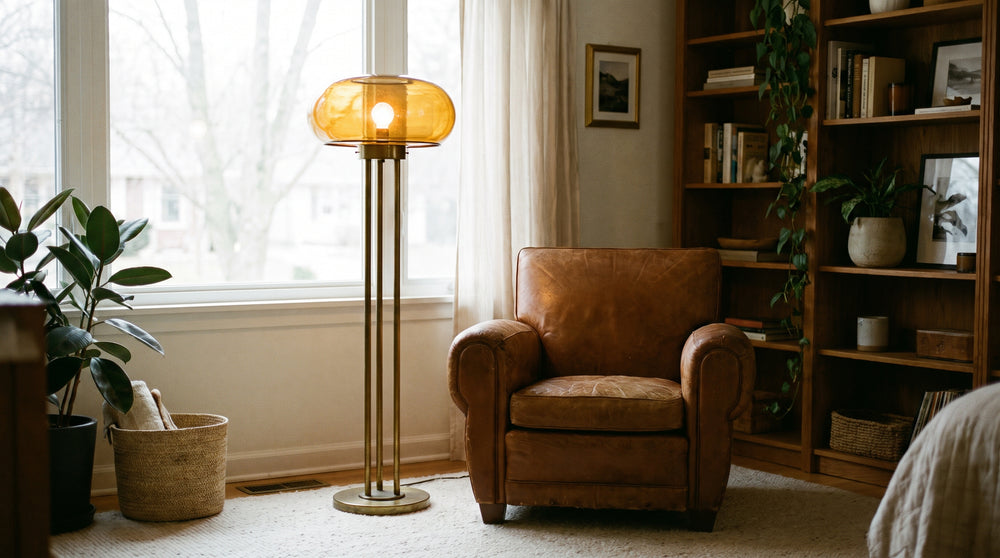
An interior that reflects who you are
Carefully selected pieces, shipped from our warehouses. Our team advises you before you buy, so you choose with confidence.
- Tracked delivery
- Pay in instalments, where available
- 14 days to change your mind
- Advice & showroom in Lyon, France
A retro floor lamp is chosen first by its height: on a piece of furniture when the stem is short, on the floor when it is tall, in both cases near a sofa, an armchair or a console. The wooden, metal or ceramic stem stays visible and sets the scene, while the shade, socket and switch are checked on the model's spec sheet before purchase.
What is a vintage floor lamp?
A vintage floor lamp is a lamp whose stem remains visible and contributes to the decor: turned wood, fine metal, matte ceramic. Its silhouette borrows from the 1950s to the 1980s, with a dressed shade that softens the light. Height decides its place: on a piece of furniture, it lights a corner; on the floor, it accompanies an armchair.
Retro floor lamps: how to recognise them
Three signs are enough: a stem that is not hidden, a textile or glass shade, a finish that accepts the patina of time. A turned wooden stem or a flared metal base sets the era on their own. Conversely, a discreet base under a wide shade leans more contemporary, which you will find in models with a more contemporary style. The rest is on the spec sheet: total height, shade diameter, switch type.
Floor lamp or standing lamp: what is the difference?
It all comes down to height and stability. A short floor lamp sits on a console, a sideboard or a bedside table, and moves with one hand. A standing lamp rests on the floor, with a base wide enough to stand straight without wobbling. This difference decides the location: the standing lamp fills an unused corner, the floor lamp slips in near the sofa. To compare lighting families, start from all the home lighting.
Where to place a living room floor lamp?
In a living room, a floor lamp finds its place next to the sofa, in a dark corner or near a reading armchair. Choose one tall enough to light over the shoulder, without sending light into the eyes of the seated person, and check the stem height and shade diameter on the spec sheet.
Near the sofa or in the corner?
Near the sofa, the lamp is for reading: it goes behind or beside the seat, the shade at shoulder level. In a corner, it fills the void: a tall stem, light directed at the wall, and the corner stops being a black hole. A third spot works well: the console behind the sofa, where a short lamp replaces a bouquet. Avoid direct reflection in the television screen, it tires more than it lights.
Reading, atmosphere or sideboard: what use for the lamp?
| Type | Where it sits | Role in the room | To check on the spec sheet |
|---|---|---|---|
| Short floor lamp | Console, sideboard, bedside | Accent light for a corner | Total height, shade diameter, socket |
| Tall floor lamp | On the floor, next to the sofa | Reading and atmosphere | Stem height, stability, switch |
| Standing lamp | In a corner, behind an armchair | Tall light that lights the whole room | Head orientation, stem material |
| Vintage desk lamp | On a work surface | Directed lighting for working | Orientation, footprint, socket |
For a workstation, look instead at design desk lamps for the office: their stem is calculated for a work surface, not for the floor.
How to recognise an Italian design floor lamp?
An Italian design floor lamp stands out for its simple lines, a slender or sculptural stem and mixed materials, metal, glass or marble. The finish is clean, the shade often reduced, the light carefully directed. Above all, check the dimensions and socket on the spec sheet rather than the overall look alone.
Italian, Scandinavian or industrial design: three directions to tell apart
The Italian spirit plays on contrast: a very slender stem under a generous volume. The Scandinavian spirit simplifies further, with light tones and visible wood, as in Nordic-inspired lamps. The industrial spirit embraces raw metal and visible mechanics. None of these directions is better: they only change the way the lamp dialogues with the rest of the living room.
Which furniture to pair with a vintage lamp?
A turned wooden stem suits solid wood furniture, second-hand tables, thick fabrics. A black metal stem holds its own against a leather sofa or graphic lines. A ceramic base goes anywhere, provided it picks up a tone already present in the room, cushion, curtain or wall. The practical rule: pick up an existing material or colour, never add a third.
Which material and colour to choose for a vintage lamp?
This collection contains no products at the moment. The spec sheets for vintage floor lamps will state, when models become available, the stem material, the socket, the total and stem height, the shade diameter and the maximum accepted wattage. No product characteristic is therefore displayed for now.
Wood, metal, ceramic: what each material changes in the room
Wood gives a warm light through reflection and ages well, provided it avoids standing moisture. Metal reflects light and draws a clean line, which helps in a small living room. Matte ceramic absorbs instead of shining: it calms a very bright room. Ceramic bases are found in ceramic bases, and wooden stems in wood in a living room.
Black, gold or white: which colour for which living room?
| Material or finish | Mood created | Care | Where to place it |
|---|---|---|---|
| Wood | Warmth, flea market spirit | Dry cloth, avoid moisture | Living room, office, bedside |
| Black metal | Graphic line, strong presence | Soft cloth, no abrasive | Living room corner, office |
| Brass and gold | Caught light, dressed effect | Soft cloth, patina embraced | Console, sideboard, hallway |
| Ceramic | Matte tone, soft silhouette | Damp cloth then dry | Bedside, living room, low furniture |
| Linen and textile | Diffused light, felted finish | Soft brush or light vacuuming | Bedroom, reading corner |
| Glass and crystal | Reflections, statement piece effect | Lint-free cloth | Living room, hallway |
For a very bright interior, linen shades diffuse without switching off. For a dark living room, gold and black finishes make the light more present without turning up the power.
How to distribute several lamps in a living room?
Combine one tall source for the whole room and two low sources for uses: a reading corner, a console, a sideboard. Lamps of the same material family answer each other without copying. Better to switch on several weak lights than to push a single lamp to full power.
Is one lamp enough in a small living room?
A tall floor lamp can light the whole of a small living room if it is well placed and if the light goes upwards or towards the wall. Beyond that, it complements more than it replaces: it creates a zone. Layering remains the best reflex, a ceiling light or spotlights for the whole room, a low lamp for each use. For spotlights, distribute them by zone to light, never in a uniform grid, and avoid dazzling someone seated.
The most beautiful living room lamps: how to make them talk to each other?
Vary the size, keep the material. Two wooden lamps of different heights answer each other; two identical lamps side by side look duplicated. If you mix materials, keep a common thread, a similar tone or stem base. Design table and floor lamps for the living room give a starting point, and adjustable lamps direct light where it is missing. In the bedroom, the same logic applies with bedroom side lower models.
How to connect several lamps to a single electrical supply?
Several lamps can share the same supply if you stay within the power planned for that circuit and if the connections remain accessible. Use a power strip or a socket block for plug-in lamps, and entrust any fixed addition, connector or new cable, to an electrician.
Power strip and extension lead: what is planned for domestic use
A power strip suits plug-in lamps, provided you stay within what it accepts, keep it clear and do not stack extension leads. Avoid doorways and cables stretched under a rug. A socket block fixed behind the sofa solves the problem once and for all, and each lamp's switch stays accessible.
When should you call an electrician?
As soon as you need to add a socket, extend a circuit, recess a cable or replace a wall switch. A cable that heats up, a socket that crackles or any doubt about the consumer unit also justify the call. The rest, choosing a lamp and plugging it into an existing socket, requires no intervention.
Which bulb and which care for a vintage lamp?
The socket and the maximum accepted wattage are stated on the lampholder or the model's spec sheet: stick to them before choosing the bulb. For care, a dry cloth is enough on wood and ceramic, a soft cloth on metal, and dust on a textile shade is removed with a brush.
What to check before buying a bulb
The socket type first, then the shape, because a narrow shade accommodates a bulb that is too long poorly. Colour temperature changes the render: around 2700 K the light leans warm and suits the living room, between 3000 and 4000 K it becomes more neutral and serves an office well. For a work lamp, LED models for the office simplify the choice, and LED models are content with a standard bulb.
Cleaning wood, metal and ceramic without damaging them
Dust dry: soft cloth on wood, ceramic and metal. No abrasive product, no moisture that lingers on wood. On brass, patina is part of the style and does not need to be erased. A ceramic base is cleaned with a damp cloth then dried immediately. Black lamps just need a lint-free cloth so as not to mark.
Second-hand vintage lamp or new model in the style?
A second-hand piece brings a patina and a model you do not come across everywhere, but you must check the wiring, the socket and the stability of the stem. A new model in vintage style offers recent wiring and materials that match the room, often simpler to integrate.
What you gain with a second-hand antique lamp
A turned wooden stem, a metal or ceramic base, a shade often to be replaced: that is what you come across at flea markets. Before buying, check the stability, the condition of the socket and the cable, and compare the height with the available space. Plan an electrical check before first use.
New retro or contemporary: how to decide
Retro brings character and suits wooden furniture and second-hand interiors. Contemporary blends more easily into a pared-back living room. The safest is to pick up a material or colour already present. Crystal pieces lean towards the exceptional, bedside ceramics towards daily use, and wooden table and floor lamps hold the middle. On a work surface, metal models for working resist knocks better.
Ordering from Designix
The collection grid shows each model's price of the day. Secure payment, tracked delivery, returns and Designix customer service accompany every order. Before confirming, one useful check: the stem height and the shade diameter, compared with the space available at home. A final look at modern desk lamps or the ceramic catalogue is often enough to decide between two models.
Frequently asked questions
How to choose a floor lamp for your living room?
Start from the use: reading near the sofa, atmosphere in a corner, accent on a console. Then look at the stem height, the shade diameter and the socket stated on the spec sheet, then the material, so that the lamp matches the rest of the living room.
How to arrange ceiling spotlights?
Distribute them by zone to light, not in a uniform grid: one point above the work surface, another towards the circulation, avoiding dazzling a seated person. Spotlights complement the low lamps of the living room rather than replacing them.
Which old floor lamps can you find at flea markets?
Mostly turned wooden stems, metal or ceramic bases and shades to be replaced. Before buying, check the stability of the stem, the condition of the socket and the cable, and compare the height with the space available in the room.
Is a power strip enough for several living room lamps?
Yes for plug-in lamps, if you stay within what the circuit and the power strip accept and if it remains accessible and clear. Avoid daisy-chained extension leads and doorways. For a fixed or recessed addition, an electrician steps in.
How to care for a vintage lamp without damaging the wood or metal?
Dust dry: soft cloth on wood, ceramic and metal, soft brush on a textile shade. No abrasive product, no standing moisture on wood. On brass, patina is part of the style and does not need to be erased.




