
Vintage fabric lampshades
This selection is also available in our French store: Abat jours en tissu vintage
No products in this selection.
- Tracked delivery to your country Tracked delivery
- Secure payment at checkout Multiple payment methods
- 14 days to change your mind 14-day returns
- Secure payment Secure payment
Not sure of your style? Find it in 30 seconds
A few questions, and we will show you the pieces made for you.
Frequently asked questions
How do I choose the right product?
What are the delivery times?
Can I return an item?
Can I pay in instalments?
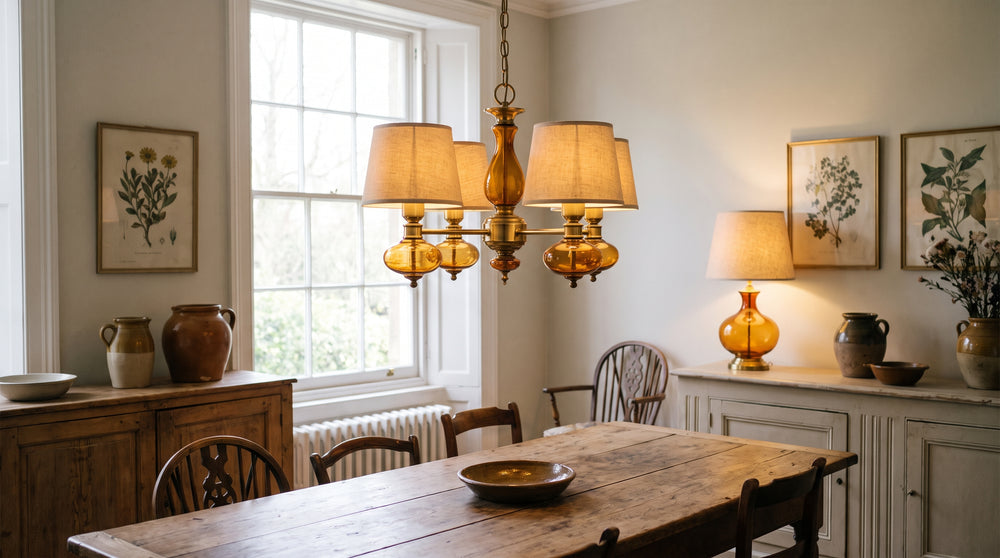
An interior that reflects who you are
Carefully selected pieces, shipped from our warehouses. Our team advises you before you buy, so you choose with confidence.
- Tracked delivery
- Pay in instalments, where available
- 14 days to change your mind
- Advice & showroom in Lyon, France
A vintage fabric lampshade softens the light and dresses a bedside lamp, a floor lamp or a pendant. You choose it first by its size, matched to the base or the socket that receives it, then by its fabric: light to spread widely, dark to concentrate the beam upwards and downwards. Style comes after, once those two points are settled.
What is a vintage fabric lampshade?
A vintage fabric lampshade is a metal frame covered with taut fabric, in a classic shape (cone, cylinder, drum) and with a matte finish, reminiscent of lamps from the past. A lining or a hem structures the drape of the fabric and evens out the diffusion.
Two measurements decide the purchase: the diameter of the ring or the socket the lampshade must fit over, and the diameter of the lower opening, which controls how much light is sent back into the room. The rest is a matter of material and silhouette. You can compare the fittings in the fabric lampshade collection before settling on a shape, then place each model in lampshade, pendant, table lamp and floor lamp.
Retro or vintage fabric lampshade: what is the difference?
Retro cites a specific decade, often through a graphic print or a tapered base. Vintage keeps the old look without dating the lamp: solid colour, visible texture, softened lines. A solid fabric settles more easily into an interior that is already busy.
What sets a fabric lampshade lamp apart
Three points show in use: the tension of the fabric (slack, it creases and casts shadows), the straightness of the rings (a warped ring throws the lampshade off axis) and the fastening method, a neck socket, a screw ring or a hook. These three details separate a lampshade that sits straight from one that leans.
What light does a vintage fabric lampshade give?
Fabric filters the light: a light fabric spreads it widely through the room, a dark fabric concentrates it upwards and downwards. A lining reinforces this effect. The result is a softened light, without direct glare, suited to a reading corner or a bedside.
This diffusion is judged in use, not in a photo: a lampshade placed on a low table lights your knees before it lights the wall. For a dinner, it creates a halo around the table without lighting the whole room.
Light fabric or dark fabric: what effect in the room?
A light fabric bounces a lot of light and brightens the wall behind the lamp; count it as full supplementary lighting. A dark fabric absorbs more, the lamp becomes a crisp point of light and the rest of the room stays in half-light. White lampshades suit rooms that lack light, black versions suit muted moods and walls that are already coloured.
What effect with a warm filament bulb?
A filament bulb, around 2700 K, warms a light fabric further and gives linen a honey tone. On a dark fabric, the same bulb brings out the texture without lighting the room. Avoid overly directional bulbs under a closed lampshade: the light bounces back and heats the fabric.
How to choose the size and shape of a vintage fabric lampshade?
Size is chosen in relation to the support: a small lampshade for a bedside lamp, a large one for a floor lamp or a pendant. The shape decides the direction of the light: the cone directs downwards, the cylinder diffuses around, the drum softens.
In general, the height of the lampshade is about one third of the total height of a table lamp, and its lower diameter stays close to the height of the base. A lampshade that is too narrow looks like a hat, too wide it crushes the furniture. The table below gives the reference points by support.
| Support | Lampshade size | Shape that works | Expected effect |
|---|---|---|---|
| Bedside lamp | Small size, contained height | Cone or drum | Light gathered on the bedside, without glare |
| Living room table lamp | Medium size | Cylinder or empire | Lights the corner without lighting the whole room |
| Floor lamp | Large size, wide base | Cylinder or flared cone | Light cast down towards the armchair |
| Pendant | Large size, opening facing down | Cone or cylinder | Light cast down onto the table |
| Baby's room | Closed size, dense fabric | Drum or lined cone | Veiled source, soft light on waking |
Large vintage fabric lampshade: for which support?
The large size is meant for a floor lamp, a big table lamp or a pendant. Its base must stay wider than the fitting so it does not tip. On a slender base, it unbalances the silhouette; in that case, keep the medium size and gain presence through the texture of the fabric rather than through volume. To find the base that goes with it, browse all our lighting.
Cylinder, cone or drum: which shape to choose?
The flared cone directs light towards the floor or the table and suits both the floor lamp and the pendant. The cylinder diffuses all around and serves a table lamp. The rounded drum softens the light at the bedside. The empire, flared and tall, gives height to a living room lamp. To decide another way, compare choosing your lampshade according to the support.
Which fabric to choose between linen, cotton and velvet?
Linen lets light through and shows a visible texture; cotton diffuses more evenly and cleans easily; velvet blocks more light and creates a muted mood. The choice therefore depends on the room and the type of light you want, not only on style.
| Fabric | Light effect | Style | Care | Room |
|---|---|---|---|---|
| Linen | Filtered light, visible texture | Natural, understated | Gentle vacuuming, spot-clean stains | Living room, hallway |
| Cotton | Even diffusion | Timeless | Cleans easily | Bedroom, bedside |
| Velvet | Light concentrated upwards and downwards | Muted, assertive | Soft brush, avoid humidity | Living room, study |
| Jute or heavy canvas | Little light passing through | Rustic | Dry dusting | Hallway, conservatory |
Linen for a natural light
Linen keeps its fibres visible and casts a slightly textured light, never harsh. It softens as it ages. Count on it for a living room or a hallway where you want a discreet lamp by day and a warm one in the evening. Seeing it in the linen lampshades helps you picture the shade before choosing.
Velvet for a muted mood
Velvet stops the light: the lampshade becomes a dark volume, the light comes out at the top and the bottom. It suits a study or a living room that is already lit elsewhere. It dislikes humidity and is dusted with a brush, without rubbing the weave.
Where to place a vintage fabric lampshade in the home?
It finds its place wherever you want supplementary light rather than general lighting: bedside, living room reading corner, hallway, guest bedroom. On a floor lamp, it lights downwards; on a pendant, it casts light down onto the table. In a baby's room, prefer a model that closes off the source.
In the living room, place it near the armchair, not facing the screen. In the hallway, a dense fabric forgives dust less than a washable cotton. To find the right size by room, compare a lampshade for the living room and bedroom models.
Which fabric lampshade for a floor lamp?
A floor lamp calls for a large size, whose base is wider than the fitting to stay stable, with the opening turned towards the floor. A cylinder or a flared cone spreads the light towards the armchair rather than towards the eyes. Check the seat height: the lampshade must stay above the eye line of a seated person.
Glass lampshade for a bedside lamp: an alternative to fabric?
Glass diffuses a more directional light and cleans with a wipe of a cloth; fabric softens more and gives a gentler light, welcome at the bedside. For reading, a light fabric lets more light through; frosted glass avoids direct glare. Both are worth it depending on use, reading leans towards light fabric.
How to install a lampshade?
Most lampshades fit onto a socket or a ring support: you slide the lampshade on, then tighten the fitting. On a floor lamp, it is often a ring or a hook. Check that the lampshade holds without touching the bulb and that the fabric does not heat up.
Always cut the power before handling a socket. After fitting, switch on for five minutes and pass your hand near the fabric: marked heat signals a bulb that is too powerful or a lampshade that is too closed.
How to hang a lampshade from the ceiling?
A lampshade alone does not fix to the ceiling: it is used with a pendant, that is a cable, a socket and a ceiling rose fixed to the ceiling. You cut the power, fix the support, connect, then place the lampshade on the socket by its ring. The choice of cable and ceiling rose is made in the Designix lighting catalogue.
How to install a lampshade on a lamp base
You remove the fitting from the socket or the support, slide the lampshade on, then tighten the ring or the hook. The lampshade must hold without play and stay straight. On a lamp base, the fitting is often by a ring at the top of the base, sometimes by a side screw: tighten by hand, never with a tool.
How to care for a fabric lampshade and change its fabric?
Regular dusting with a soft brush or a vacuum on the gentle setting is enough in most cases. For a stain, work locally with a damp cloth and a product suited to the fabric, without soaking the lampshade or rubbing hard. Leave to dry in the open air, with the power off.
How to remove pen marks from fabric?
Dab the stain with a cloth soaked in 70% alcohol or a mild detergent, from the centre outwards, without rubbing. Rinse, then dry in the open air. Test on a hidden area: some velvets mark on contact with alcohol. Never immerse a lampshade fitted on its lamp.
How to change the fabric of a lampshade?
You keep the frame and replace the cover: you peel off or unpick the old fabric, use it as a pattern, then stretch the new fabric over the rings and fix it by sewing or gluing. A thick fabric and even tension prevent creases. Replacement is worth it when the rings are straight; if not, change the whole lampshade.
How to match a vintage fabric lampshade with vintage decor?
You match the lampshade with the materials already present: the patinated leather of an armchair, the wrought iron of a bench, the wood of the furniture. A solid fabric pairs more easily than a print; a shade close to the wall enlarges, a contrasting shade draws the eye to the lamp.
The shade rule is simple: pick up the wall colour for a blended effect, or the colour of an object in the room for an echo. A floral or graphic print assumes an already calm room, otherwise the patterns compete. For a crisper result, look at modern style lampshades and keep vintage for the main lamp.
With a vintage leather armchair
Patinated leather accepts warm tones, honey, terracotta, old rose, and ecru linen. A green or burgundy velvet answers the leather by contrast. Avoid a satin fabric, which clashes with the grain of the leather.
With a wrought iron bench and vintage lighting
Wrought iron calls for matte fabrics and neutral shades: linen, cotton, jute. It is all our lighting that must stay consistent: if several lamps share the room, keep the same fabric family and vary the sizes. For a baby, choose a closed model from a lampshade for a baby's room.
Frequently asked questions
How to hang a lampshade from the ceiling?
A lampshade alone does not fix to the ceiling: it is used with a pendant, that is a cable, a socket and a ceiling rose fixed to the ceiling. You cut the power, fix the support, connect, then place the lampshade on the socket by its ring.
How to change the fabric of a lampshade?
You keep the frame and replace the cover: you peel off or unpick the old fabric, use it as a pattern, then stretch the new fabric over the rings and fix it by sewing or gluing. A thick fabric and even tension prevent creases.
How to remove pen marks from fabric?
Dab the stain with a cloth soaked in 70% alcohol or a mild detergent, from the centre outwards, without rubbing. Rinse, then dry in the open air. Always test on a hidden area of the lampshade and never immerse a lampshade fitted on its lamp.
Glass lampshade for a bedside lamp: an alternative to fabric?
Glass diffuses a more directional light and cleans with a wipe of a cloth; fabric softens more and gives a gentler light, welcome at the bedside. For reading, a light fabric lets more light through; frosted glass avoids direct glare.
What is a vintage light fixture?
A vintage light fixture means a lamp with an old inspiration: metal or turned wood base, fabric lampshade, shapes inherited from past decades. The term describes the style, not the age of the object: a new production can perfectly well be vintage.
Secure payment, tracked delivery, returns and Designix customer service: you order without risk, and the team answers before as well as after the purchase. If you hesitate between two sizes, measure your support first, then browse equipping the living room reading corner to see the volumes at the scale of a room.




