
Vintage ceramic wall sconces
This selection is also available in our French store: Appliques murales en céramique vintage
No products in this selection.
- Tracked delivery to your country Tracked delivery
- Secure payment at checkout Multiple payment methods
- 14 days to change your mind 14-day returns
- Secure payment Secure payment
Not sure of your style? Find it in 30 seconds
A few questions, and we will show you the pieces made for you.
Frequently asked questions
How do I choose the right product?
What are the delivery times?
Can I return an item?
Can I pay in instalments?
An interior that reflects who you are
Carefully selected pieces, shipped from our warehouses. Our team advises you before you buy, so you choose with confidence.
- Tracked delivery
- Pay in instalments, where available
- 14 days to change your mind
- Advice & showroom in Lyon, France
Plan for one sconce per bedside, or two on either side of the sofa, set at seated shoulder height, and check the socket and the projection before drilling. The vintage ceramic wall sconce is a glazed clay wall light: it casts a warm halo on the wall and plays more of a decorative role than a main lighting one.
What light does a vintage ceramic wall sconce give?
Glazed ceramic stops part of the light and sends it back as a soft halo on the wall, without glare. Depending on the shade of the glaze and the shape of the diffuser, the light stays warm and enveloping. It is accent lighting: it highlights a stretch of wall rather than lighting a whole room.
Vintage ceramic wall sconce: what it changes in a room
The wall stops being a neutral backdrop: the light grazes the surface, brings out the relief of the plate and draws a warm patch above the furniture. As a general guide, a bulb around 2700 K gives that amber tone; moving towards 3000 K cools the whole slightly. The fixture remains an accent, to be completed with a ceiling light or a floor lamp.
Light glaze, coloured glaze: what light comes out
A light, glossy glaze sends more light upwards and leaves the wall brighter. A dark, matt or speckled glaze absorbs part of the output and concentrates the halo downwards, with a softer result. Neither finish replaces task lighting: they colour the atmosphere.
Where to install a vintage ceramic wall sconce in the living room?
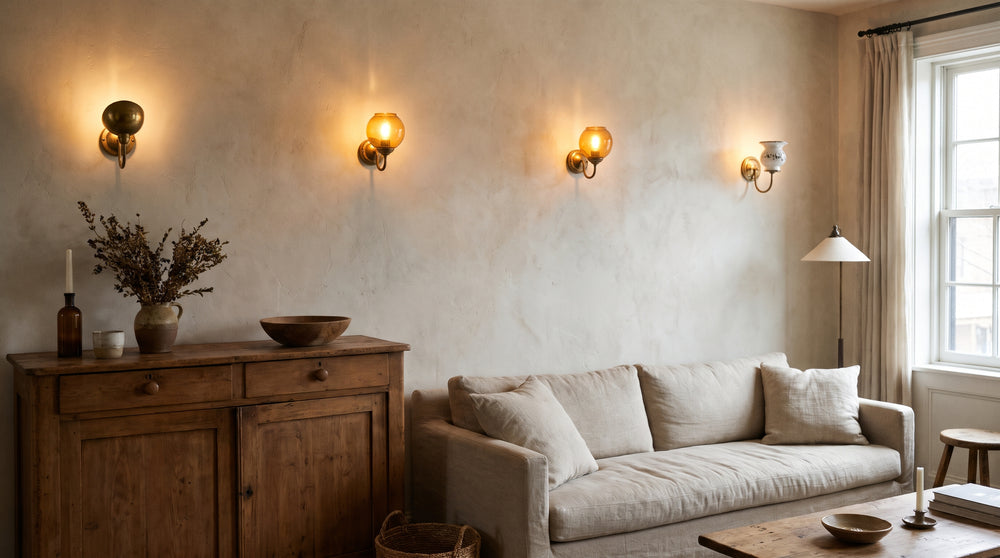
In the living room, the sconce is used as accent lighting: on either side of the sofa, at seated shoulder height, or in pairs to frame a bookcase or a bare wall. Two points are better than one central point, and a dimmable output avoids harsh lighting in the evening.
On each side of the sofa
Plan for one sconce per armrest, at about 1.10 m from the floor, and check the projection: a wide plate behind guests gets in the way. This is where dimmable wall sconces make full sense, with an inline dimmer or a compatible module.
Two sconces rather than one: the living room pair
A pair frames a bookcase, a mirror or a large canvas and gives the wall a regular rhythm. Repeat the same model and the same mounting height. If the wall is already busy with patterns, a plain model works better than a heavily decorated plate, like our wall sconces for the living room.
| Room | Role of the light | Recommended shape | What to check on the listing |
|---|---|---|---|
| Living room | Side accent, halo on the wall | Arm sconce or wide plate | Projection, socket, dimmable output |
| Adult bedroom | Bedside reading, low light | Small adjustable diffuser | Mounting height, maximum bulb wattage |
| Kitchen | Accent above the worktop | Compact model, glaze easy to wipe | Ingress protection rating, direct or diffused light |
| Hallway or corridor | Wayfinding, light marker | Simple sconce, low projection | Available width, height relative to doors |
| Bathroom | Accent around the mirror | Model intended for damp rooms | Ingress protection rating stated by the manufacturer |
| Covered terrace | Evening atmosphere | Dedicated outdoor sconce | Ingress protection rating and material intended for outdoor use |
Which wall sconce for an adult bedroom?
In an adult bedroom, you want low, adjustable light: an arm sconce or one with a small diffuser, placed at each bedside, which frees up the nightstand and is used for reading. A dimmable output and a low-gloss glaze prevent glare and reflections in the field of view.
Adult bedroom sconces: reading above the bed
Place the light source about 60 to 70 cm above the mattress, offset towards the outer side of the bed so as not to light the neck of the person next to you. An adjustable arm lets you aim it at the page. For the light, a warm module remains the most comfortable, and you will find these guidelines in our bedroom wall lighting.
Replacing bedside lamps
The sconce frees up the whole surface of the nightstand and removes the cable trailing on the floor. It does, however, require drilling and planning a power supply: existing back box, cable outlet or switched socket. Check the maximum bulb wattage accepted by the socket before choosing your model.
1930s art deco and art nouveau sconces: what is the stylistic difference?
1930s art deco plays with geometry: straight lines, regular arcs, fan or stepped motifs. Art nouveau prefers the continuous curve, the plant line and the sinuous motif. Both styles are read first in the shape of the plate and the design of the glaze, before the shade.
1930s art deco sconces: geometry
The plate is structured, symmetrical, often with cut corners. The design repeats in a regular frieze, fan or stepped pattern, and the glaze stays plain or two-tone. It is the line that signs the era, not the colour. See the ceramic wall sconces to spot these profiles.
Art nouveau sconces: the curve
Here the line avoids the right angle: scroll, stem, flower, sinuous silhouette. The design unfolds without strict symmetry and the glaze is often nuanced or iridescent. This style pairs well with a mirror in a soft frame or a curved piece of furniture in a vintage glass set.
| Style | Shapes | Typical decoration | Where it works |
|---|---|---|---|
| 1930s art deco | Geometry, regular arcs, straight lines | Fan, stepped or regular frieze motif | Corridor, hallway, structured living room |
| Art nouveau | Continuous curve, plant line | Scrolls, flowers, sinuous silhouettes | Bedroom, living room, around a mirror |
| Rustic plate | Round or square plate, irregular edge | Painted flowers, naive motif, speckled glaze | Kitchen, hallway, country house |
| Glazed country | Simple body, small arm | Plain glaze, off-white or pastel | Adult bedroom, corridor, dry bathroom |
| Exceptional piece | Sculpted shape, strong volume | Elaborate glaze, raised decoration | Living room, hallway, feature wall |
How to choose between white and coloured ceramic?
Glazed white sends back more light and blends into a light wall: it suits when the sconce should stay discreet. Coloured or raw clay ceramic becomes a motif in its own right, best kept for a neutral wall to avoid visual competition. The gloss of the glaze matters as much as the shade.
White ceramic wall sconces
On a light wall, white ceramic is read through its shape and relief, without creating a patch of colour. It remains the safe choice for a corridor repainted often or for a pair framing a mirror. A glossy glaze sends back a little more light than a matt white.
Coloured glaze, raw clay: what it changes on a wall
A strong shade, a water green or an old ochre catches the eye and works like a frame. Terracotta or stoneware left raw bring a matt texture, more rustic, which ages without showing fingerprints. In both cases, keep the neighbouring wall calm and allow only one coloured piece per stretch of wall.
How to match a ceramic sconce with the rest of the room?
Ceramic is matched by family of shades and by period, not by exact symmetry: patinated wood, aged brass, frosted glass and matt textile dialogue well with an old glaze. In a kitchen or a hallway, it is better to repeat the same model than to multiply different shapes.
In the kitchen
Above the worktop, choose a compact model with low projection, whose glaze wipes clean in one movement. Steam and splashes require an ingress protection rating stated by the manufacturer. The vintage kitchen sconces meet this use, to be completed with a vintage metal sconce if you are looking for a plainer material.
In a hallway or corridor
Choose a simple, shallow sconce that does not catch your shoulder as you pass, and place it about 1.80 m from the floor, clear of the doors. Repeat the same model along the corridor for a regular rhythm. Our selection of wall sconces for hallways and our corridor sconces give width guidelines.
How to install and care for an old wall sconce?
First fix the bracket to the wall, keep the cable clear of the walkway, then screw on the body of the sconce before fitting the socket and the bulb. Clean with a dry cloth or a barely damp one, never by immersion, and switch off the power before any work.
At what height should a wall sconce be placed
Allow about 1.10 m for living room accent lighting, 60 to 70 cm above the mattress in a bedroom, 1.80 m in a corridor and around 1.70 m to frame a bathroom mirror. These guidelines vary with the room and the size of the users. For connection, E27 socket models accept standard bulbs; E14 sockets take smaller formats.
Cleaning ceramic without damaging the glaze
A soft, barely damp cloth is enough for dust; dry immediately to avoid limescale marks. No scraper, no abrasive product, no soaking. Switch off the power at the breaker before removing a diffuser or changing the bulb, and check the maximum wattage stated on the fixture label.
High-end design wall sconces: what really changes?
What sets a high-end model apart comes down to the clay, the consistency of the glaze and the finish of the metal parts: no bubble, no run, a constant shade from one piece to the next. The difference is read in that consistency, more than in a heavier decorative load.
The work of the glaze
A well-controlled glaze gives a smooth surface, with no sharp edge or gap on the edge of the plate. In a pair, two pieces from the same series look alike, which matters on a feature wall. The designer LED sconces also show this level of finish, in a more contemporary register.
What an affordable model also shows
To choose a sconce, check the socket base, the IP rating and the projection from the wall, then the care of the glaze. Ceramic remains a robust material, which copes with changes of decor. High-end is justified when the piece is looked at up close and the whole is meant to last.
For damp rooms, caution is still needed: an IP44 wall sconce or a model rated by the manufacturer for the bathroom avoids unpleasant surprises, as do the vintage bathroom sconces intended for this use.
In the Designix shop, payment is secure, delivery is tracked and returns are possible. Customer service answers questions about dimensions and sockets before ordering. You can compare shapes in our catalogue of vintage lighting and find the mood sconces on the ceramic wall sconces page, or take ceramic out into the garden with the vintage outdoor sconces. Before ordering, note the desired mounting height and the distance between the socket and the wall. This collection currently has no products.
Frequently asked questions
How do you recognise a 1930s art deco sconce?
By its geometry: straight lines, regular arcs, fan, stepped or repeated frieze motifs. The plate is often structured and the design symmetrical. The glaze stays plain or two-tone. Colour comes next; it is the shape that signs the style, not the shade of the glaze.
How do you recognise an art nouveau sconce?
By the curve: continuous line, plant motif, scroll, sinuous silhouette. The plate avoids the right angle and the design unfolds without strict symmetry. The glaze is often nuanced or iridescent. The line, more than the shade, distinguishes art nouveau from art deco.
Which wall sconce should you choose for the living room?
An accent sconce, placed in pairs on either side of the sofa or framing a bookcase. Favour an arm model or a wide plate, with a dimmable output, and check the projection so as not to obstruct the passage behind the sofa.
Which wall sconce for an adult bedroom?
A low, adjustable model, placed at each bedside in place of bedside lamps: small diffuser or articulated arm, low-gloss glaze, dimmable output for reading. Check the mounting height relative to the mattress and the maximum bulb wattage accepted by the socket.
Can a ceramic sconce be installed in a bathroom?
Only if the manufacturer states an ingress protection rating suited to the damp room; this information appears on the product listing and cannot be guessed. Otherwise, keep ceramic for dry rooms and choose a model explicitly intended for damp conditions for the bathroom.




