
Vintage brass floor lamps
This selection is also available in our French store: Lampes à poser sur pied en laiton vintage
No products in this selection.
- Tracked delivery to your country Tracked delivery
- Secure payment at checkout Multiple payment methods
- 14 days to change your mind 14-day returns
- Secure payment Secure payment
Not sure of your style? Find it in 30 seconds
A few questions, and we will show you the pieces made for you.
Frequently asked questions
How do I choose the right product?
What are the delivery times?
Can I return an item?
Can I pay in instalments?
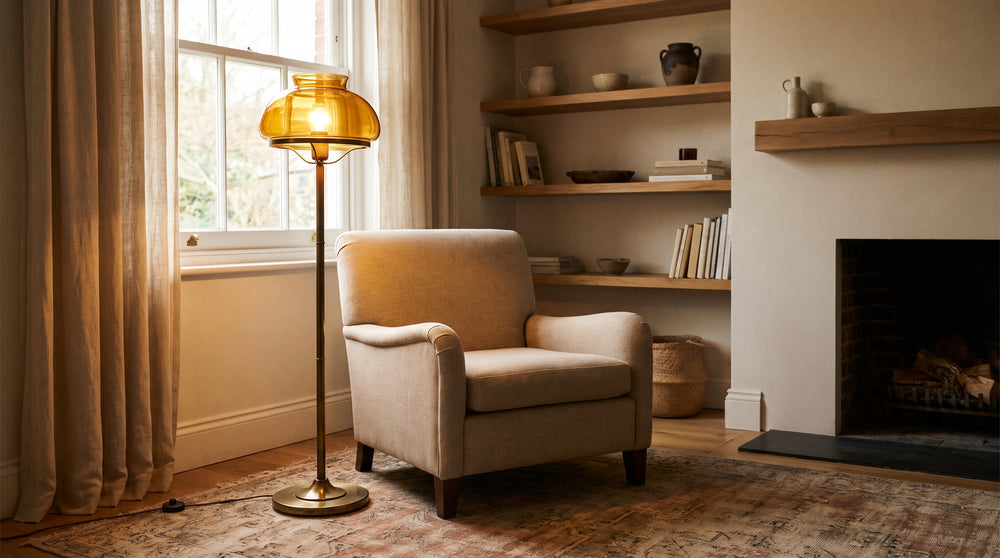
An interior that reflects who you are
Carefully selected pieces, shipped from our warehouses. Our team advises you before you buy, so you choose with confidence.
- Tracked delivery
- Pay in instalments, where available
- 14 days to change your mind
- Advice & showroom in Lyon, France
Allow one floor lamp per seat you want to serve: a brass base placed near the sofa, the shade at shoulder height for a seated person. Brass, brushed or patinated, tints the light without dimming it, and the vintage style draws on the 1930s to the 1970s without being a second-hand object.
What is a vintage brass floor lamp?
A floor lamp is a light whose source sits at seating height: the brass base carries the shade, and the whole thing stands on the floor or on a low piece of furniture. The word vintage describes a style inspired by the 1930s to the 1970s, not an antique object. Brass gives a warm light and a matte sheen that ages well.
Floor lamp, standard lamp, table lamp: the right words
A standard lamp touches the floor and often lights upwards or at seating height on a tall stem. A classic table lamp sits on a bedside table or a desk. The floor lamp sits in between: a base tall enough to light an armchair, compact enough to slip between two pieces of furniture. This vocabulary nuance helps you search accurately, whether you are browsing all our lighting or a selection of design table lamps for the living room.
Antique, brushed or lacquered brass: what it changes at home
Brushed brass offers an even grain and matte reflections, more discreet than polished metal. Patinated or antique brass takes on a darker tone and marks of time. Lacquered brass keeps a clear, stable shine, but dislikes alcohol and abrasive sponges. These three finishes are not interchangeable: above all they change how the lamp converses with leather, wood and ceramic.
| Brass finish | Look | Care | Decor pairing |
|---|---|---|---|
| Brushed brass | Even grain, matte reflections | Soft cloth, no abrasives | Contemporary interiors, vintage leather armchair |
| Patinated or antique brass | Darker tone, marks of time | Dust, do not strip | Flea-market decors, solid wood, ceramic |
| Lacquered brass | Clear, stable shine | Avoid alcohol and abrasive sponges | Bright rooms, gold and black colourways |
What light does a vintage brass lamp give?
Brass does not make light, it tints it. A brushed brass base returns a matte, warm reflection, especially when the shade lets the beam fall downwards. The final result therefore depends on the shade and the bulb more than on the metal alone: that is where you need to decide before buying.
Brushed brass: a softer light than it seems
A brushed brass light does not throw a hard glare: its grain diffuses the light instead of reflecting it sharply. The result is a round, warm pool of light on the wall or on the back of the sofa, with no glare in your eyes. A linen shade enhances this softness, an opaque shade concentrates it downwards.
Which socket and which bulb for a warm result?
Most table and floor lamps use an E27 socket, small formats an E14 socket. A filament LED bulb around 2700 K gives a warm light close to incandescence, between 3000 and 3500 K a more neutral white for reading. Check the colour temperature before buying: it decides the atmosphere, not the colour of the base.
Where to place a floor lamp in the living room?
In a living room, the floor lamp goes out of the walkway, near the seat it is meant to serve: corner of the sofa, side of an armchair, corner of the room. The shade sits at reading height, slightly above the shoulder of a seated person, to light without dazzling. A nearby socket avoids an extension lead across the floor.
Near the sofa and the vintage leather armchair
A reading armchair needs side light, never behind you. Place the lamp beside the armchair, the shade roughly at shoulder height once seated, and let the base stand slightly beyond the backrest: the light then falls on the book, not on your face. Our wooden pieces for the living room and the ceramic bases play the same role with less reflection than brass.
Eating at a wooden table without a tablecloth: stains, protection, patina, then where to place the light?
On a raw wooden table, grazing light reveals the grain and the marks. Prefer a side source or a pendant placed above the tabletop, never a floor lamp at the end of the table that dazzles the person opposite. A downward shade frames the beam on the plate and leaves the rest of the room in soft shadow.
How to connect several lamps to a single power supply?
Several lamps can share one supply if the total power stays within the limits of the circuit and the power strip. Avoid stacking adapters, prefer a power strip with a switch and an extension lead in good condition, and spread the lamps over several sockets when possible. At the slightest repeated tripping, have the line checked.
Power strip, extension lead or extra socket
A power strip with a switch cuts everything with one gesture in the evening, without unplugging four plugs. An extension lead must stay visible and uncoiled if it powers several sources, and its surface condition matters as much as its length. The wall socket remains the best solution for a reading lamp used every day.
What trips a circuit when you multiply lamps
The accumulation of powerful bulbs, a multi-adapter on a single socket and a cable pinched behind a piece of furniture are the most frequent causes. A design LED lamp uses little power and lightens the load, while a classic metal desk lamp weighs more. Spread, do not stack.
Brass chandelier, Italian design table lamp or floor lamp: what to choose?
A brass chandelier lights a room from the centre and requires a ceiling point. A floor lamp lights a precise area and moves without any work. An Italian design table lamp plays on line and detail. The choice therefore depends on what you want to light: a table, an armchair or the whole living room.
| Format | What it lights | Where it goes | Point to check |
|---|---|---|---|
| Table lamp (small format) | A book, a tablet, a worktop | Bedside table, desk, side of the sofa | Stability of the base and cord length |
| Floor lamp (intermediate format) | An armchair, a reading corner | Beside the sofa, between two doors | Height of the shade relative to the seat |
| Standard lamp | A corner of the room, a bookcase | Corner of the living room, near a free wall | Floor footprint and nearby socket |
| Pendant or chandelier | The whole room or the table | Centre of the ceiling, above a table | Clear height under the light |
Brass chandelier: for which type of room?
A brass chandelier suits a room where you want central light, often above a table or in a large living room. It needs a solid fixing point and sufficient clear height under the light. In a low room, a modern lamp for the living room does the same job without occupying the ceiling.
Italian design table lamp: line before technique
The expression refers to table lamps with a drawn line, in metal or glass, where form matters as much as light. It is neither a standard nor a brand: you judge the silhouette, the proportions and the quality of the finishes. The gold and black duo remains the easiest variation to pair.
1930s or 1970s: what differences between these vintage brass lamps?
The 1930s favour geometric volumes, opaque shades and straight bases. The 1970s play with freer shapes, mixed materials and a more prominent brass. Both styles are recognised by the overall silhouette, never by a logo, and pair very well with an English interior.
1930s: geometric lines and opaque shade
A lamp with a 1930s spirit stands on a straight stem, a disc or a cylinder, with a shade that hides the bulb and sends the light downwards. These are models that age well because they follow no fashion: a brass base, an off-white shade, and the result lasts ten years. See also the Nordic-inspired pieces, from the same family of purity.
1970s and antique brass: what pairs well
The 1970s mix antique brass, enamelled ceramic and wood. A vintage brass floor lamp pairs with flea-market furniture and design wood pieces, provided you do not stack three materials in the same corner. A crystal table lamp brings a useful contrast if everything else is matte.
How to care for a brushed brass light?
A brushed brass light is dusted with a soft cloth and, if needed, a little soapy water. Avoid abrasive powders and alcohol, which attack the lacquer and the finishes. Regular patina is part of brass: removing it is not an obligation.
Cleaning without removing the patina
Pass the cloth in the direction of the brushing, without rubbing in circles, and dry immediately. On patinated brass, a simple dusting is enough: any more aggressive product erases part of the work of time. Dust the shade dry according to its material, never wetting a glued fabric.
When brass oxidises: what can be fixed
A darker tone on the touched areas is normal. You can keep it, or reduce it very locally with a mild brass product, never with an abrasive pad. On a lacquered piece, do nothing: the lacquer protects and cannot be touched up properly at home. To change the atmosphere without touching the metal, an adjustable source moves the light elsewhere.
The most beautiful living room lamps: how to pair them with a vintage interior?
A vintage interior holds together through materials, not accumulation: brass, leather, ceramic and wood respond to each other if you keep one lamp as the focal point and the rest more discreet. A vintage brass floor lamp is often enough to set the tone of a living room, without multiplying visible sources.
Pairing brass with a vintage leather armchair
With a vintage leather armchair, the brass lamp brings the warm point and the leather brings the mass. One showy light per area, spaced-out sources, and patinated leather pairs with patinated brass rather than contradicting it. A second-hand vintage leather armchair works the same: it is the tone of the leather that dictates, not its age.
Mixing brass, ceramic, wood and black
Start from a brass base, add a matte material (ceramic, wood) and keep black for a detail, lamp base or switch. A matte black version for the living room calms a corner that is too golden, and a metal lamp for the desk settles the question elsewhere in the house. For the bedroom, see the models designed for the bedroom and the bedside ceramic, gentler on waking than bare metal.
Before confirming a model, measure three things: the height of the seat to be served, the width available between the furniture and the door, and the distance to the socket. These three measurements decide the format more surely than the photo. The Designix lighting catalogue is then browsed with these references in hand, and a desk model completes the setup if you work from home.
Order placed on Designix: secure payment, tracked delivery, returns according to the shop conditions and customer service for any question about a socket, a height or a shade. Choose the lamp that lights the seat you use most in the evening, then check the floor space before ordering it.
Frequently asked questions
What are floor lamps called?
A floor lamp is called a standard lamp when it rests directly on the floor and lights upwards or at seating height. We speak of a floor lamp for an intermediate format, placed on the floor or on a low piece of furniture, with a brass base carrying the shade.
What is a well-known vintage lamp?
The most cited models remain the 1930s articulated desk lamp, the brass stem standard lamp with a cylindrical shade, and the 1970s ceramic table lamp. Their common point: a simple, recognisable silhouette and materials that age well.
Living room floor lamp: which model to choose?
First choose the seat to be served: a tall base and a downward shade near a sofa, a more compact format near an armchair. Brushed brass goes anywhere; patinated brass pairs better with dark woods and old leathers. Then check the shade height and the nearest socket.
Brushed brass light: is it easy to care for?
Yes: a soft cloth is enough most of the time. Brushed brass shows few fingerprints thanks to its matte grain. Avoid abrasive products and alcohol, do not insist on lacquered areas, and dust the shade dry according to its material.
Can you pair a brass lamp with a second-hand vintage leather armchair?
Yes, provided you do not gild everything: the brass lamp brings the warm point, the leather brings the mass. Keep one showy light per area, space out the sources, and accept that patinated leather and patinated brass resemble each other rather than contrast.




