
Terracotta-colored floor lamps
This selection is also available in our French store: Lampes à poser sur pied coloris terracotta
No products in this selection.
- Tracked delivery to your country Tracked delivery
- Secure payment at checkout Multiple payment methods
- 14 days to change your mind 14-day returns
- Secure payment Secure payment
Not sure of your style? Find it in 30 seconds
A few questions, and we will show you the pieces made for you.
Frequently asked questions
How do I choose the right product?
What are the delivery times?
Can I return an item?
Can I pay in instalments?
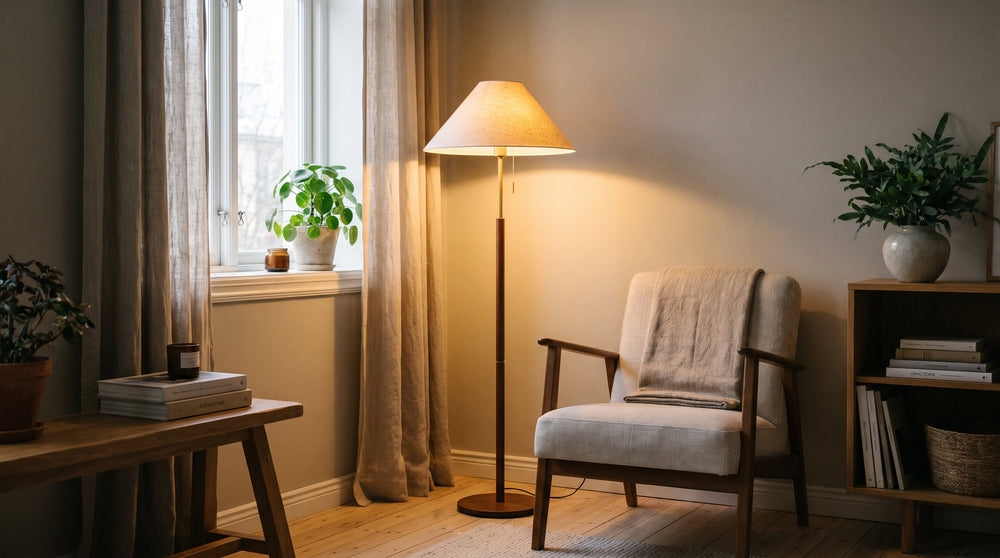
An interior that reflects who you are
Carefully selected pieces, shipped from our warehouses. Our team advises you before you buy, so you choose with confidence.
- Tracked delivery
- Pay in instalments, where available
- 14 days to change your mind
- Advice & showroom in Lyon, France
What is a terracotta standing lamp?
It is an accent lamp whose vertical stem rests on the floor or on a low piece of furniture, dressed in a terracotta hue between burnt orange and dusty pink. It provides ambient light at seat height, without glare, in a living room or a reading corner. You choose it for the warmth it casts on a pale wall, more than for its power.
What "standing" means
The vertical stem is the marker: it holds the light above the seat, within reach when you are sitting. That is what sets it apart from a floor lamp, which is taller, lights a whole area and sometimes replaces the ceiling light. This one moves from one corner to another, slips between the sofa and the wall. To see the other formats, browse lighting by type and by room.
Terracotta, ceramic or lacquered metal
Terracotta gives a matte surface that patinas and absorbs the light. Glazed ceramic catches a sharper reflection and wipes clean in one stroke, as found on ceramic table and standing lamps. Lacquered metal offers a solid colour and a lighter weight, handy if the lamp often changes room.
What light does a terracotta standing lamp give in a living room?
The terracotta hue warms the perceived light: depending on the shade, it spreads a soft halo upwards and outwards rather than a directed beam. It is used as accent lighting, alongside a ceiling light, to soften a living room lit in white in the evening.
A warm halo rather than a directed beam
A fabric or diffusing shade spreads the light over the nearby wall and ceiling. The result shows on faces and materials: wood looks warmer, off-white less cold. If you are after concentrated light on a book instead, look at adjustable models for reading.
Its role next to the living room ceiling light
The ceiling light illuminates the room, the standing lamp sets the evening mood. You switch on the second alone to watch a film or talk, both together when you have guests. The socket stated on the model's sheet decides the bulb: a warm white LED bulb extends the terracotta effect without heating the shade.
Where to place a standing living room lamp?
In a corner near the sofa, beside a reading armchair or along an empty wall, where light is missing in the evening. Place it within reach of the seat for reading, or further back when you only want an ambient halo.
| Room | What you expect from the light | Recommended position | Point to check |
|---|---|---|---|
| Living room, sofa corner | A warm halo that complements the ceiling light in the evening | Corner near the sofa, within reach of the seat | Stability of the base and shape of the shade |
| Reading corner or desk | Light close to the book, without glare | Beside the armchair, on the free-hand side | Whether the shade can be angled |
| Bedroom | Low light for the evening | Near the bedside table or in the free corner | Bulb intensity and colour of the stem |
| Hallway or corridor | A bright landmark on arrival | Against the wall, out of the walkway | Floor footprint and ease of cleaning |
| Living area with a terracotta wall | Let the lamp echo the wall colour | In front of the curtain or the empty area | Matte or glazed finish of the colour |
Near the sofa and in the bedroom
By the sofa, choose the free-hand side: you read without twisting. In the bedroom, a low lamp placed near the bed replaces the bedside lamp when the table is cluttered, to be found among ceramic bedside lamps and designer lamps for the bedroom.
Places to avoid
Not directly in line with the sofa facing the television, not in the middle of a walkway, not in front of a window in full daylight: the stem then stands out as a black silhouette. For a workspace, prefer metal for the desk or designer desk lamps.
How to choose an original terracotta standing lamp?
First look at the silhouette of the stem, slim, tripod or full, then the proportion between base and shade, and finally the terracotta finish, matte or glazed. The height of the stem and the diameter of the shade decide the effect in the room.
| Silhouette | Visual effect | Room where it works | Point of attention |
|---|---|---|---|
| Slim cylindrical stem | Discreet, lets the wall breathe | Living room, bedroom, hallway | Floor contact to check on parquet |
| Tripod base | Light, a little retro | Living room and desk corner | Balance of the whole |
| Full base | Solid, very present on the floor | Large living room, hallway | Footprint in the walkway |
| Sculptural stem | A piece in itself, draws the eye | Living area with an empty wall | Proportion with the shade |
| Tapered stem, Italian design style | Slender, readable from afar | Contemporary living room | Height relative to the seat |
Silhouette above all
A sculptural stem works as decoration, a slim stem goes unnoticed. Look at the wall behind: on a bare surface, the silhouette matters as much as the light. Modern living room lamps play on clean lines, while designer wood brings a different grain.
The relationship between stem and shade
A wide shade on a slim base unbalances the line; a narrow shade on a full base weighs it down. The right proportion can be seen from afar, at three metres. The finish matters too: matte terracotta on a textured wall, glazed on a smooth wall.
Which curtain colour with a terracotta wall?
A terracotta wall pairs with off-white, pale linen, sage green or midnight blue curtains. Pale tones calm the room and let the wall colour dominate; a darker curtain structures it and brings out the lamp placed in front.
Pale curtains on a terracotta wall
Pale linen, off-white or dusty beige: the wall keeps the lead and the terracotta lamp blends into the whole. It is the easiest pairing to live with, and the one that forgives seasonal changes best. Compare with the white design colourway to gauge the difference in mood.
Dark curtains and graphic textiles
Sage green for a natural pairing, midnight blue for a strong contrast, black to underline the silhouette of the light. A dark curtain structures the room and brings out the warm hue of the stem. The blue colourway for contrast follows the same logic, and the gold and black finishes highlight the details of the base.
How to connect several lamps to a single power outlet?
Group the lamps on a power strip or a switched block, plugged into the existing socket, adding up the bulb wattage to stay within what the socket can take. Avoid stacking extension leads and power strips, and prefer a switched socket. If in doubt, an electrician decides.
Grouping the lamps on a switched socket
A socket controlled by a switch, or a block with its own button, turns everything on in one go instead of hunting for three switches. It is the setup that serves best day to day in a living room with two or three accent light points.
Adding up the wattages before plugging in
Note the wattage of each bulb, add it up, and compare it with what the socket can take. A single-bulb lamp stays modest, the vigilance lies in the number. Never run a power strip through a doorway, and keep the cables along the wall.
How to care for a terracotta lamp?
A soft dry cloth is enough on terracotta or ceramic; water and detergents mark matte finishes. Dust the shade dry, unplug the lamp before cleaning the base and let it dry before plugging it back in.
Cleaning the base without damaging the finish
On matte terracotta, a slightly damp microfibre cloth is already a limit: rub without insisting, dry straight away. A glazed ceramic tolerates a mild product, never an abrasive. Ceramic table and standing lamps stay clean this way for years.
Caring for the shade and changing the bulb
Dust the fabric dry, with a soft brush or a vacuum on low, without wetting it. To change the bulb, switch off at the wall or unplug, let it cool, then handle the socket by its base. A stained shade is easier to replace than to clean.
Italian design standing lamp: what sets this style apart?
Italian design from the 1950s to the 1970s favours simple volumes, tapered or tripod stems and warm materials such as terracotta or lacquered metal. A lamp in this style is recognised by its readable silhouette, its right proportions and its ochre or terracotta hue.
The codes of Italian design
Few details, a continuous line from stem to shade, colours drawn from earth and metal. The stem narrows, the base widens just enough for stability. Nothing decorative added afterwards: it is this restraint that ages well.
How to bring it into a contemporary interior
One such piece is enough in a pale living area, near a bare wall or a wooden piece of furniture. It sits well with wooden lamps for the living room without imitating them. To widen the comparison, see designer standing lamps for a living room and the crystal selection, more formal. The rest of the catalogue can be browsed from all the lamps in the Designix catalogue.
Secure payment, tracked delivery, returns and Designix customer service: every order can be tracked from dispatch to receipt. If you are still unsure about the colour match, start again from our full lighting collection and compare the colourways side by side before deciding.
Frequently asked questions about terracotta standing lamps
What is the difference between a standing lamp and a floor lamp?
A floor lamp is a tall light, placed on the floor, that illuminates a whole area and sometimes replaces a ceiling light. A standing lamp is lower and more mobile: it adds ambient light at seat height, and can be moved from one corner to another.
How to choose a standing living room lamp?
Start from the use: reading near the sofa or an ambient halo in a corner. Then come the silhouette of the stem, the diameter of the shade and the terracotta finish. The lamp must stay stable on the floor and match the textiles already in the living room.
What are the most beautiful living room lamps?
There is no absolute answer: a beautiful living room lamp depends on its proportions, the consistency between stem and shade, and how well the colour matches the room. A matte terracotta hue and a simple silhouette age better than a heavily decorated model.
How to arrange ceiling spotlights?
Place the spotlights according to the areas to be lit rather than in a regular grid: one point above the worktop, another towards the sofa, avoiding the direct line of the seats where you sit facing the light. A standing lamp then completes the areas left in shadow.
Can you eat at a wooden table without a tablecloth?
Yes, provided you choose a treated or oiled wood and wipe marks away quickly. A raw top marks on contact with water and grease. If the table doubles as a workspace in the evening, a standing lamp placed nearby lights better than a distant ceiling light.
What is an original standing lamp?
It is a model whose silhouette stands out without being spectacular: tripod stem, tapered base, full base, glazed or textured terracotta finish. The originality comes from proportions and material, not from an added detail that ages badly or complicates care.
How to place a standing living room lamp?
Install it in a corner or beside the sofa, preferably on the free-hand side, to read without getting up. Leave a little distance from the wall so the halo can breathe, and keep the walkways clear. The cable runs along the wall.




