
Solar LED string lights for patio
This selection is also available in our French store: Guirlandes LED solaires pour terrasse
No products in this selection.
- Tracked delivery to your country Tracked delivery
- Secure payment at checkout Multiple payment methods
- 14 days to change your mind 14-day returns
- Secure payment Secure payment
Not sure of your style? Find it in 30 seconds
A few questions, and we will show you the pieces made for you.
Frequently asked questions
How do I choose the right product?
What are the delivery times?
Can I return an item?
Can I pay in instalments?
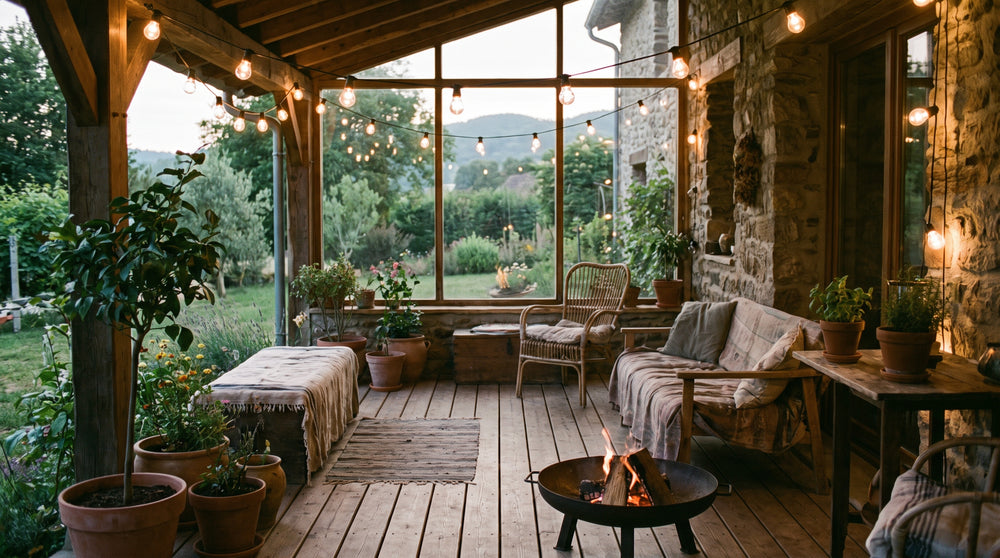
An interior that reflects who you are
Carefully selected pieces, shipped from our warehouses. Our team advises you before you buy, so you choose with confidence.
- Tracked delivery
- Pay in instalments, where available
- 14 days to change your mind
- Advice & showroom in Lyon, France
Hang the string lights where the solar panel can see the sky, then check the protection rating before anything else: IP44 under a sheltered pergola, IP65 on an open terrace that gets watered. Length, spacing of the light points and light colour are decided next, once the hanging point is settled.
- How a solar string light works
- Where to install it
- The criteria that matter
- Which IP rating
- Length and fixing
- Solar, 220V or rechargeable
- Matching it to the terrace
- Care and winter storage
What is a solar string light for a patio and how does it work?
A solar string light for a patio works without a socket: a photovoltaic panel recharges the battery during the day, a sensor switches the LEDs on as soon as light drops, and the stored energy takes over in the evening. No cable to run from the house, no connection to plan.
Outdoor solar string light: from panel to bulb
The panel captures daylight and turns it into current, stored in a small battery housed in the control box. At nightfall, the cell detects the drop in brightness and switches the power to the LEDs, with no intervention. The next day, the cycle starts again. A solar string light for a patio therefore stays self-sufficient as long as the panel receives light, which is why its orientation matters so much.
What changes the runtime: sunshine, season, panel position
A grey day recharges less than a clear one, and the short days of winter reduce the available reserve. A panel placed in the shade of a pergola canvas or foliage produces little, even if the patio is bright. To compare formats, also take a look at classic string lights: length and the number of light points change consumption, and therefore how long they last in the evening.
Where to install a solar patio string light so it lights well and recharges well?
The panel must see the sun, the bulbs must see the patio: that is the only rule. The string light is hung on a pergola, a railing, a wall or between two posts, keeping the panel clear of shadows from the railing, the canvas or a tree.
Hanging points that hold on a patio
A pergola offers the longest span: stretch from one upright to the other, in a slight zigzag to avoid too rigid a line. A railing calls for a flexible cable and regular clips. A patio wall or a facade accepts round bulbs, provided the panel is turned towards the sky rather than the wall. On a tree or a hedge, keep some slack. To widen the search beyond string lights, all Designix light fittings can be browsed by use.
Balcony without a socket: the solar solution
On a balcony, no cable can come out from inside: solar solves the problem. The sensitive point remains the panel, often masked by the railing or the neighbouring wall. Fix it high up, tilted towards the light, and check the cast shadow before running the cable. If the balcony stays dark, compare with rechargeable LED string lights, which are simpler to bring inside.
Which outdoor solar string light to choose: the criteria that count?
First look at the protection rating according to rain exposure, then the useful length and spacing of the light points, then the light colour and bulb format. Style comes last, once these four points are validated for the intended outdoor space.
Length, spacing and number of light points
Two string lights of the same length do not give the same wash of light: closely spaced points make a continuous cord, widely spaced points draw a discreet line. Count the useful bulbs, not the total cable length, and check the part that actually lights between the box and the last LED.
Solar string lights for garden or covered patio: the right format
The garden accepts long spans and thin cables, a covered patio prefers round bulbs near the wall, and a dining table calls for a short format, laid rather than stretched. The table below sums up the most common cases.
| Location | Recommended format | Point to watch | Light colour |
|---|---|---|---|
| Pergola or arbour | Long string light with spaced points | The panel must clear the shadow of the canvas | Warm white |
| Railing or balustrade | Short string light, flexible cable | Fixing without drilling, cable left slack | Warm white |
| Patio wall or facade | String light with round bulbs | Turn the panel towards daylight | Neutral white |
| Garden, hedge, tree | Thin cable, long length | Keep away from automatic sprinklers | Multicolour for parties |
| Table or dining corner | Rechargeable string light, laid down | Bring the battery inside to recharge | Warm white |
Depending on the actual exposure, go for IP44 LED string lights for a sheltered spot, or for IP65 LED string lights for an open patio.
Which IP protection rating to choose for an outdoor solar string light?
IP44 covers water splashes and suits under an awning or a sheltered pergola. IP65 withstands water jets and dust, so it is right for genuinely exposed patios and frequent watering. The rating tells you about the sealing of the box, not about light output.
IP44: covered patio, awning, sheltered pergola
The first digit concerns dust, the second water. An IP44 rating withstands oblique rain and splashes, which is enough when the string light stays under a roof, an awning or a closed arbour. The panel box and the connections must stay out of direct jets.
IP65: exposed patio, watering, poolside
On an open patio, near a water point or under a sprinkler, IP65 is the reference to remember: it holds up against jets and dust. Still check the condition of the panel seal and the connectors, because the rating describes a new, correctly closed box. The details of the ranges can be read on the models sealed against water jets, and comparing them with the string lights designed for water splashes helps you decide.
| Rating | Withstands | Install in | Care |
|---|---|---|---|
| IP44 | Water splashes, limited dust | Covered patio, awning, sheltered pergola | Damp cloth on the box |
| IP65 | Water jets, dust | Exposed patio, frequent watering, poolside | Check the condition of the panel seal |
How many metres of string light to plan for and how to fix it without drilling?
Measure the linear run to cover, add the slack between two hanging points and the return to the solar panel. To fix without drilling, use clips that snap onto a gutter, cable ties on a railing or clips on a pergola, letting the cable stay slack.
Measuring the length without getting it wrong
Follow the actual cable route with a piece of string, then measure it: a zigzag uses more than a straight line, and the solar box must reach its support. Add the reserve needed for the return to the panel and a little slack at the ends.
Fixing without drilling: clips, hooks, ties
Clips pinch onto a gutter or a tube, hooks screw onto a pergola upright when drilling is accepted, cable ties wrap around a railing. Avoid stretching it like a rope: at night the cable contracts and tears the fixings off. The choice of support dictates the rest, and all our solar string lights should be read with that constraint in mind.
Solar string light, 220V string light or rechargeable string light: which to choose?
Solar goes anywhere there is no socket and withstands direct exposure. 220V gives constant light but requires a connection. Rechargeable is brought inside to recharge and suits shaded balconies, tables and patios without sun. 24V remains a low-voltage supply to be wired in.
Solar when there is no socket at all
This is the case for most house patios: the garden is not wired, and running an outdoor line means building work. Solar removes the problem, provided you accept an intensity that varies with the day's weather. 220V LED string lights take over when an outdoor socket already exists.
220V, 24V and rechargeable: the cases where they take over
A covered patio with an electrical supply gains consistency with the classic mains version. A pergola fitted with a supply accepts 24V LED string lights, at low voltage. On a shaded balcony or for a table, rechargeable LED string lights remain the simplest to live with.
How to match a solar string light with the patio decor?
Choose the light colour before the shape: warm white warms wood and brick, neutral white suits grey facades and metal, multicolour is reserved for parties. The string light underlines a line of the patio, it does not cover it.
Warm white, neutral white or multicolour: which light for which mood
Warm white (around 2700 to 3000 K) gives an evening patio, close to indoor light. Neutral white (around 4000 K) makes a contemporary facade look sharper. Multicolour is only justified for an event, otherwise it tires the eye. This selection of light fittings complements the string light for useful lighting.
A patio that extends the kitchen: hanging without cluttering
When the patio serves as a summer kitchen, the wire stretched above the worktop plays a real decorative role for outdoor cooking: it lights without taking up the surface. A straight line, warm white, nothing hanging in the field of view, and you get the codes of modern kitchen decor applied outside. Ambient string lights complement this setup well.
How to care for and winter a solar string light?
A panel dusted with a damp cloth regains efficiency, and a slack cable avoids strain on the fixings. In winter, bring the string light and its battery inside to a dry place when the manufacturer provides for it, otherwise leave the panel clear of snow and leaves.
Cleaning the solar panel without damaging the box
A soft, damp cloth is enough, with no abrasive product and no direct jet on the seal. A film of dust or pollen loses charge without being visible to the eye. Also check the fixings: a cable that slaps in the wind ends up wearing through its sheath.
Wintering the string light and its battery
Bring the battery inside to a dry place if the instructions ask for it, because prolonged cold reduces its capacity. Otherwise, leave the string light in place, panel clear, and check after gales. To replace or complete your set, the full lighting catalogue remains the reference.
Payment, delivery and returns at Designix
Payment is secure, delivery is tracked and returns are handled according to the shop's conditions. Designix customer service answers fixing and selection questions both before and after ordering.
Before confirming, go back over the two points that decide everything: the protection rating according to actual exposure, and the useful length between the box and the last LED. Browse all our solar string lights to compare the available formats.
Which solar patio string light withstands rain?
An IP44 rating is enough under an awning or a sheltered pergola, because it covers water splashes. For an open patio, one that gets watered or is near a pool, an IP65 rating is more suitable since it withstands water jets and dust.
Do solar string lights for the garden really light up at night?
Yes, as long as the battery has stored enough energy during the day: a sensor detects the drop in light and switches the LEDs on. Runtime varies with sunshine, season and panel position, which must not stay in the shade of foliage.
Can a solar string light be installed without a socket on a balcony?
Yes, that is precisely its point: no cable to run from inside. The thing to watch is the panel, which must receive daylight despite the railing or the wall. On a very shaded balcony, a rechargeable string light is often simpler.
Should a solar string light be brought inside in winter?
When the manufacturer provides for it, bring the string light and its battery inside to a dry place for the cold season. Otherwise, leave the panel clear of snow, leaves and dirt, and check that the cable has not been stretched by the wind.
Does a solar string light give enough light to dine outside?
A solar string light creates ambient light: it outlines the patio and accompanies the meal, but it does not replace functional lighting for reading or cooking outside. To light a table, complete it with a dedicated source.




