
Solar deck lights
This selection is also available in our French store: Spots solaires pour terrasse
No products in this selection.
- Tracked delivery to your country Tracked delivery
- Secure payment at checkout Multiple payment methods
- 14 days to change your mind 14-day returns
- Secure payment Secure payment
Not sure of your style? Find it in 30 seconds
A few questions, and we will show you the pieces made for you.
Frequently asked questions
How do I choose the right light output?
At what height should the light be installed?
What type of bulb?
Compatible with LEDs and dimmers?
Light changes everything
From statement chandeliers to discreet wall lights, we help you choose the right brightness, height and style for every room.
- Tracked delivery
- Pay in instalments, where available
- 14 days to change your mind
- Advice & showroom in Lyon, France
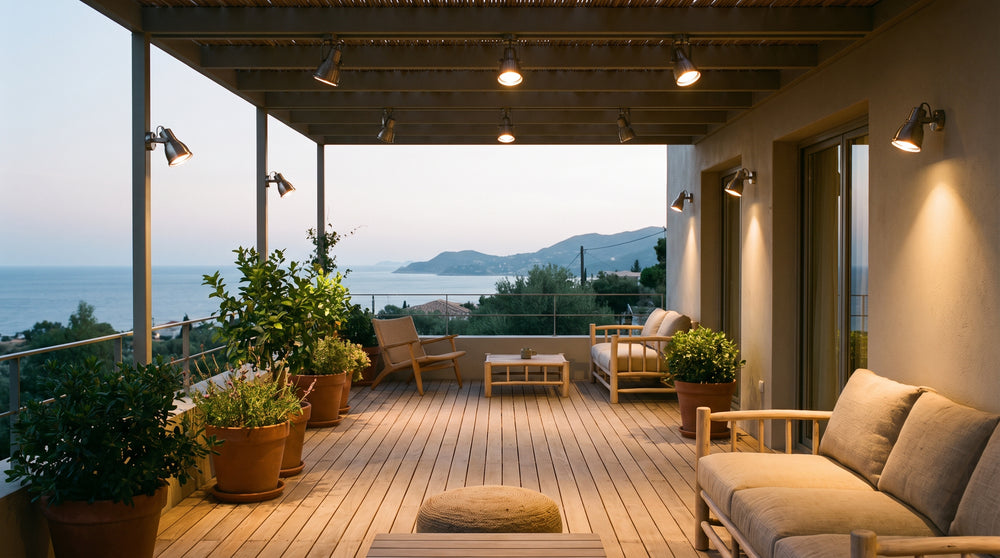
Plan on one stake-mounted spotlight every two or three metres along the path, a recessed model at the edge of the deck and an adjustable projector aimed at a tree or a facade wall. A solar spotlight captures daylight, stores it in a battery and switches on at dusk: no cable to run, no socket to plan for on the patio.
How do you light an outdoor patio with solar spotlights?
A solar spotlight works on its own: the panel captures daylight, the battery recharges, a sensor triggers the switch-on at nightfall. You then light in zones, a few low markers for the walkways and one or two beams aimed at a plant or a wall, rather than a uniform wash that flattens the garden.
Outdoor solar spotlight for a patio: how does it work in the evening?
The photovoltaic panel recharges a built-in battery during the day. A dusk cell switches the spotlight on as soon as the light drops, and switch-off follows a timer or sunrise. Some models add a motion sensor: the light only comes on when someone passes, which saves charge for the genuinely useful moments of the evening.
Lighting a patio without cables: what it changes
With no cable to bury, installation is limited to planting, placing or screwing the spotlight. The patio becomes flexible: you can move a stake-mounted model from one bed to another as the seasons go by. Recharging, however, depends on real exposure. Before choosing, compare the outdoor solar spotlights and the solar-powered LED range: the two families are not installed in the same way.
Which type of solar spotlight for a patio should you choose?
Three families cover the patio: the stake-mounted spotlight, which is planted in a bed or a lawn, the recessed spotlight, designed for a deck board or a drilled support, and the adjustable projector, fixed to the wall or the ground to light a facade or a tree. The choice depends on the support available.
| Type of spotlight | Mounting support | Use on the patio | What to check |
|---|---|---|---|
| Stake-mounted | Lawn, bed, loose soil | Path marking, edge of a bed | Length of the stake and wind resistance |
| Recessed | Deck board, slab, drilled support | Flush lighting of a deck | Available thickness under the support |
| Adjustable projector | Wall, facade, ground, wall base | Highlighting a tree or a wall | Orientation of the head and the panel |
| Compact wall mount | House wall, low wall, fence | Additional lighting near the door | Strength of the fixing and sun exposure |
Solar spotlight for a wooden patio: stake-mounted or recessed?
The stake is planted in the ground at the edge of the deck, without touching the wood: nothing to drill, and the spotlight can be removed before winter if needed. The recessed model sits flush with the board and gives a continuous line along the deck. It requires a board thick enough and access underneath. If you do not want to touch the wood, the first solution does the same job.
Outdoor solar spotlight: projector or low point?
The low point guides and secures: it marks a step, a turn, an edge. The projector, on the other hand, draws: it sends a beam onto a trunk, a wall or a hedge. An adjustable head changes everything, and spotlights with an adjustable head let you aim without moving the base. For durability, a sober finish ages better: metal spotlights withstand frost and UV.
How do you lay out a 50 m2 patio in terms of lighting?
On a large patio, you light in zones rather than everywhere: a few stake-mounted spotlights along the path, a recessed model at the edge of the deck, a projector aimed at a tree or a wall. Dining and circulation areas stand out without multiplying light points.
Laying out a 50 m2 patio: the zones to light first
Start with what you walk through: the access from the house, any steps, the path to the gate. The threshold deserves an additional point, as when lighting the threshold of the house. Then comes the decor: a tree base, a bed, a bare wall. The dining area closes the list, with soft light that is never aimed at faces.
| Patio zone | Recommended type | Desired effect | Point of vigilance |
|---|---|---|---|
| Path and driveway | Stake-mounted spotlight | Low markers that guide the step | Space them regularly, out of foot traffic |
| Edge of a wooden deck | Recessed spotlight | Flush line of light | Do not weaken a load-bearing board |
| Bed and tree base | Adjustable ground spotlight | Relief and volume of the plants | Aim the beam, keep the panel clear |
| Facade wall and door | Wall mount | Welcome and safety at the threshold | Mounting height and risk of glare |
| Dining corner and outdoor lounge | Low points with soft intensity | Atmosphere without dazzling guests | Avoid direct light in the eyes |
Sun lounger, dining corner, vegetable patch: adapting the light to each use
A dining corner is happy with ambient lighting, a sun lounger with a discreet halo, a vegetable patch with stronger light for working in the cool. The rest of the garden can be discovered in our full range of lighting, if you also want to dress a facade, a gate or a driveway.
Recessed solar spotlight for a wooden patio: how do you fit it?
A recessed spotlight sits in a deck board or in an added support, so that it is flush with the surface: nothing protrudes, feet do not catch on it. You need to check the available thickness under the board and orient the solar panel towards the sunniest area of the day.
Recessed solar spotlight for a wooden patio: step-by-step fitting
- Mark the location along the deck, at regular intervals, and check what runs under the board.
- Measure the available thickness: the body of the spotlight and its battery must fit underneath, panel included.
- Cut to the diameter of the spotlight, or use the added support provided by the manufacturer.
- Seat the spotlight, check that it is flush, then test the fixing before nightfall.
- Orient the panel towards the clear south and make sure no leaf covers it.
Recessed solar spotlight for a patio: mistakes to avoid
- Recessing into a board that carries the structure: better to choose an edge board.
- Hiding the panel under a table or in the shade of a wall, charging collapses.
- Making the panel inaccessible: you need to be able to clean it by hand.
- Mixing a matte black version and light finishes on the same deck line, the alignment reads less well.
Outdoor solar spotlight to light a tree: how do you go about it?
Install the spotlight at the base of the tree or in a neighbouring bed, panel turned towards the sunniest area, and aim the beam at the trunk or the branches: grazing light emphasises the bark, whereas front lighting flattens the volume. A ground fixing avoids drilling into the trunk.
Outdoor solar spotlight to light a tree: where to place it?
One or two metres are often enough: too close, the beam only lights a strip of bark. Place the spotlight on the ground, aim the head towards the top of the trunk, then step back until you get the desired height of light. Some models are adjustable in intensity, such as spotlights with adjustable light intensity, which leaves room for a softer result.
Highlighting a bed or a hedge without dazzling guests
Aim at the plants, never at the seating: the source stays hidden behind a clump or a low wall, and the light bounces off the foliage. Space the points along the hedge to avoid a garland effect. A wide bed takes two crossed beams, a thin border is happy with one.
How long does a solar spotlight light at night and how do you maintain it?
Runtime depends on the day's sunshine, the setting and the condition of the battery: a cloudy day means a shorter night. Clean the panel and the diffuser with clear water, remove leaves and dust, and reorient the panel if the shade has moved.
Why does a solar spotlight light less in winter?
Days are shorter, the sun is lower and often hazy: the battery recharges less. A panel shaded by evergreen foliage or by a wall loses even more charge. Clean the panel, clear it, lower the intensity or switch to detection mode to last the whole night. Steps and walkways benefit: marking a staircase with individual points uses less than continuous lighting.
How do you clean and maintain a patio solar spotlight?
- Panel and diffuser: soft cloth and clear water, no abrasive product.
- Leaves, sand and droppings: remove them every few weeks, this is what blocks charging the most.
- Stake or fixing: check it holds after a gust of wind.
- Battery: if lighting shortens markedly despite correct exposure, it is often reaching the end of its life.
A use close to that of lighting steps inside the house: a few well-placed points are better than a continuous line.
What is the best brand of outdoor solar lamp?
There is no brand to insist on: the specifications decide. Look at the material and finish, the water and dust protection rating, the size of the solar panel, the presence of a motion sensor and the ability to orient the head.
What criteria before buying an outdoor solar spotlight?
For outdoors, you want real protection against water spray and dust, rated by the IP index on the technical sheet: the more exposed the fixture, the higher this index should be. Then check the material against frost and UV, aluminium or treated steel age better than thin plastic. Colour temperature matters too: around 2700 to 3000 K, the light stays warm, a more neutral tone suits work areas. Models in a contemporary style blend more easily into a recent patio.
Budget: accessible models or an exceptional piece?
An accessible model does a marking job very well: it moves, it gets replaced, and it covers secondary areas. A more refined piece is justified on a very visible point, an entrance, a facade wall, a staged tree, where the finish and the quality of the beam show every evening. Between the two, the real question remains the exposure of the panel: a simple model well placed lights better than a high-end model in the shade.
How do you match patio lighting with the rest of the house?
A patio is seen in the evening from the interior rooms: outdoor light that is too white or too strong crushes the living room. Keep a warm tone outside for atmosphere, a more neutral light on worktops and reading areas inside, and avoid mixing opposite tones.
What light colour for a living room: matching interior and patio?
A warm light, around 2700 to 3000 K, stays consistent between the two spaces. If you are looking for living room light, stay in this range so that the bay window does not create a break in the evening. A very cool tone outside, very warm inside, is immediately noticeable from the sofa.
Decor for a modern kitchen: extending the light indoors
The same reasoning applies to the kitchen: a neutral light on worktops, warmer for atmosphere. Seeing the decor for a modern kitchen helps to set this progression, from the patio threshold to the room. For night-time rooms, the bedroom atmosphere calls instead for low, warm light, with no direct beam.
Ordering your patio solar spotlight from Designix
Payment is secure, delivery is tracked and returns are possible if the model does not suit the support. Designix customer service answers installation questions before ordering: board thickness, panel exposure, wall fixing. To go further, explore the Designix lighting catalogue and the solutions designed for indoor circulation.
Frequently asked questions about patio solar spotlights
Solar spotlight for a wooden patio: how do you fix it without damaging the boards?
The simplest is recessing into an existing board, with a spotlight designed to sit flush with the surface, or installing a stake-mounted spotlight at the edge of the deck. If you do not want to drill anything, a model placed on the ground or fixed to a nearby low wall does the same job.
How long does a solar spotlight light at night?
The duration depends on the charge accumulated during the day, the size of the panel and the intensity setting. A sunny day gives a full night, a grey day much less. Models with a motion sensor only switch on when someone passes, which extends runtime.
Does a solar spotlight work in winter or in cloudy weather?
Yes, but for less time: less sun means less charge and a shorter night. To compensate, keep the panel clear, clean it regularly and avoid the shade of a wall or growing foliage. Lowering the intensity also helps it last until morning.
Can you light a tree with an outdoor solar spotlight?
Yes: install the spotlight on the ground, in a bed or a few metres from the trunk, panel turned towards the sunniest area, and aim the beam at the trunk or the branches. Grazing light reveals the bark, whereas front lighting flattens the volume.
Which protection rating should you choose for a patio solar spotlight?
A spotlight placed outside must be stated as protected against water and dust: this is the protection rating, noted IP, shown on the technical sheet. The higher the rating, the better the fixture withstands rain, watering and spray. Check it before buying.




