
Solar outdoor wall light
This selection is also available in our French store: Applique exterieur solaire
No products in this selection.
- Tracked delivery to your country Tracked delivery
- Secure payment at checkout Multiple payment methods
- 14 days to change your mind 14-day returns
- Secure payment Secure payment
Not sure of your style? Find it in 30 seconds
A few questions, and we will show you the pieces made for you.
Frequently asked questions
How do I choose the right product?
What are the delivery times?
Can I return an item?
Can I pay in instalments?
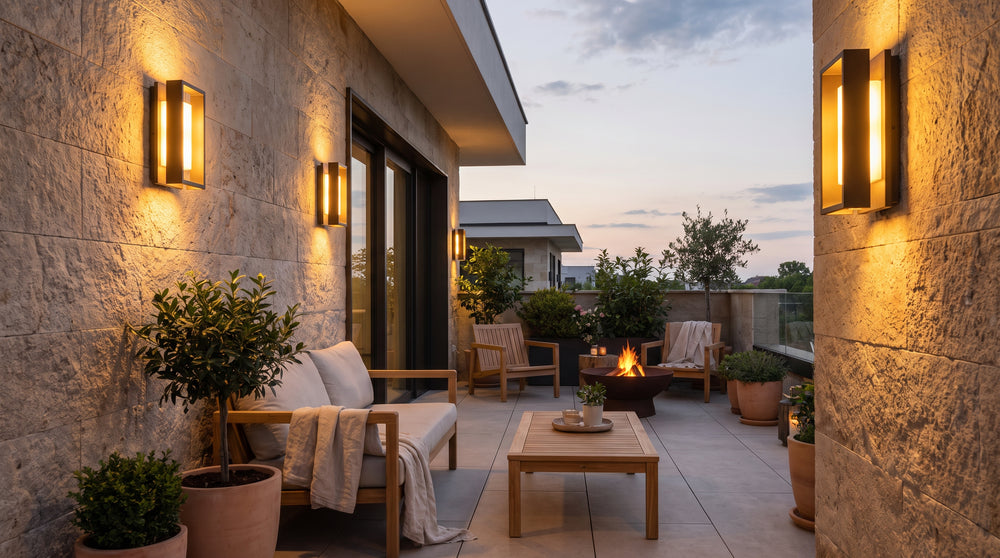
An interior that reflects who you are
Carefully selected pieces, shipped from our warehouses. Our team advises you before you buy, so you choose with confidence.
- Tracked delivery
- Pay in instalments, where available
- 14 days to change your mind
- Advice & showroom in Lyon, France
Place the wall light where its panel receives direct sunlight for several hours a day, then choose the direction of the light: upwards for ambient light on the facade, downwards to light a step or a lock. A solar outdoor wall light installs without a cable or mains connection, which makes it suitable for walls that get the sun.
Which solar outdoor wall light should you choose for a facade or a terrace?
The look comes first: a well-placed solar wall light traces a pool of grazing light on the render or stone, and disappears into the wall during the day. The absence of a cable changes everything on an old facade you do not want to open up. Three points then decide it: the exposure of the panel, the direction of the light, and the footprint relative to the face of the wall.
Solar outdoor wall light in aluminium or painted metal
Powder-coated aluminium keeps its colour and does not rust, which matters on a wall battered by rain. Painted metal often costs less and ages nicely, but the paint flakes first at the corners: look at the finish of the edges before fixing. To compare finishes, browse the metal wall lights, and note that those that combine metal and glass give a softer light, without a dazzling point.
Integrated panel or remote sensor: where to place the panel
On a model with an integrated panel, the sensor is attached to the housing: installation is quick, but the orientation is dictated by the wall. A panel on a short cable can be raised or tilted to escape the shade of a roof overhang. This is the choice to favour when the facade is set back, under a canopy or behind a gutter. The range of solar wall lights should be read product by product on this point.
Which waterproof outdoor wall light should you choose?
A waterproof outdoor wall light is recognised by its ingress protection rating, marked IP followed by two digits: the first concerns solids, the second water. The higher the second digit, the better the light resists splashes and rain. A wall under a canopy and a facade fully exposed to the wind do not call for the same level of protection.
Reading the ingress protection rating without getting it wrong
As a general guide, an IP44 covers water splashes and suits a sheltered wall; an IP65 resists jets and is justified on a very exposed facade, near a door or a downpipe. The digit that matters is the second one. The solids digit mainly protects against dust and insects, not rain.
Materials that age well outdoors: aluminium, glass, treated metal
Aluminium, tempered glass and UV-treated metal come through the seasons without deforming. Salt and sea spray, near the coast, speed up the ageing of all finishes: rinsing with clean water twice a year limits the damage. Find the models designed for outdoor use in all our outdoor wall lights.
How long does it take to charge a solar light?
Charging happens during the day, when the panel is exposed directly to the sun, and it varies with the season, the orientation and the cleanliness of the sensor. A light placed in the shade or behind a window charges poorly. The exact time depends on the panel and battery supplied with the model, and is given on its product page.
What lengthens charging: shade, glazing, poor orientation
A branch growing in front of the sensor is enough to halve the charge. A panel behind a window loses most of the useful radiation. A north-facing orientation, or a panel lying flat under a roof overhang, gives the same result. In winter, the lower path of the sun and the short days reduce the available reserve: this is normal and does not indicate a fault.
How to tell that the battery is charged
A properly charged light switches on at dusk and keeps the same brightness until it goes out. If the light dims after a few hours, the charge is insufficient: clean the panel with clean water, trim the vegetation in front, check the orientation. To find the models, see designer wall lighting and the product pages for each reference.
What is the best solar outdoor light?
There is no best solar light in absolute terms: the right wall light is the one whose brightness, lighting duration and triggering match the use. To light a passage, a sensor and a light directed towards the ground matter more than a stated power. A successful solar outdoor light is judged on what it lights, not on what it promises.
The stated power does not tell the whole story
The watts consumed do not tell you how much light is emitted. Rely on the direction of the beam and the colour temperature: a light that is too cool whitens the stone and dazzles, a warmer tone makes a facade readable without being harsh. On a terrace, a well-aimed outdoor wall light for a terrace lights better than a more powerful model that is badly pointed.
Lighting or signalling: two different lights
Lighting means directing a flow towards the useful area: step, lock, handle. Signalling means placing a point of light visible from afar, without claiming to light the ground. A solar outdoor spotlight or a solar outdoor floodlight meet the second need, a light directed downwards meets the first. Choose the function before the look, then match the style.
Solar outdoor wall light with motion sensor or without a motion sensor?
With a sensor, the light switches on when someone passes: useful for a path, a gate or an entrance, and it saves the battery. Without a sensor, it shines continuously from nightfall, which suits a terrace better where you sit and want a steady ambient light.
With motion sensor: path, gate, passage
The sensor is useless if it faces a wall or a hedge that is constantly moving. Aim it towards the circulation area, at passage height, and set the delay long enough not to plunge back into darkness in the middle of the steps. A solar outdoor light with a sensor uses its reserve in short bursts, which leaves some margin on evenings without sun.
Without motion sensor: continuous ambience on a terrace
A solar outdoor wall light without a motion sensor switches on at nightfall and off at dawn. This is the expected behaviour around a garden table. Some models accept a remote control to adjust the brightness or switch off the light without removing the housing: handy when the light is fixed high up. See also the LED wall lights for colour temperature and consumption.
Where should you install a solar outdoor wall light?
Place the light where the panel sees the sky: facade, post, terrace wall or shed. Avoid areas shaded by a tree or a roof overhang. On a staircase, place it at hand height, on the wall side, to light the step without dazzling.
Staircase, corridor and passage: height and direction of light
On an outdoor staircase, the light should graze the step and not hit the eyes of the person coming down. Fix it low, on the wall side, shining towards the edge of the step. For a covered passage, see corridors and passages and, for the garden, lighting a staircase. A garden shed or a gate post works the same way, with the panel facing south when possible.
Toilet, WC or outbuilding: an original WC wall light
In an outbuilding without electricity, a solar light near the door avoids running a cable. Inside, an original WC wall light with an adjustable arm lights without dazzling. Check the ingress protection rating if the wall gets rain, and keep the sensor outside, never behind the door.
| Location | Height and fixing | Desired light | Point to watch |
|---|---|---|---|
| Facade near the front door | Above the handle, on the wall side | Downwards, directed light | Panel clear of the roof overhang |
| Path and gate | At shoulder height on a post or wall | Triggered on passage | Sensor aimed at the circulation area |
| Terrace | Seated to standing height | Continuous ambient light | No shadow cast on the sensor |
| Outdoor staircase | At hand height, on the wall side | Grazing towards the step | Avoid direct glare |
| Outbuilding or garden WC | Near the door, under cover | Soft, without dazzling | Ingress protection suited to exposure |
Wired wall light or solar outdoor wall light: which to choose?
Solar suits walls far from a socket: gate, shed, garden staircase. Wired remains relevant when the light must be strong and constant all night, or when the facade is very shaded. In that case, a wired wall light fitted with a powerful LED remains the solution.
When solar is enough
A wall without a power supply, an outbuilding at the bottom of the garden, an isolated stone staircase: solar avoids the trench and the conduit. It is also enough to signal an entrance, provided the panel gets the sun. The solar outdoor wall lights are then installed with a single wall fixing, without an electrician.
When a wired wall light remains the right answer
A north-facing facade, a deep porch, a need for strong and continuous output: the battery will not keep up. A powerful LED wall light, powered from the mains, holds its brightness all night. For indoor use, compare with living room wall lighting and for indoor use.
| Criterion | Solar outdoor wall light | Wired wall light |
|---|---|---|
| Connection | No cable, photovoltaic panel | Mains supply required |
| Installation | Simple wall fixing, without an electrician | Cable routing and connection |
| Autonomy | Depends on the day's charge and the season | Works without interruption |
| Brightness and duration | Limited by the model's battery | Can stay strong and constant |
| Maintenance | Clean the panel, clear the vegetation | Check the waterproofing and connections |
| Where it is relevant | Gate, shed, garden staircase | Already wired facade, strong light |
What style and budget for an original wall light?
Style is chosen before the technical spec, because it decides the look on the facade: boho chic for a stone wall or a planted garden, country chic for an old house, vintage for a shed, white or black to stay discreet. The finish must withstand the sun.
Boho chic and country chic: the styles that dress a facade
A country chic wall light takes the form of a lantern, in painted or patinated metal, and gives a warm, readable light near a door. Boho chic plays on openwork and curves, with a soft light. For clean lines on contemporary render, see contemporary lines.
Vintage, white, gold: choosing the colour on the wall
On light render, white models blend in and leave only the light visible; on stone or dark wood, black finishes draw the silhouette. A gold finish warms an old wall but quickly shows marks. On budget, stay relative: entry level or a more elaborate piece, the current price is shown in the grid. The most affordable models do the same job when the facade is simple.
Secure payment, tracked delivery, returns, Designix customer service: the process is the same whether you order a wall light or another light fitting. Browse the Designix catalogue to match the whole facade, then return to the lighting department from the lighting department to complete the entrance.
Frequently asked questions
Can a modern living room wall light be used outdoors?
A living room model is only suitable outdoors if it is designed for outdoor use: an ingress protection rating suited to rain, a material that does not mind UV. Otherwise, prefer an outdoor wall light designed for the facade, which uses the same modern lines.
Which powerful LED wall light should you choose for outdoors?
The power stated in watts is not enough: look at the direction of the light and the colour temperature. For an outdoor area without a connection, a solar wall light with an integrated LED and sensor covers a passage. For a high and constant output, a wired LED wall light remains safer.
How do you recognise a boho chic wall light?
It combines a natural material or a patinated metal, a rounded or openwork shape, and a soft light. On a facade, it pairs with wood, stone or climbing plants. Check that the finish and the ingress protection rating hold up outdoors.
What is a country chic wall light and where should you place it?
It is a wall light in a traditional style, often in painted or patinated metal, with a shade or a simple shape, reminiscent of farm lanterns. It finds its place on a stone facade, near a front door, a gate or a courtyard wall.
Which designer WC wall light should you choose for a toilet that opens onto the garden?
If the toilet is an outbuilding without electricity, a solar wall light fixed near the door avoids running a cable. Inside, an original WC wall light, with an adjustable arm or a shade, lights without dazzling. Check the ingress protection rating if the wall is exposed.
Is a solar staircase wall light suitable for an outdoor staircase?
Yes, if the panel catches the sun: on a garden staircase, fix the light on the wall side, at hand height, with the light directed towards the step to avoid glare. An indoor staircase, without direct sun, is better suited to a classic wired model.
Solar outdoor wall light with remote control: what is it for?
The remote control lets you adjust the brightness, the lighting duration or switch to standby without touching the housing. It is handy when the light is fixed high up or when you want to modulate the light on a terrace. Check that it is supplied and that the range is sufficient.
Is a wired wall light more powerful than a solar wall light?
Generally yes, because it is not limited by the battery capacity: the brightness and lighting duration can be higher. A solar wall light prioritises autonomy. The choice depends on the location: a wall without a power supply for solar, a wired facade for a strong and constant output.




