
Solar outdoor chandeliers
This selection is also available in our French store: Lustres d exterieur solaires
No products in this selection.
- Tracked delivery to your country Tracked delivery
- Secure payment at checkout Multiple payment methods
- 14 days to change your mind 14-day returns
- Secure payment Secure payment
Not sure of your style? Find it in 30 seconds
A few questions, and we will show you the pieces made for you.
Frequently asked questions
How do I choose the right product?
What are the delivery times?
Can I return an item?
Can I pay in instalments?
An interior that reflects who you are
Carefully selected pieces, shipped from our warehouses. Our team advises you before you buy, so you choose with confidence.
- Tracked delivery
- Pay in instalments, where available
- 14 days to change your mind
- Advice & showroom in Lyon, France
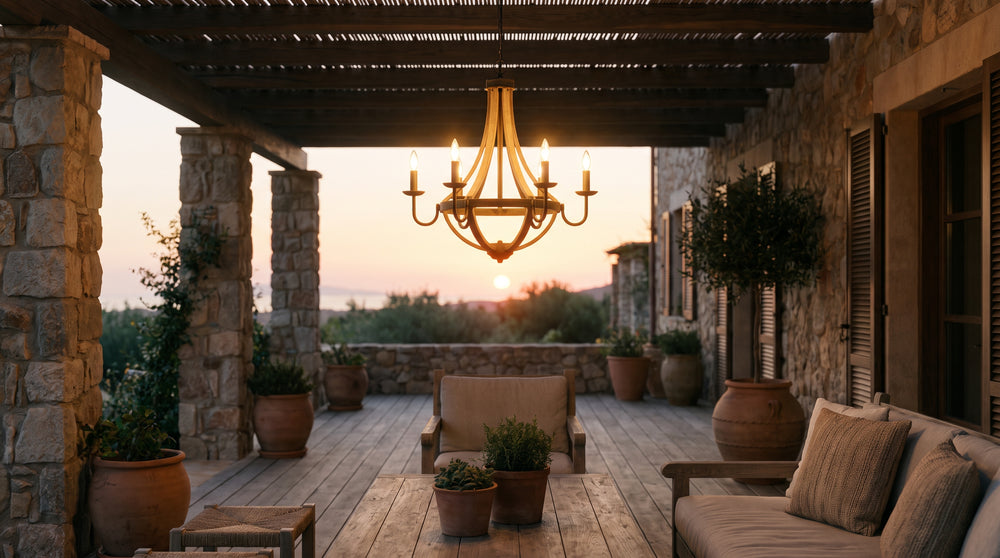
A solar outdoor chandelier hangs above a table, a patio corner or under a pergola, with its panel facing the sun for several hours a day. The choice comes down to three points: how much sun the panel gets, the size of the fixture relative to its area, and the quality of light you expect, warm and decorative.
What is a solar outdoor chandelier and what light does it give?
A solar outdoor chandelier is a hanging light fixture powered by a small photovoltaic panel connected to a rechargeable battery. A sensor detects nightfall and switches it on by itself. It gives a warm, decorative light, made to extend an evening outdoors rather than to light a path.
Solar outdoor chandelier: what recharges and what lights up
The panel recharges the battery during the day, the dusk sensor switches the power on in the evening, the LED lights up with no cable or switch. These three parts work together: a dirty panel or one placed in the shade is enough to cut the runtime. The result stays that of ambient lighting, lower than a living room ceiling light. Browse the Designix lighting catalogue to compare structures before making your choice.
Solar outdoor lighting: what light quality to expect?
Expect a warm light, around 2700 to 3000 K depending on the model, and a deliberately soft intensity. It outlines a table, highlights foliage, accompanies a conversation; it does not secure a driveway. For a stronger result indoors, designer LED chandeliers give a useful point of comparison.
Where to hang a solar outdoor chandelier: terrace, pergola or garden?
Hang it where the panel gets several hours of sun a day: above a terrace table, under a pergola with a translucent roof, or in the centre of a garden corner. A solid support and direct exposure matter more than the size of the fixture.
Height is set by use: above a table, the bottom of the fixture should stay above heads once guests are seated, without hiding faces. Under a canopy, find where the roof's shadow falls before drilling, that is what decides the runtime. A post planted in the garden helps when there is no frame, provided it holds in the wind. Pendants for high ceilings give a sense of proportion in a tall space.
| Area to light | Suitable fixture type | Mounting | What to check |
|---|---|---|---|
| Terrace table | Pendant above the tabletop | Hook or bracket in the frame | Exposed panel and height that does not bother guests |
| Pergola or canopy | Solar chandelier with several light points | Beam or crossbar | Shadow cast by the roof on the panel |
| Garden corner or patio | Low chandelier or hanging lantern | Branch, post or planted support | Stability of the support and exposure |
| Wall, door, passage | Outdoor terrace wall light | Wall mounting | Protection rating and dusk detection |
| Sheltered entrance | Small solar pendant | Porch ceiling | Accent light, not main lighting |
Can a solar chandelier be installed in a living room or dining room?
Yes, provided the room opens to the outside. In a conservatory, covered patio or summer dining room, the solar chandelier works if the panel stays exposed to daylight. In a closed living room, it does not recharge enough and soon goes out.
Living room and dining room chandeliers: the cases that work
Conservatory, enclosed terrace, patio under a translucent canopy: three configurations where the panel sees the sky. The chandelier plays the role of an evening light point, above a coffee table or a reading corner. LED chandeliers for living rooms remain the reference for a closed room that needs a real light level.
Dining room chandeliers in a conservatory: check the sunlight
Spend a day in the room before fixing anything: note the hours when the sun reaches the planned spot. Tinted glazing or a filtering blind already reduces recharging. If the input is low, an LED pendant for dining rooms powered from the mains will be safer for an evening meal.
How to choose the size and scale for the area to light?
Scale follows the relationship between the fixture and its area, not an absolute number: above a table, the chandelier should stay narrower than the tabletop so it does not bother guests. In a tall space, a wider model hung lower balances the perspective.
What chandelier diameter above a table?
Generally stay under the width of the tabletop, by about a third: a fixture that is too wide spills into the guests' field of view, one that is too small gets lost. On a round table, a shape close to a circle works better than an elongated structure.
Hanging height: the reference to respect
Allow around 75 to 90 cm between the bottom of the fixture and the tabletop in a dining room, a little higher on a terrace where people move around. Plan the space for the solar panel before drilling: it must stay accessible for cleaning. A fixture for a sheltered entrance hangs shorter, without blocking the way.
Original chandeliers: which styles of solar outdoor lighting to choose?
The originality of a solar chandelier lies in its structure: globe, cluster, metal cage, asymmetrical pendant. The material decides the style, metal for a workshop feel, glass for a softer result, resin for free forms. One strong piece is enough in a garden corner.
Match the finish to the furniture: black frame with wooden seats, brass with rattan tables. Glass chandeliers wrap the light and soften a mineral terrace. For finishes, gold tones mark a dining corner more strongly without overloading the whole.
| Style | Materials and finishes | Light effect | Where it fits |
|---|---|---|---|
| Globe | Opal glass or resin | Soft, even light | Terrace table, patio |
| Metal cage | Black or gold metal | Warm light filtered by the structure | Pergola, workshop feel |
| Cluster | Metal and small diffusers | Pointillist, decorative light | Garden corner, large table |
| Asymmetrical | Metal and glass | Off-centre focal point | Designer terrace, sheltered entrance |
| Hanging lantern | Metal and glass | Low candle-like glow | Garden, path |
Which bulb for an outdoor chandelier: outdoor E27 bulb or integrated LED?
A solar chandelier works either with a replaceable outdoor E27 bulb or with an integrated LED. The E27 socket lets you choose the colour temperature and change the source; the integrated LED imposes its light but requires fewer steps. In both cases, the assembly must stay sealed against moisture.
Outdoor E27 bulb: what to check
The socket is not enough: the bulb must be rated for outdoor use and the fixture designed to take it. Close the diffuser properly after replacement, the seal is what keeps it watertight. Choose the colour temperature to suit the mood, around 2700 K for a warm light, more neutral towards 4000 K.
Integrated LED: advantages and limits
Nothing to change, an optical unit sealed at the factory, maintenance limited to the diffuser: integrated LED makes life simpler. In return, the light is fixed from the start and the source cannot be replaced. Modern LED chandeliers show what this design gives indoors.
Outdoor terrace wall light or hanging chandelier: how to choose?
The outdoor terrace wall light illuminates a passage, a door or a wall without taking up volume; the hanging chandelier creates a focal point above a table or a rest area. The two complement each other: the wall light secures movement, the chandelier dresses the centre.
Outdoor terrace wall light: where to place it
Near a door, at shoulder height, or along a wall bordering the walkway. Check the protection rating first of all: it indicates resistance to rain and dust. A wall light does not replace a decorative pendant above a table.
Hanging chandelier or wall light: combining both
On the same terrace, keep one striking piece and leave the other discreet: the chandelier above the table, the wall light on the back wall. Designer chandeliers for dining rooms give an idea of proportions when the room opens to the outside.
How to install and care for a solar outdoor chandelier?
The panel is fixed in an open spot, facing the sun when possible, and the fixture hangs above the area to light. A damp cloth on the panel and diffusers is enough. In winter, runtime shortens, which is normal.
Installing without a cable: mounting and panel orientation
Drill into the frame, a beam or a masonry support, never into a thin board that moves in the wind. Point the panel south when the layout allows, and keep it clear of foliage. A panel separate from the fixture solves the case of a pendant that is itself in the shade.
Care and winter: keeping the solar chandelier efficient
Clean the panel about every two months, more often under trees. In winter, remove leaves and dust, leave the fixture in place and accept shorter evenings. Do not move it through the seasons: its orientation determines recharging. For another use, see all our lighting.
Solar chandeliers: which mistakes to avoid before ordering?
Panel in the shade, size too large for the table, protection rating forgotten, expecting main lighting: these four mistakes come up most often. A solar chandelier is decorative and supplementary; it complements existing lighting, it does not replace it.
The most common selection mistakes
Hanging the fixture under an opaque roof while counting on daylight, choosing a model wider than the tabletop, neglecting the protection rating on an exposed terrace, or relying on a single pendant to light a passage. Also check the weight and the nature of the support before drilling.
Ordering a solar chandelier with confidence
Secure payment, tracked delivery, returns and Designix customer service: you order without risk and can change your mind. Before confirming, re-read the exposure of your location and the fixing height, these are the two points that make the difference in use. Browse our lighting collections to compare structures, or move up to exceptional pieces if the project calls for it.
Which solar outdoor chandelier to choose for a covered terrace?
Choose a model whose panel can be offset or placed outside the roof, because a covered terrace leaves little direct sun. Favour a light pendant, matched to the table, and check that the fixing holds in the frame or crossbar.
Can an outdoor E27 bulb be used in a solar chandelier?
Yes if the fixture is designed for an E27 socket and the bulb is intended for outdoor use. The E27 socket lets you choose the colour temperature and replace the bulb. Check that the diffuser closes properly: it is what keeps moisture away.
What to do with a solar outdoor chandelier in winter?
Leave it in place: the panel captures less light, runtime shortens, which is normal. Clean the panel and diffusers more often, remove leaves and dust, and avoid moving the fixture, as its orientation matters for recharging.
How to choose original chandeliers for the garden?
Play on a single strong piece: globe shape, metal cage, cluster or asymmetrical pendant. The material decides the style, metal for a workshop feel, glass for a softer result. Avoid piling up several striking models in the same garden corner.
Do solar chandeliers give enough light for a living room or dining room?
In a living room or dining room open to the outside, they provide a warm, decorative light, enough to extend an evening. They do not replace main lighting: for a real light level indoors, a mains-powered chandelier remains the solution.




