
Solar outdoor LED panels
This selection is also available in our French store: Panneaux LED d exterieur solaires
No products in this selection.
- Tracked delivery to your country Tracked delivery
- Secure payment at checkout Multiple payment methods
- 14 days to change your mind 14-day returns
- Secure payment Secure payment
Not sure of your style? Find it in 30 seconds
A few questions, and we will show you the pieces made for you.
Frequently asked questions
How do I choose the right product?
What are the delivery times?
Can I return an item?
Can I pay in instalments?
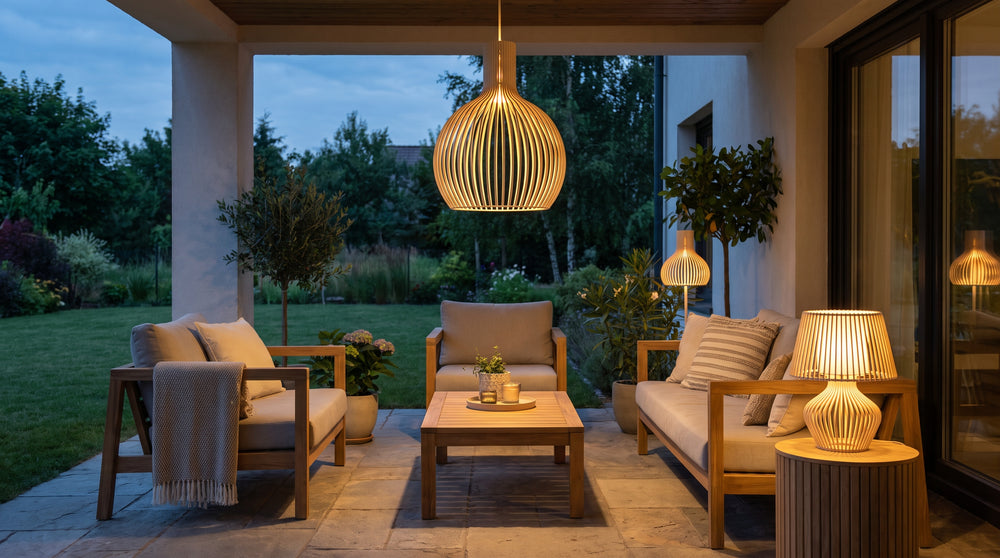
An interior that reflects who you are
Carefully selected pieces, shipped from our warehouses. Our team advises you before you buy, so you choose with confidence.
- Tracked delivery
- Pay in instalments, where available
- 14 days to change your mind
- Advice & showroom in Lyon, France
Solar LED outdoor panels are installed where no cable can be run: they recharge in the sun during the day and light up in the evening, with no intervention. The choice comes down to three concrete points: the area to be lit, the mounting method and whether or not a sensor is present.
Which solar LED panel should you choose for your outdoor space?
The right panel depends first on what you want to light: a path is marked out at ground level, a terrace is extended overhead, a facade is underlined. Then choose the mounting method, spike, wall or free-standing, and whether a sensor is present, which changes how the battery drains at night.
The models gathered in the Panneaux LED collection also differ in the space given to the solar panel: attached to the housing or connected by a cable. This detail decides whether the luminaire can light a shady corner while recharging in the sun.
Solar LED garden outdoor panels
The spike marker works close to the ground, thirty or forty centimetres high: it traces the edge of a path without dazzling and moves from one bed to another with the seasons. Look for a stable spike and a panel facing the sky, not the hedge.
Decorative solar LED outdoor panels
A halo on a wall, a line of light in a bed: these models aim for effect before range. Their light stays soft, often warm white, and is best appreciated at close distance. To compare with classic wired luminaires, browse all our luminaires.
| Location | What you expect from the light | Point to check before buying |
|---|---|---|
| Garden path | Mark the way, guide without dazzling | Spike mounting, low height, panel facing the sky |
| Terrace | Extend the evening, soft light | Separate panel if the lit area is covered |
| Entrance and gate | See clearly, feel expected | Presence of a sensor and sensitivity setting |
| Facade and wall | Highlight a volume, light a door | Wall fixing and housing sealing |
| Shed | Light a little-used access | Autonomy over several nights without sun |
| Garage | Light a work or entry area | Panel orientation and lighting mode |
What is the best solar light for outdoors?
The most suitable light is the one that matches the use: a warm white for a relaxation corner or a terrace, a more neutral white for an entrance, a gate or a garage, where you want to see clearly. This collection contains only one solar panel: its product page details the characteristics.
Solar LED outdoor panels for the terrace
On a terrace, the luminaire often lights a covered area while the panel itself must stay outside. A model with a separate panel solves this case: the sensor catches the sun on the low wall or the railing, the light falls on the table. No mains connection is needed, only a support suited to the wall or railing.
Solar LED lighting for a shed or garage
In a little-used room, you want to see clearly when you enter, then nothing more. A model with a sensor placed above the door works better than an ambient luminaire. Continue your reading with LED panels for garage if the surface to cover is larger.
Solar LED outdoor panels with motion sensor: is it always useful?
The sensor turns the panel on only when someone passes, which saves the battery and makes the lighting more useful near an entrance, a gate or a staircase. On a terrace where you stay seated, permanent lighting or extended standby is often more comfortable than repeated bursts.
When the sensor saves autonomy
On occasional passage, the battery drains only when triggered: the luminaire lasts longer in the grey season. Point the lens towards the walking area, never towards the ground, then set the sensitivity in the evening by testing on foot.
Solar LED outdoor panels without a sensor: for what use?
Without a sensor, the luminaire turns on at dusk and off at dawn, or stays on standby at reduced intensity. This is the mode suited to a facade or a relaxation corner visible late. Compare the two approaches with our LED panels and their description of functions.
| Mode | When to choose it | Effect on autonomy |
|---|---|---|
| Motion sensor | Occasional passage: staircase, gate, entrance | The battery drains only when triggered |
| Lighting at dusk | Terrace, relaxation corner, continuous ambiance | Draws on the battery all night |
| Standby at reduced intensity | Facade or garden visible late | Lower consumption than full lighting |
| Without sensor | Decorative free-standing or spike luminaire | Depends only on the sun received during the day |
Where should you place the panel so it really recharges?
The panel must receive direct sun for most of the day: due south, without shade from a tree, wall or roof. A separate panel is placed in the best spot then connected to the luminaire by a cable, whereas an all-in-one model requires placing the whole unit where it catches the most.
Separate panel or all-in-one: what is the difference?
The all-in-one is fixed in a single move, ideal when the luminaire and the sensor see the sky the same way. The separate model handles awkward situations: luminaire under an awning, sensor three metres higher on the wall. In that case, check the cable length stated on the product page.
Which exposure and orientation should you choose?
Aim for south, or east and west failing that, with a clear tilt towards the sky. A branch that grows in summer is enough to halve the recharge: spot the cast shadows at midday before screwing. The details of the models can be read in the LED panels range.
How do you install a solar LED panel without an electrician?
Most models are fixed without an electrical panel: a spike planted in the ground for a marker, a screwed or glued bracket for a wall model, a free-standing base for a table luminaire. Before fixing, check the height, the panel orientation and the cable route if there is one.
Fixing without drilling: spike and free-standing bracket
The spike needs soft ground, not paving. The adhesive bracket holds on a clean, smooth wall, to be reserved for light luminaires. For a heavier model, two screws and a plug suited to the surface remain the safest solution. See all Designix luminaires for wall formats.
Checking sealing and cable routing
On a separate model, the cable must slope gently down to the luminaire, with a low point under the cable gland so water drains away. Check that the housing gasket is in place and that the stated protection rating matches the actual exposure. A model under shelter withstands less than a model planted in the middle of a lawn.
Why does my solar panel give less light in winter?
In winter, days are shorter and the sun is lower: the panel recharges less and the lighting lasts less long. It is not a fault. Clean the panel and the sensor lens, check that no branch casts shade and let the luminaire recharge without drawing on it.
Cleaning the panel and the sensor
A damp cloth on the sensor glass, twice a year, is enough to regain recharge. Dust, droppings and dead leaves do more damage than they appear to. Take the opportunity to look at the condition of the housing and the fixing.
Change the battery or change the model?
If the luminaire still lasts a few hours after a full day of sun, the battery is at the end of its life. When it is stated as replaceable, changing it extends the device. Otherwise, turn to the LED panels for the home whose product page mentions an accessible battery.
Cheap solar LED outdoor panels: where can you save?
The price gap comes mainly from the quality of the panel, the battery capacity and the finish of the housing, not from the number of functions. An entry-level model suits a garden bed marker, a more refined model suits a facade or a terrace you want to keep for a long time.
What distinguishes an entry-level model from a refined one
Look at the sensor, the closing of the housing and the way the battery is replaced. A simple but well-assembled luminaire lasts longer than a multi-mode model whose seals wear out. The rest of the luminaire range as a whole follows the same manufacturing logic.
The points on which you should not save
Sealing and fixing decide how long it lasts: a housing that takes in water stops within a season. Favour a protection rating consistent with the exposure and a replaceable battery. For a work room, compare with lighting a garage or a shed.
Secure payment, tracked delivery, returns and Designix customer service: once you have identified your location and noted the height, all that remains is to choose the lighting mode.
Frequently asked questions about solar LED outdoor panels
Which LED for outdoors?
For outdoors, choose a luminaire whose protection rating suits the location: a model exposed to rain must be designed for humidity, a model under shelter can be simpler. The solar version is suitable where no cable can be run, provided the panel sees the sun.
Solar LED garden outdoor panels: how should they be distributed?
In a garden, spread the light points rather than concentrating them: one marker along the path, one towards the bed, one near the table. Each panel must stay exposed to the sun, so avoid placing it under dense foliage or against a shaded wall.
Cheap solar LED outdoor panels: is it a good choice?
An affordable model can be enough to mark out a path or light a corner of the garden. Look above all for a real solar sensor, the quality of the housing and the way the battery is replaced: that is what makes an entry-level luminaire last, more than the number of modes offered.
Decorative solar LED outdoor panels: do they withstand rain?
A decorative solar panel intended for the garden must be designed to stay outside: look for the protection rating stated on the product page and the way the housing is closed. A model placed under an overhang or in a sheltered bed remains less exposed than a model planted in the middle of a lawn.
Solar LED outdoor panels with sensor: what detection range?
The range depends on the setting and the lens, and it is adjusted on site, after installation. Point the sensor towards the passage area rather than towards the ground, test by walking once night falls, then refine the sensitivity. Also check that detection is not triggered by the street.




