
Solar LED outdoor lights
This selection is also available in our French store: Luminaires d exterieur LED solaires
No products in this selection.
- Tracked delivery to your country Tracked delivery
- Secure payment at checkout Multiple payment methods
- 14 days to change your mind 14-day returns
- Secure payment Secure payment
Not sure of your style? Find it in 30 seconds
A few questions, and we will show you the pieces made for you.
Frequently asked questions
How do I choose the right product?
What are the delivery times?
Can I return an item?
Can I pay in instalments?
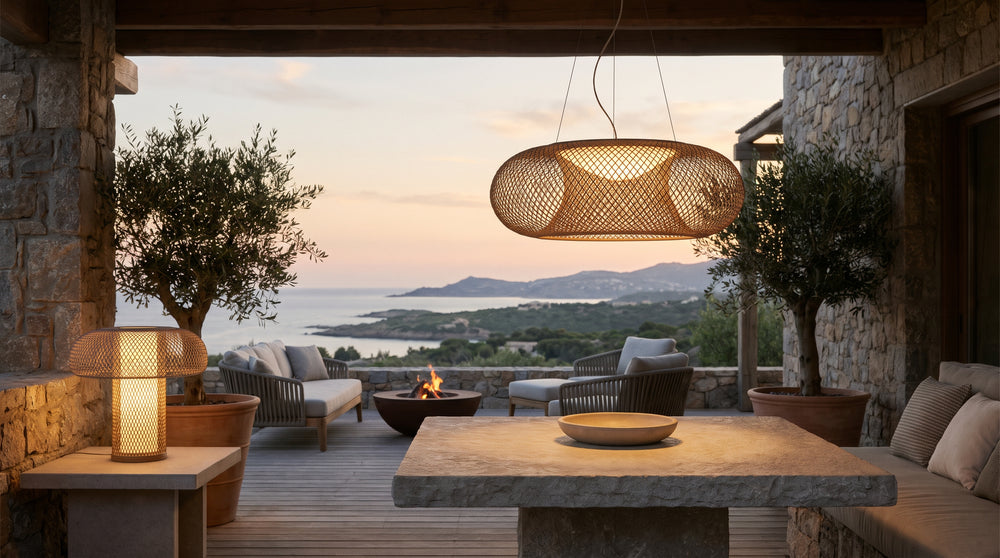
An interior that reflects who you are
Carefully selected pieces, shipped from our warehouses. Our team advises you before you buy, so you choose with confidence.
- Tracked delivery
- Pay in instalments, where available
- 14 days to change your mind
- Advice & showroom in Lyon, France
Choose the location first, then the panel: a driveway is marked out with a low bollard, a facade is lit with a wall light, a terrace is dressed with a pendant or a freestanding model. A solar LED outdoor light generates its own electricity through its photovoltaic panel, stores it in a battery and switches on by itself at dusk, with no cable or socket.
How does a solar LED outdoor light work?
The photovoltaic panel converts daylight into electricity, the battery stores it, and the LED releases that energy as soon as the sensor detects night. Nothing is connected to the grid: no cable, no socket, no trench. Only the panel's location determines the recharge, and therefore the quality of the evening light. To compare with mains-powered models, browse all our lights.
The role of the panel and the battery
The collection has two references. The panel captures, the battery stores, the LED diffuses: these three parts hold together, and the housing that contains them matters as much as the LED, because it is what faces the rain and the frost.
Why runtime drops in winter
Short days, a low sun and cloudy spells reduce the recharge, while the lamp demands just as much light. You can fix this without tools: clear the panel of leaves, angle it more directly towards the south, and on a model with a sensor, switch to on-at-passage rather than continuous mode. A spot shaded all day cannot be rescued, whatever the model.
Where to install a solar outdoor light: driveway, terrace or facade?
A driveway is marked out at ground level with a bollard or a low marker, to guide footsteps without dazzling. A facade, a porch or a terrace wall calls for a wall light, sometimes an adjustable spotlight. On a terrace, a freestanding model moves with the seasons, a pendant is fixed under a pergola. The panel's exposure matters more than the wattage printed on the box.
| Format | Where to install it | Fixing | What it changes |
|---|---|---|---|
| Bollard or low marker | Driveway edge, stairs, flowerbed | To stake or screw into the ground | Guides footsteps without dazzling |
| Wall light | Facade, terrace wall, porch | Screwed to the wall | Lights the walkway area |
| Spotlight | Wall corner, gate, outbuilding | Screwed or on a clamp | Wider reach, adjustable |
| Pendant | Pergola, branch, awning | Hook or cable | Downward light above the table |
| Freestanding model | Terrace, poolside | Placed, movable | Moves with use |
Marking out a driveway or outdoor stairs
Allow one marker every two to three metres along a path, and one per rising step if the staircase stays dark. A low light aimed at the ground lights the step without throwing the visitor into shadow. Freestanding outdoor lights do the same job where drilling into the ground is not possible.
Lighting a facade, porch or terrace
On a facade, place the wall light at shoulder height, directly above the walkway area, not above the door where it dazzles. A ceiling light works under a covered porch, provided the protection rating matches the humidity of the place. For poolside areas, see the poolside lighting, designed for water splashes.
Which IP rating should you choose for a solar LED outdoor light?
The IP rating gives two pieces of information: resistance to dust, then to water. In full rain, aim for at least IP65; under a sheltered awning, IP44 is enough. The panel and the battery housing matter as much as the LED, because standing water and frost damage them before the electronics. A properly sealed housing ages better than a brighter but poorly protected model.
| Rating | Stated protection | Suitable location |
|---|---|---|
| IP44 | Resists water splashes | Under awning, sheltered porch |
| IP54 | Limited dust, water splashes | Facade wall with little exposure |
| IP65 | Water-jet proof | Full rain, terrace edge |
| IP67 | Temporary immersion | Pool area, very wet ground |
What the number really protects
The first digit concerns solids, the second liquids. An IP65 withstands a jet, not a stay in water: a light placed in a basin that fills up stays drowned. Also check the cover gasket and the cable entry, weak points of an otherwise well-rated housing.
Can a solar light stay outside all year?
Yes, if it is designed for it: sealed housing, battery housed under cover, accessible panel glass. In winter, snow covering the panel stops the recharge without breaking the device. For a highly exposed wall, compare the modern-design outdoor lights, often better sealed than entry-level models.
Which light for a garden: warm white, neutral white or cool white?
A warm white, around 2700 to 3000 K, gives a golden light close to that of a living room: ideal on a terrace where you sit. A whiter light, around 4000 K, makes outlines sharp and secures a staircase or a gate. On the same facade, better to keep a single white family to avoid patches of different colours.
Warm white for a friendly terrace
The 2700 K and 3000 K markers are orders of magnitude for ambiance, not a measurement of our models. They are enough to decide: coffee table, outdoor dining area, reading corner. A light that is too white in that spot hardens faces and breaks the urge to stay.
A whiter light to secure a passage
Around 4000 K, the light becomes neutral again, steps and obstacles read better. Reserve it for circulation: stairs, gate, wall corner. For a well-kept entrance, the design pieces for the facade and the original lights bring the design touch that purely functional lighting lacks.
Motion sensor or dusk sensor: which automation should you choose?
The dusk sensor switches on at nightfall and off at daybreak: handy for an entrance or a gate. The motion sensor only lights on passage, which saves the battery and extends cloudy nights. On a terrace where you stay a long time, continuous mode remains the easiest to live with, provided the panel is well exposed.
Presence detection for a passage driveway
It triggers when someone arrives, then switches off: the battery drains more slowly and the driveway stays dark the rest of the time. Adjust the sensitivity once the device is in place, by walking the actual route, not by waving a hand in front of the sensor.
Continuous mode for an occupied terrace
A long dinner does not tolerate lighting that switches off every minute. Switch to continuous mode on evenings of use, return to the sensor on other days if the model allows it. The white models for light walls stay discreet above a table.
How to match the material and colour of a solar light to your facade?
On a light wall or a stone-toned render, a white or beige finish fades away and leaves only the light visible. On a dark facade or wood cladding, black underlines the light's line. Green blends into a hedge, while copper and smoked glass dress a more refined entrance. The chosen material must also withstand sea salt and UV.
Blending into the decor
Painted aluminium and stainless steel age well outdoors. A colour close to the wall reduces the "added object" effect. In the garden, the green finish for the garden disappears into the foliage, which brings the light forward rather than the housing.
Copper and smoked glass for a more dressed outdoor space
Copper takes on a patina over time, smoked glass softens the source and avoids direct glare. These two materials suit worked entrances, on a door or a low wall. See the copper finishes and the smoked glass to compose a coherent set.
How to install and maintain a solar outdoor light?
Aim the panel due south or south-east, tilted, away from the shade of a tree or a wall: that is where the recharge is won. Once a year, a damp cloth on the glass and on the sensor is enough to restore the first evening's switch-on. No connection to the grid is needed, so installation requires no electrician.
Orientation and shadows: getting the panel installation right
Fix the bracket first, then check the sunlight at three times of day before screwing it in for good. A shadow cast two hours a day matters more than a generous stated wattage. On a pergola, the other pendant lights show how a high point lights a table without dazzling.
Cleaning and winter storage
Clear water and a soft cloth on the panel, never an abrasive product. In winter, clear snow and leaves, and bring in models placed on the ground if frost is forecast. Also check that water does not stagnate in the bracket's cup.
What budget should you plan and where to buy solar LED outdoor lights?
The budget follows three items: the panel, the battery and the quality of the housing. An entry-level model suits a little-used driveway marker. A more durable model is justified on a highly exposed facade, where the housing works all year. For a project in Lyon, clearance lighting lyon can be compared online, checking the IP rating before confirming.
Entry-level or durable model
What changes is not the LED but the assembly: cover gasket, bracket fixing, battery resistance to cold. For daily use, a properly sealed housing lasts longer than a brighter but poorly protected model. For an entrance you want noticed, look at the exceptional models for an entrance. And for indoors, LED living room lighting remains the right answer.
Tracked delivery, returns and secure payment at Designix
Designix is an online store: the selection is browsed and ordered remotely, with secure payment, tracked delivery, returns and customer service. Compare the formats in the Designix lighting collection before ordering. A solar light has no place in a closed room: for windowless toilets, prefer the mains-powered toilet lights.
Frequently asked questions
Do you need an electrical connection for a solar LED outdoor light?
No. The photovoltaic panel recharges the built-in battery, which powers the LED: no cable, no socket and no trench are needed. The only constraint is that the location must receive enough daylight for the recharge to happen, which determines the evening switch-on.
Can a powerful LED wall light work without a cable outdoors?
Yes, provided you choose a solar wall light, with its own panel and battery: that is what replaces the connection. On a facade wall, check the protection rating before installation and aim the panel towards the south so the recharge keeps pace with the nights.
Can a powerful LED ceiling light be installed under a porch or covered terrace?
A ceiling light is fixed to the ceiling and therefore suits a covered porch, provided the protection rating matches the humidity of the area. Under a sheltered awning, IP44 is enough; if rain reaches the light, aim for at least IP65. The panel's orientation then determines the recharge.
Can an LED chandelier be installed outdoors?
A chandelier remains an indoor light: its structure, suspensions and aesthetics are designed for a living room or dining room. Outdoors, an outdoor pendant designed for humidity is preferred, or a wall light if the support is a facade rather than a ceiling.
How to choose original lights for a garden?
First look for the function: marking out, lighting a table, highlighting a wall. Then the shape that suits the place. An original piece is recognised by its line, not its size: a well-drawn compact format will hold better than an oversized model. Then check the IP rating and the panel's exposure.




