
Solar garden spotlights
This selection is also available in our French store: Spots solaires pour jardin
No products in this selection.
- Tracked delivery to your country Tracked delivery
- Secure payment at checkout Multiple payment methods
- 14 days to change your mind 14-day returns
- Secure payment Secure payment
Not sure of your style? Find it in 30 seconds
A few questions, and we will show you the pieces made for you.
Frequently asked questions
How do I choose the right light output?
At what height should the light be installed?
What type of bulb?
Compatible with LEDs and dimmers?
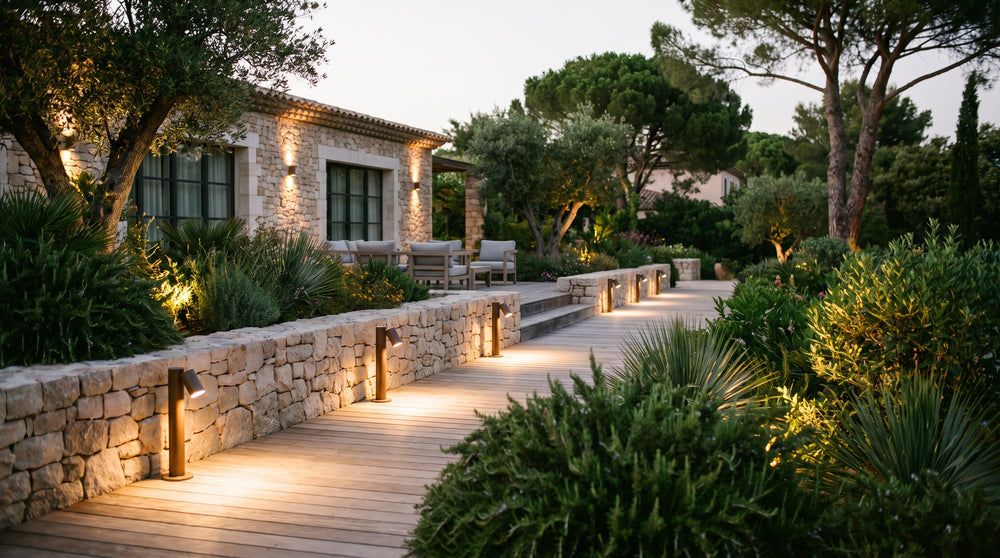
Light changes everything
From statement chandeliers to discreet wall lights, we help you choose the right brightness, height and style for every room.
- Tracked delivery
- Pay in instalments, where available
- 14 days to change your mind
- Advice & showroom in Lyon, France
Aim for one spotlight per dark area rather than a single floodlight: a low point aimed at the ground for the path, another on the terrace edge, a third at the foot of the tree. Solar garden spotlights recharge their battery in the sun and switch on by themselves at dusk, with no trench to dig and no cable to run.
Which solar spotlight works for a path or a terrace?
For a path or a terrace, a solar spotlight aimed at the ground works better than a floodlight aimed at the eyes: grazing light draws the route without dazzling your guests. Choose a model whose panel stays clear of the walkway and of the shadow cast by the house, and multiply low-intensity points rather than relying on a single strong one.
Outdoor solar spotlight for a terrace: where should it go?
On a terrace, the spotlight sits on a slab, a low wall or the edge of a step, and aims at the ground or the face of the wall. The table and the seats stay in a soft half-light, which makes the evening more comfortable than frontal lighting. A solar wall light also works along the facade. You will find these formats in all outdoor solar spotlights and, for the threshold, in lighting the entrance and threshold.
Marking a path without dazzling
Push the spotlights into the border, a few steps apart, and aim each beam at the gravel or the slabs. The path takes shape once night falls and the eye never meets the source. An adjustable-head model lets you correct the angle after installation, when you see the real result once darkness sets in.
Outdoor solar spotlight for a tree: how do you choose it?
Lighting a tree calls for a solar spotlight with a narrow beam, placed on the ground and aimed at the trunk or the canopy: the light runs up the bark and lifts the tree away from the garden backdrop. Keep the panel out of the shade of the leaves, otherwise the battery recharges poorly and runtime drops.
Outdoor solar spotlight for lighting a tree: aim at the trunk or the canopy?
A tight beam placed on the ground, close to the trunk, runs up the bark and brings out the lower branches. Aiming higher lights the canopy and gives a more spectacular sense of volume, but needs a little more power. An adjustable head can be set either way, and adjusted through the seasons as the foliage grows. Models with fine adjustment are gathered in adjustable directional heads.
Which fixing at the foot of the trunk?
A spotlight on a spike pushed into loose soil installs in a minute and moves if the shade has spread. On compacted ground or thick mulch, a base to set down or a screwed plate holds better. Check that the panel stays clear to the north, never under the crown of the tree. Sturdy housings are in metal housings for outdoor use.
How do you choose an outdoor solar spotlight?
An outdoor solar spotlight is judged on four points: the surface of the panel and its exposure, the battery it recharges, the IP rating that indicates its resistance to water and dust, and the direction of the beam. This collection brings together 28 models for the garden.
IP rating: what it really tells you
The IP rating reads in two digits: the first concerns dust and solid objects, the second water. For lasting outdoor use, aim for a high second digit, because rain, watering and frost do more damage than dust. A spotlight placed under an awning can get away with less than one sitting in the middle of a lawn.
Panel, battery, adjustable head: the points to check
A large panel captures more light on grey days, and a battery of sufficient capacity lasts the night after a cloudy day. The adjustable head matters just as much: it decides what you light. Some models accept a brightness setting, useful for dimming the light on a terrace, as the brightness settings allow.
Where should you install a solar spotlight in the garden?
The most useful areas are the entrance and the gate, the steps and the staircase, the edge of the path, the foot of the shrubs and the facade. Place the spotlight where the route is dark, but always keep the solar panel facing south and unobstructed, including in winter when the sun is low.
Solar spotlight for entrance and gate: how should it be fitted?
On a facade wall or a gate pillar, a screwed wall light holds better than a stake, and sits clear of the route so it is not knocked. A single point leaves dark areas: spread two or three sources along the way. To go further, compare the LED models among the solar LED models for the garden.
Lighting an outdoor staircase without wiring
A staircase is marked step by step, with small side points or step lights: each step edge becomes readable and the flight is walked down without hesitation. A single spotlight at the top lights the void and leaves the bottom in the dark. Suitable formats are found in making a staircase safe and LED spotlights for steps and flights.
| Area to light | Recommended fitting type | What matters first | What to avoid |
|---|---|---|---|
| Path edge and flower bed | Spike pushed into the ground | Beam aimed at the ground, clear panel | A wide beam that dazzles passers-by |
| Terrace and dining corner | Set down on a slab or low wall | Adjustable head, soft light | Aiming light at the eyes of your guests |
| Foot of a tree or shrub | Spike, head aimed upwards | Narrow beam running up the bark | Leaving the panel under the foliage |
| Entrance, gate and facade | Wall light screwed to the wall | Stable fixing, height clear of the route | A single point that leaves dark areas |
| Staircase and outdoor steps | Step light or side wall light | Marking each step without dazzling | A single spotlight at the top of the flight |
| Fence and boundary wall | Wall light or stake on top of the wall | Even distribution along the wall | A panel hidden by the wall |
Which mistakes should you avoid with solar garden spotlights?
Three mistakes come up again and again: placing the panel in the shade of a wall or foliage, expecting a solar spotlight to light like a mains-connected floodlight, and leaving it covered in leaves or snow. The panel needs to see the sky all day long.
Panel in the shade: the mistake that drains the battery
A panel in the shade of a wall, a hedge or a gutter only recharges in part, and runtime collapses within a few days. Move the spotlight a few dozen centimetres towards a clear area, even if the spot looks less pretty, or choose a model whose panel is set apart on a cable.
Confusing ambient lighting with safety lighting
A solar spotlight creates an atmosphere, guides the footstep and signals a step. It does not replace permanently powered safety lighting, which must stay on even after several grey days. For regular traffic, a wired point keeps the advantage, like the recessed spotlights connected to the mains.
Which light colour should you choose for lighting the garden in the evening?
Outdoors, a warm white makes foliage and stone softer and tires the eyes less than a cooler, more technical white. Keep cool white for the traffic areas you want highly readable, and stay in the same colour temperature family as your indoor lighting to avoid a visual break in front of the glazing.
Warm white or cool white outdoors?
Around 2,700 to 3,000 kelvins, the light leans golden: it warms stone, wood and foliage, and suits a terrace or an ornamental garden. Above 4,000 kelvins, the light becomes whiter and cooler: useful on a gate or a car park, less flattering on a flower bed.
Matching garden lighting with the decor of the house
In front of a glass door, the garden light is seen from inside: stay in the same colour temperature family as your rooms. A room lit in warm white, as a light colour for the living room provides, sits badly with a very white outdoors. Also think about continuity when you work on a modern kitchen decor and consistent lighting visible from the terrace.
| Colour temperature | Atmosphere created | Where to use it | Point to watch |
|---|---|---|---|
| Warm white | Golden light, stone and foliage warmed | Terrace, ornamental garden, foot of a wall | Too warm, it flattens the details |
| Neutral white | Natural light, easy to read | Path, entrance, staircase | Less cosy in a relaxation area |
| Cool white | Very white light, close to daylight | Gate, technical area, car park | Dazzling and unflattering on a flower bed |
How do you install and maintain an outdoor solar spotlight?
Installation needs no wiring: you push the stem into loose soil, set the base on a slab or screw the wall light to a wall, then aim the panel south. Clean the panel with clear water from time to time and clear it of leaves in autumn.
Solar spotlight without an electrician: what can be done in one evening
No cable to run, no trench to dig, no consumer unit to open: fitting comes down to choosing the location and planting or screwing. Allow a screwdriver for a wall light, nothing more for a stake. All the wiring-free solutions are in outdoor lighting without wiring.
Maintenance, winter and grey days: keeping the light
A clean panel captures noticeably more than one covered in dust, pollen or droppings. In autumn, remove the leaves that fall on the sensor, and the snow in winter. If a hedge has grown and casts shade, move the spotlight. Light-coloured housings show dirt less, like the white versions on a light wall.
How do you decide and order your solar garden spotlights?
Go back over the area to light, the type of fitting, the exposure of the panel and the light colour you want, then compare the models in the collection. At Designix, payment is secure, delivery is tracked, returns are possible and customer service answers fitting questions before you buy.
Summing up before ordering
In order: which area is dark tonight, should it be spiked, set down or screwed, will the panel see the sun all day, and which colour temperature matches the facade. A dark housing disappears on a dark wall, a light housing fades into render. Browse discreet black finishes and the Designix lighting catalogue to place the styles.
Payment, delivery and returns at Designix
Designix customer service answers questions on fixing, panel orientation or height before you buy: ask your question, then order. To widen the thinking room by room, see also choosing the right light for every room.
Frequently asked questions about solar garden spotlights
Where can I buy solar garden lights?
The solar garden spotlights and lights in this collection are available at Designix, with secure payment, tracked delivery and returns. There you can compare spike, set-down and screw-fixed models according to the area to light, and Designix customer service answers fixing or orientation questions before you buy.
Outdoor solar spotlight for a tree: how should it be aimed?
Place the spotlight on the ground, close to the trunk, and aim the beam upwards to run up the bark and the canopy. The solar panel, for its part, must stay clear of the foliage and turned towards the sun's path, otherwise the battery recharges poorly.
Which outdoor solar spotlight should you choose for a terrace?
On a terrace, a solar spotlight set down on a slab or low wall, with an adjustable head, gives a soft light aimed at the ground or the wall. Avoid aiming at the seats: the goal is to draw the space, not to light it like a floodlight. Check that the panel stays in the sun.
Does a solar spotlight work in winter and in cloudy weather?
In cloudy weather or in winter, the panel recharges less and runtime drops: the light may last less long or lose intensity. Move the spotlight if an obstacle casts shade, clean the panel and remove leaves or snow to make the most of every bright spell.
Can you install a solar spotlight without an electrician?
Yes, a solar spotlight is not connected to the mains: it is spiked into loose soil, set down on a slab or screwed to a wall, then the panel is aimed. No cable to run, no trench to dig. The only precaution: a location where the panel sees the sky.
Do you need a motion sensor on a solar garden spotlight?
A motion sensor switches the spotlight on as you pass and saves battery, which suits an entrance, a gate or a traffic area. For a terrace or a flower bed, continuous switching on at dusk gives a more even and more decorative light.
Outdoor solar spotlight for lighting a tree: which beam should you choose?
Prefer a narrow beam: it concentrates the light on the trunk and branches instead of scattering it into the void. A wide beam lights the ground around the tree and tires the eye. Adjustable orientation lets you correct the result from one season to the next.
Are solar garden spotlights bright enough?
A solar spotlight lights a precise area: path edge, step, trunk, facade. It creates an atmosphere and guides the footstep rather than flooding a yard. For a large surface, it is better to multiply low-intensity points, spreading them along the route.




