
Smart street light
This selection is also available in our French store: Lampadaire intelligent
No products in this selection.
- Tracked delivery to your country Tracked delivery
- Secure payment at checkout Multiple payment methods
- 14 days to change your mind 14-day returns
- Secure payment Secure payment
Not sure of your style? Find it in 30 seconds
A few questions, and we will show you the pieces made for you.
Frequently asked questions
How do I choose the right product?
What are the delivery times?
Can I return an item?
Can I pay in instalments?
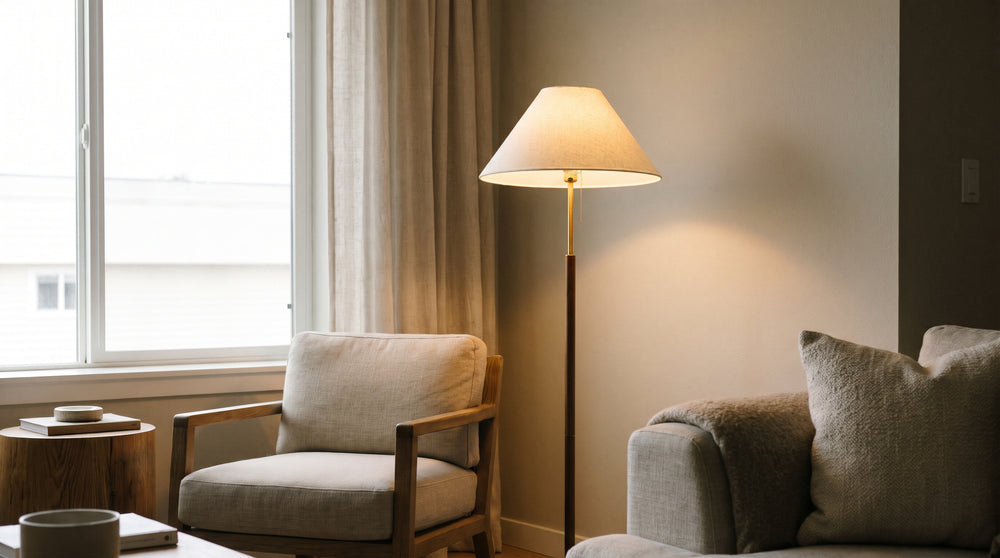
An interior that reflects who you are
Carefully selected pieces, shipped from our warehouses. Our team advises you before you buy, so you choose with confidence.
- Tracked delivery
- Pay in instalments, where available
- 14 days to change your mind
- Advice & showroom in Lyon, France
A smart floor lamp is chosen first by how it is controlled: a module built into the fixture, or a connected bulb screwed into a standard socket. Then check the height, the floor footprint and the space available in the room, because these three points decide whether the fixture lights well or gets in the way.
What is a smart floor lamp and how does it work?
A smart floor lamp is a floor-standing lamp whose light is adjusted by something other than a switch: brightness, colour temperature or switch-on time, from an app, a remote control or your voice. Depending on the model, the control is built into the fixture or runs through a connected bulb screwed into a standard socket.
Smart floor lamp: how it works in plain terms
Two architectures coexist. In the first, the radio module and the LED are inside the fixture: nothing to screw in, but the manufacturer's system is imposed. In the second, an E27 or E14 socket takes a connected bulb: you keep the base and change the light source whenever you want, which makes the fixture reversible. There is no single inventor of the smart floor lamp, only the meeting of LED, Wi-Fi or Bluetooth modules and voice assistants, with a different app per manufacturer. The product sheet, more than the history, tells you what the device can do.
Smart indoor lighting: what changes in the evening
In the evening, smart lighting dims with a gesture without getting up, can be scheduled to switch off after reading, and returns to its morning level. Compare the dimming options offered and bear in mind that the wall switch remains usable: that is the safety point in a household where not everyone has the app. To see the light sources, browse the LED sources and the full range of our light fixtures.
Where to install a smart floor lamp in the home?
In the living room, it sits beside the sofa or in a corner for ambient light; in the bedroom, near the headboard with a brightness that goes low; in the office, next to the desk to light your hands. In a small room, the floor footprint decides.
Living room floor lamp: near the sofa rather than in the centre
A living room floor lamp placed in the corner behind the sofa lights without glare, whereas in the centre of the room it creates an obstacle and throws shadows onto the wall. Check the passage between the sofa and the door before fixing the spot.
Bedroom floor lamp: light that does not wake you
In a bedroom, look for a closed diffuser aimed at the wall, and a low minimum brightness: a bare source at pillow height is visible even at low power. Bedroom floor lamps go beside the headboard, within reach of the switch.
WC and small rooms: format first
For a WC floor lamp, the question is not style but size: narrow base, height compatible with the room, and a suitable protection rating if the spot is damp. A narrow, battery-powered model fits where an arc does not.
| Room | What you expect from the light | Recommended format | What to check |
|---|---|---|---|
| Living room | Warm, adjustable ambient light in the evening | Floor-standing or arc, near the sofa | Height above the seat, base stability, cable length |
| Adult bedroom | Soft light for reading, then low brightness | Closed diffuser, near the headboard | Low minimum brightness, no glare, quiet control |
| Office | Light directed at the desk | Straight base or adjustable arm | Source orientation, screen reflections, nearby socket |
| Hallway or corridor | A bright landmark on arrival | Narrow model, weighted base | Floor footprint, quick switch-on, timer programming |
| Small room and WC | See without taking up floor space | Narrow format or high fixing | IP rating if the room is damp, available height |
What height and format should you choose for a floor lamp?
A floor lamp is chosen first by its height: seated on the sofa, the shade should stay above eye level and light downwards. A straight base takes up little floor space, an arc reaches out over the sofa, a globe gives a more diffuse light. Check the passage and the cable length.
Floor lamp: judge the height while seated
Sit where you will read: the bottom of the diffuser should pass above your eyes so as not to glare, while staying low enough to light a book. The floor lamp collection is best browsed by format rather than material. A floor-standing model in wood needs a wide base: the weight of the base provides stability, not the slimness of the stem.
Arc, globe or straight floor lamp: three footprints
The arc reaches out and frees the floor under the shade, but its base stays wide and its reach should be measured before buying. Globe shapes diffuse in all directions and suit a corner. The straight base slips between two pieces of furniture and moves effortlessly.
LED floor lamp or halogen floor lamp: what changes with LED?
A halogen gives a very pronounced warm tint and heats up a lot; a controllable LED source heats less, dims and can be scheduled. The gain depends on compatibility: a connected bulb in an existing socket, or a built-in LED module that imposes the manufacturer's system.
Halogen floor lamp: what you gain by switching
A halogen floor lamp keeps a fixed tint and a dimmer that is sometimes incompatible with recent bulbs. Before electricity, people lit their homes with flame, weak and mobile; electric light first reproduced that warm tint, then LED made it adjustable. Switching to an LED floor lamp therefore comes down to three points: heat given off, dimmable brightness, scheduling.
Connected bulb or built-in module: two ways to be smart
Note the cap (E27 or E14) and the voltage shown on the socket or the product sheet: that is what allows, or does not allow, a connected bulb to be fitted. A model with a built-in module cannot be converted; a model with a standard socket follows market developments. A metal floor lamp with a standard socket thus offers both options depending on the bulb chosen.
How to choose between a design, original, gold or driftwood floor lamp?
Shape and material change a room more than a colour change: a globe, an arc, a driftwood base or a glass structure alter the silhouette, the light and the reflection. Gold warms, crystal diffracts, wood softens, black recedes. Choose the style, then check the control.
Original floor lamp and design floor lamp: stepping away from the standard model
A design floor lamp is judged by its proportion: empty space around the silhouette makes it readable. Contemporary silhouettes play on fine lines and a small light point, which lights less widely than a tall diffuser.
Gold, crystal or driftwood floor lamp: material decides the light
Gold finishes reflect a warm glow at the light point. Glass models diffract and turn light into a pattern. Wooden floor lamps, especially driftwood, soften and mellow shadows: handy in a bedroom, more discreet in an office where documents are read.
Original living room floor lamp: the corner that changes the room
An assertive living room floor lamp goes in the blind corner of a room, where the eye lands on entering: it becomes a visual landmark as much as a light source. In an industrial interior, the black version or an industrial model matches better than a light finish.
How to control your floor lamp: remote, app or voice control?
Three controls coexist: the Wi-Fi app, Bluetooth at close range and the supplied remote control. All adjust brightness and switching, but only a connection to the home network allows timer programming and remote control. Voice control is added if the model is compatible with the assistant.
| Control | What it allows | Limitation to know | For whom |
|---|---|---|---|
| Wi-Fi | Control from the app, schedule, link voice | Depends on the router and network, initial pairing required | Those who want scheduled scenes |
| Bluetooth | Direct adjustment nearby, no router | Limited range, no remote control | One room, simple use |
| Supplied remote control | Switch on, off, dim without a phone | Battery and storage, functions limited to the model | Those who refuse the app |
| Wall switch | Usual switching, adjustment via the app | Can cut the power to the connected module | Mixed households, guests |
| Voice control | Switch on or dim by voice | Requires an account and a compatible device | Hands busy, family use |
Smart lighting and television: avoiding reflections
Keep the source out of the screen's field: a floor lamp behind the television creates a reflection on the panel, a side lamp does not. In the evening, lower the brightness rather than switching off, to keep a low contrast between screen and room.
Smart ceiling light or floor lamp: spreading the light
A smart ceiling light illuminates the whole room and suits meals or cleaning; a floor lamp lights one zone and leaves the rest in the background. For a living room, mixing the two gives a discreet base and an accent point. See also the floor lamps with a current design.
How to install and maintain a connected floor lamp?
Assembly is often limited to the base, the diffuser and the plug. Three points decide comfort: base stability, routing the cable away from walkways, and access to a switched socket if the module must stay powered. Cleaning is done dry, with the power off.
Assembly, cable and stability
Assemble the base on a flat surface, then check with one hand that the fixture does not tip before plugging it in. Route the cable along the wall or under a piece of furniture, never across a walkway or under a rug. If children are around, prefer a weighted base and a socket out of reach.
Cleaning, pairing and updates
Dust the diffuser dry, with the power off, without product on the metal parts. After a power cut or a move, redo the pairing from the app and keep the remote control within reach: it is the fallback when the network goes down. A white floor lamp needs a non-abrasive cloth to stay clean.
What mistakes should you avoid before buying a smart floor lamp?
The mistakes that cost dear: buying without checking the cap or voltage, choosing a model with a built-in LED without knowing its app, forgetting the height under the shade, or placing the floor lamp in a walkway. Note the room, the evening use and the floor space before comparing models.
The checks that avoid a return
Note four things: cap and voltage, app compatibility with your phone, floor dimensions and total height, base weight. Add the cable length if the socket is far away. For a first purchase, affordable models with a standard socket limit the risk, because the bulb remains replaceable. Current shapes for the living room are easy to compare by silhouette.
Payment, delivery, returns: what is secure
Before ordering, note the cap and voltage, the floor dimensions, the total height and the base weight. These details let you check compatibility and installation. Have the fixture reference and the desired cap ready: the answer comes faster.
Now compare the floor lamps designed for the adult bedroom, the models for lighting an office, or return to the full selection of floor lamps.
What is smart lighting?
It is lighting whose brightness, tint or switch-on time is adjusted by something other than a simple switch: via an app, remote control, timer programming or voice control. The fixture keeps its primary role, lighting a room, but the light adapts to the time and the use.
Can you put a smart floor lamp in a bedroom?
Yes, provided you choose a model whose brightness goes low and whose light does not shine straight into your eyes: a closed diffuser aimed at the wall is better than a bare source. Scheduling lets you switch off after reading, and the control saves you getting up.
Halogen floor lamp: can it be replaced by a smart floor lamp?
Yes, if the fixture accepts a connected bulb with the right cap and voltage. A halogen heats up a lot and gives a very pronounced warm tint; a controllable LED source heats less, dims and can be scheduled. Check the cap and compatibility before changing.
Can a gold or crystal floor lamp be connected?
Yes, the finish does not decide connectivity: what matters is the presence of a built-in module or a socket compatible with a connected bulb. A model with a standard socket can therefore become smart by changing the bulb, whereas a model with a built-in LED remains tied to its original system.
Do you need a router or an extra box for a smart floor lamp?
Not always: Wi-Fi models connect directly to the home network, Bluetooth models work nearby without a router, and some systems require a gateway to link several fixtures. This is stated on the product sheet; if not, the supplied remote control is enough to adjust the essentials.




